Join us on a literary world trip!
Add this book to bookshelf
Grey
Write a new comment Default profile 50px
Grey
Subscribe to read the full book or read the first pages for free!
All characters reduced
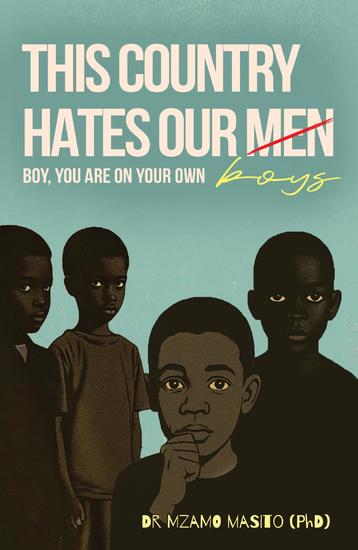
This Country Hates Our Boys - Boy You Are On Your Own - cover

This Country Hates Our Boys - Boy You Are On Your Own

Mzamo Masito

Publisher: Tracey McDonald Publishers

  • 0
  • 0
  • 0

Summary

'I do not hate boys, I hate men.'
This provocative statement sets the stage for a searing exploration of the complex relationship South African society holds with its Black and Coloured men and boys. Dr Mzamo Masito's urgent new book, This Country hates Our Boys, confronts the pervasive 'cold and hot love' that often translates into collective male guilt. When a child goes missing, a collective sigh of relief by men is heard when the blame points to maternal filicide, such as headlines like 'South African woman guilty of kidnapping and trafficking daughter aged 6' (BBC).
The widely accepted phrase 'amadoda zizinja' – men are dogs – is more than a colloquialism; it's a symptom of a society where positive masculine role models are scarce. This linguistic shortcut flattens the nuanced reality of masculinity into a single, simplistic concept of patriarchy, obscuring the complex, chaotic social issues at play.
Through the vital work of African Men Care, a non-profit organisation, Dr Masito unpacks the interlocking crises facing Black boys and men: educational disparities, mental health struggles, pervasive violence, and fractured relationships. More crucially, the book illuminates a clear path forward.
'Every man is every boy' is not merely an observation but a powerful call to action. The struggles of adult men today are often rooted in the unaddressed needs and unrealised potential of the boys they once were. The lament 'awekho amadoda' (there are no men) serves as a stark warning: without decisive intervention, we risk losing entire generations. This book reveals how individual trauma metastasises into a collective crisis. When boys lack robust interior lives and positive identity models, the repercussions echo through families, schools, and communities. Hurt boys mature into hurting men, perpetuating cycles that impact everyone, including the girls and women in their lives.
¬This Country Hates Our Boys is essential reading for men, educators, policymakers, community leaders, parents, and anyone committed to breaking cycles of hurt and forging futures where all young people can thrive. The ultimate goal is revolutionary in its simplicity: to empower both girls and boys, ensuring no child is left behind.
Available since: 01/02/2026.
Print length: 300 pages.

Other books that might interest you

  • Mental Health and the Church - A Ministry Handbook for Including Children and Adults with ADHD Anxiety Mood Disorders and Other Common Mental Health Conditions - cover

    Mental Health and the Church - A...

    MD Stephen Grcevich

    • 0
    • 0
    • 0
    A guide for those looking to combine traditional ministry with modern support for children, teens, and adults with common mental health conditions and their families. 
    The church across North America has struggled to minister effectively with people struggling with mental health issues. One reason for the lack of ministry is the absence of a widely accepted model for mental health outreach and inclusion. 
    In Mental Health and the Church, Dr. Stephen Grcevich presents a simple and flexible model for mental health inclusion ministry for implementation by churches of all sizes, denominations, and organizational styles. The model is based upon recognition of seven barriers to church attendance and assimilation resulting from mental illness: 
     stigma,anxiety,self-control,differences in social communication and sensory processing,social isolation,and past experiences of church. 
      
    Seven broad inclusion strategies are presented for helping persons of all ages with common mental health conditions and their families to fully participate in all of the ministries offered by the local church. 
      
    Mental Health and the Church is a useful resource for parents, grandparents, and spouses interested in promoting the spiritual growth of loved ones with mental illness.
    Show book
  • The Ceely Rose Murders at Malabar Farm - cover

    The Ceely Rose Murders at...

    Mark Sebastian Jordan

    • 0
    • 0
    • 0
    The people of mid-Ohio's Pleasant Valley went on with their normal lives that cold and rainy spring of 1896, not knowing that young Ceely Rose was brooding. She'd been told to forget her obsession with handsome Guy Berry. She'd been told about the danger of Rough-on-Rats poison. She'd heard about murdering those who stand in the way of love. By the time she was done, her family would be dead and others threatened. Later, the place where these crimes took place became Malabar Farm, the estate of Pulitzer Prize-winning author and conservationist Louis Bromfield. Historian, playwright, and storyteller Mark Sebastian Jordan examines the story of the Poisoner of Pleasant Valley, Ceely Rose, and how it has resonated throughout the years.
    Show book
  • Payyannur Gramam - cover

    Payyannur Gramam

    Kottarathil Sankunni

    • 0
    • 0
    • 0
    Aithihyamala is a collection of century-old stories from Kerala that cover a vast spectrum of life, famous persons and events. It is a collection of legends numbering over a hundred, about magicians and yakshis, feudal rulers and conceited poets, Kalaripayattu experts, practitioners of Ayurveda and courtiers; elephants and their mahouts, tantric experts.
    Show book
  • The Theory and Practice of Alchemy - cover

    The Theory and Practice of Alchemy

    Manly Palmer Hall

    • 0
    • 0
    • 0
    ALCHEMY, the secret art of the land of Khem, is one of the two oldest sciences known to the world. The other is astrology. The beginnings of both extend back into the obscurity of prehistoric times. According to the earliest records extant, alchemy and astrology were considered as divinely revealed to man so that by their aid he might regain his lost estate. According to old legends preserved by the Rabbins, the angel at the gate of Eden instructed Adam in the mysteries of Qabbalah and of alchemy, promising that when the human race had thoroughly mastered the secret wisdom concealed within these inspired arts, the curse of the forbidden fruit would be removed and man might again enter into the Garden of the Lord. As man took upon himself "coats of skins" (physical bodies) at the time of his fall, so these sacred sciences were brought by him into the lower worlds incarnated in dense vehicles, through which their spiritual transcendental natures could no longer manifest themselves. Therefore they were considered as being dead or lost. 
    The earthly body of alchemy is chemistry, for chemists do not realize that half of The Book of Torah is forever concealed behind the veil of Isis (see the Tarot), and that so long as they study only material elements they can at best discover but half of the mystery. Astrology has crystallized into astronomy, whose votaries ridicule the dreams of ancient seers and sages, deriding their symbols as meaningless products of superstition. Nevertheless, the intelligentsia of the modern world can never pass behind the veil which divides the seen from the unseen except in the way appointed--the Mysteries.
    Show book
  • How to Deal with a Narcissist: Strategies for Managing Toxic Relationships - Practical Tips for Protecting Your Mental Health - cover

    How to Deal with a Narcissist:...

    Emily Scott

    • 0
    • 0
    • 0
    For anyone facing the difficulties of a narcissistic relationship, "How to Deal with a Narcissist: Strategies for Managing Toxic Relationships—Practical Tips for Protecting Your Mental Health" is an indispensable resource. Dealing with the emotional manipulation, control, and poisonous dynamics of a narcissist in a personal or familial relationship can leave you feeling exhausted, bewildered, and helpless. This book offers helpful advice on how to spot narcissistic behaviors, establish and uphold boundaries, resolve conflicts amicably, and safeguard your mental and emotional health. 
    This thorough book will teach you how to recognize the telltale indicators of narcissistic behavior, comprehend the effects it has on your mind and self-esteem, and acquire the skills you need to remove yourself or end the relationship safely. You'll also get advice on how to mend from narcissistic abuse, reestablish your sense of value, and get help from a specialist to ensure long-term recovery. 
    With compassion and knowledge, "How to Deal with a Narcissist" gives you the tools you need to end the destructive cycle, take back control of your life, and cultivate happier, more satisfying relationships. This book provides the tools and support you need to succeed, whether you are leaving a narcissistic relationship or are in the middle of one and need to cope.
    Show book
  • Economic Impacts of Imperialism - How Empire Building Shaped Global Trade and Economics - cover

    Economic Impacts of Imperialism...

    Arlo Holders

    • 0
    • 0
    • 0
    Imperialism, as a driving force in global history, established the foundation for much of the modern world's economic and political systems. The roots of imperialism stretch back to ancient civilizations, where conquest and control of territories provided the resources and labor necessary for expansion and prosperity. Over time, the concept evolved, shaped by cultural ambitions, geopolitical competition, and economic incentives. By the late 15th century, the age of exploration began a new phase of empire building, marked by the European powers seeking wealth and influence beyond their borders. 
    At the heart of imperialism was the pursuit of economic gain. Wealth from foreign lands, particularly precious metals, spices, and other coveted resources, spurred the earliest imperial endeavors. These ventures not only enriched nations but also fueled rivalry among emerging powers. The drive for resources and markets intensified during the Renaissance and the early modern period, as advancements in navigation and maritime technology made long-distance expeditions feasible. Imperial powers sought to expand their influence by establishing colonies, which would serve as sources of raw materials and as markets for manufactured goods. 
    Cultural and ideological factors also played a role in shaping imperialism. The belief in the superiority of certain civilizations over others justified the conquest and subjugation of indigenous peoples. Religion was another motivator, with missionary efforts often accompanying territorial expansion. Christianity, in particular, became a tool for legitimizing imperial control, as colonizing powers framed their endeavors as missions to civilize and convert native populations. This intertwined economic exploitation with a sense of moral and cultural obligation, creating a complex dynamic between the colonizers and the colonized.
    Show book