

Join us on a literary world trip!
Add this book to bookshelf
Grey
Write a new comment Default profile 50px
Grey
Subscribe to read the full book or read the first pages for free!
All characters reduced
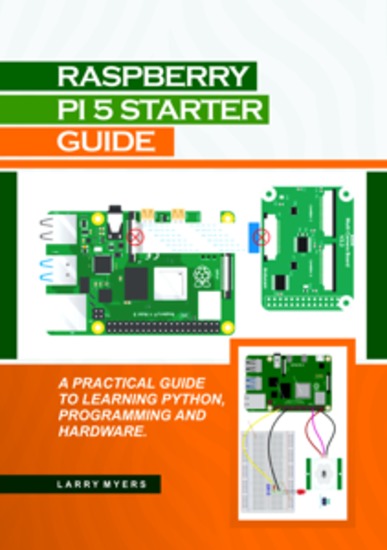
Raspberry Pi 5 Starter Guide - A Practical Guide to Learning Python Programming and Hardware - cover

Raspberry Pi 5 Starter Guide - A Practical Guide to Learning Python Programming and Hardware

Myers Larry

Publisher: AMD

  • 0
  • 0
  • 0

Summary

Whether you’re brand new to computing or just curious about the Raspberry Pi 5, this beginner-friendly guide is the perfect place to start. The Beginner’s Guide to Raspberry Pi 5 walks you through everything you need to know to turn this powerful little computer into something amazing—from setup and wiring to programming and real-world projects.Packed with clear explanations, step-by-step tutorials, and practical examples, this book will help you:Set up your Raspberry Pi 5 and understand how it worksLearn the basics of Python programmingBuild simple circuits with LEDs, buzzers, sensors, and moreCreate fun and useful projects like a motion detector, media center, or personal serverExplore ideas for automation, robotics, and IoTNo technical background? No problem. This book is written with beginners in mind, using everyday language and plenty of illustrations to guide you every step of the way.Click the BUY-NOW button to Start your Raspberry Pi journey today and bring your ideas to life—one project at a time.
Available since: 01/19/2026.

Other books that might interest you

  • TV Lobotomy The Scientific Truth About the Effects of Television - cover

    TV Lobotomy The Scientific Truth...

    Michel Desmurget

    • 0
    • 0
    • 0
    "TV unleashes the imagination and feeds intelligence." • "A child deprived of TV risks social isolation." • "TV dumbs you down." • "TV makes you obese." It seems that everything—and its opposite—has already been said about TV. But what is it really? How can we distinguish between the radical "No TV" of some and the supposedly entertaining virtues touted by others? Michel Desmurget, a doctor in neuroscience, has sifted through and synthesized thousands of research articles published over the last fifty years in the most rigorous international journals. The conclusion is unequivocal—we must stop watching television for good, whatever the program. All content, even that meant to teach, can never come close to any other learning method. The data is clear—television viewing is detrimental to school performance. For a child in elementary school, for example, every hour spent daily watching television increases the likelihood that he or she will one day leave the school system without any qualifications. For specialists, there is no doubt that television has a negative influence, not only on intellectual development but also on behavior. Thus, certain eating disorders (anorexia, bulimia) are related to a frantic consumption of—television programs! In short, watching television has an impact on our life expectancy. However, the harmful impact of this risk is largely underestimated, because of the large sector of the public exposed to television (more than 85% of Western households have at least one television set), and because of a debate on the subject that has become inaudible and confused. Moreover, the results of the research initiated by the big media groups on the subject remain "proprietary," i.e., closed to the general public. Believing that we is facing a real public health problem, Michel Desmurget wants to act as a responsible scientist—with a clear, concise and rigorously referenced book, the message cannot go unnoticed. Michel Desmurget is a doctor of neuropsychology. He attended several major American universities (MIT, Emory, UCSF) and is now a research director at INSERM in cognitive neuroscience. He is particularly interested in the problems of brain organization and plasticity. He is the author of the book TV Lobotomy (Max Milo, 2022), which is based in part on his personal history. Exasperated by having to constantly justify the choice not to have television at home—and to prevent his children from having access to it—and not to be seen as a sociopath in the eyes of those around him, he has done a massive job to argue his point. 
    This audiobook is read by a synthesized voice.
    Show book
  • The Shocking Truth about Animal Testing - cover

    The Shocking Truth about Animal...

    Zoey Fraisers

    • 0
    • 0
    • 0
    Animal testing has long been a cornerstone of scientific research, serving as a method to understand biological processes, test the safety and efficacy of products, and develop medical treatments. It involves the use of live animals in experiments and observational studies to explore the effects of drugs, chemicals, and other substances on biological systems. This practice, while often viewed as essential, is fraught with controversy, ethical dilemmas, and scientific scrutiny. 
    The origins of animal testing can be traced back to ancient Greece, where philosophers like Aristotle and Erasistratus conducted rudimentary experiments on animals to study anatomy and physiology. Over centuries, as medicine and technology advanced, the scope and complexity of animal testing expanded. By the 19th and 20th centuries, animal experimentation had become an institutionalized component of biomedical research, contributing to groundbreaking discoveries such as vaccines, antibiotics, and surgical techniques. 
    Today, animal testing is pervasive across multiple industries, including pharmaceuticals, cosmetics, and chemicals. It is primarily used to evaluate the safety of products, ensure regulatory compliance, and develop new treatments for diseases. Animals such as mice, rats, rabbits, and primates are commonly employed because of their physiological similarities to humans, which researchers argue make them suitable models for studying human biology.
    Show book
  • Tracking Giants - Big Trees Tiny Triumphs and Misadventures in the Forest - cover

    Tracking Giants - Big Trees Tiny...

    Amanda Lewis, Dr. Diana...

    • 0
    • 0
    • 0
    Amanda Lewis was an overachieving, burned-out book editor most familiar with trees as dead blocks of paper. A dedicated "indoorswoman," she could barely tell a birch from a beech. But that didn't stop her from pledging to visit all of the biggest trees in British Columbia, a Canadian province known for its rugged terrain and gigantic trees. 


    The "Champion" trees on Lewis's ambitious list ranged from mighty Western red cedars to towering arbutus. The only problem? Well, there were many . . . 


    Climate change and a pandemic aside, Lewis's lack of wilderness experience, the upsetting reality of old-growth logging, the ever-changing nature of trees, and the pressures of her one-year time frame complicated her quest. Burned out again—and realizing that her "checklist" approach to life might be the problem—she reframed her search for trees to something humbler and more meaningful: getting to know forests in an interconnected way. 


    Weaving in insights from writers and artists, Lewis uncovers what we're really after when we pursue the big things—revealing that sometimes it's the smaller joys, the mindsets we have, and the companions we're with that make us feel more connected to the natural world.
    Show book
  • LLM Domain-specific LLMs & Multimodal - A Comprehensive Guide to Language Model Development Domain-specific Language Models and Multimodal Language Models AI - cover

    LLM Domain-specific LLMs &...

    Et Tu Code

    • 0
    • 0
    • 0
    LLM, Domain-specific LLMs & Multimodals: Your Guide to Language Model Development 
    Master the world of language models with this comprehensive ebook! 
    This book is your one-stop guide to understanding and building your own language models. Whether you're a beginner or an experienced developer, you'll find everything you need to know, from the basics of natural language processing to cutting-edge multimodal models. 
    What You'll Learn:The fundamentals of language model development:Choose the right framework for your needs.Collect and preprocess data effectively.Design and train your own language model.Evaluate and fine-tune your model for optimal performance.Explore the exciting world of domain-specific LLMs:Tailor your model to specific industries and tasks.Discover popular pre-trained models and fine-tuning techniques.Navigate ethical considerations and best practices.Dive into the power of multimodal LLMs:Combine text, images, audio, and more for richer understanding.Build and implement your own multimodal models.Explore practical applications and future directions. 
    Plus:Case studies and project examples to inspire you.Community resources and tools to help you get started.In-depth discussion of ethical considerations and security best practices. 
    With its clear explanations, practical guidance, and comprehensive coverage, this ebook is your essential resource for unlocking the power of language models.
    Show book
  • Generative AI in Practice - 100+ Amazing Ways Generative Artificial Intelligence Is Changing Business And Society - cover

    Generative AI in Practice - 100+...

    Bernard Marr

    • 0
    • 0
    • 0
    Generative AI is rewriting the rulebook with its seemingly endless capabilities, from crafting intricate industrial designs, writing computer code, and producing mesmerizing synthetic voices to composing enchanting music and innovating genetic breakthroughs. In Generative AI in Practice, renowned futurist Bernard Marr offers listeners a deep dive into the captivating universe of GenAI. This comprehensive guide introduces you to the basics of this groundbreaking technology and outlines the profound impact that GenAI will have on business and society. 


    In this book, Marr sheds light on the most innovative real-world GenAI applications through practical examples. You'll enjoy a captivating discussion of innovations in media and entertainment, seismic shifts in advertising, and the future trajectory of GenAI. You will: 


    ● Navigate the complex landscapes of risks and challenges posed by Generative AI 


    ● Delve into the revolutionary transformation of the job market in the age of GenAI 


    ● Understand AI's transformative impact on education, healthcare, and retail 


    ● And more 


    This audiobook includes a bonus afterword not included in the print edition.
    Show book
  • Pale Blue Dot: Book Summary & Analysis - cover

    Pale Blue Dot: Book Summary &...

    Briefly Summaries

    • 0
    • 0
    • 0
    This is a concise summary and analysis of Pale Blue Dot, by Carl Sagan. It is not the original book and is not affiliated with or endorsed by Carl Sagan. Ideal for those seeking a quick and insightful overview.
     
    In this profound and inspiring exploration of our place in the universe, the author takes readers on a journey through space and time, reflecting on humanity’s future beyond Earth. Using breathtaking imagery and thought-provoking insights, this book examines our cosmic insignificance and the responsibility we bear for our fragile planet. Blending science, philosophy, and a call to stewardship, it offers a compelling vision of humanity’s potential destiny among the stars.
    Show book
