Join us on a literary world trip!
Add this book to bookshelf
Grey
Write a new comment Default profile 50px
Grey
Subscribe to read the full book or read the first pages for free!
All characters reduced
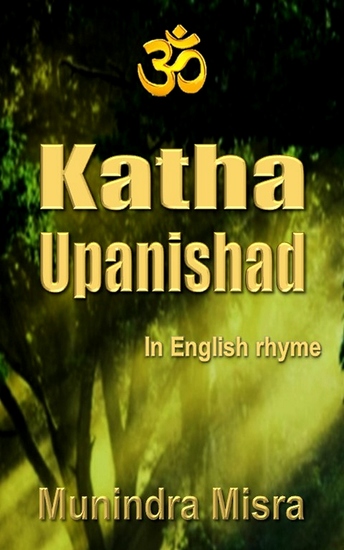
Katha Upanishad - In English rhyme - cover

Katha Upanishad - In English rhyme

Munindra Misra

Publisher: Munindra Misra

  • 0
  • 1
  • 0

Summary

Sri Katha Upanishad in English rhyme with original text have no consensus regarding their source. They vary from Yajur, Sama, Atharva to Rig-Veda.


Upanishads are prime portions of the Vedas, They are the foundational theological discourses of Hindu traditions called Vedanta or the conclusion of the Vedas. 
Available since: 08/19/2022.
Print length: 45 pages.
Other books that might interest you

  • Over The Wall - The Stasi Spy Network in East Germany After World War II - cover

    Over The Wall - The Stasi Spy...

    Davis Truman

    • 0
    • 0
    • 0
    Through meticulous research and compelling analysis, this book unravels the insidious politicization of intelligence under Ulbricht's regime. Witness accounts clash with Stasi reports, revealing a stark disparity between the reality of East German sentiments and the distorted narrative peddled to the politburo. As labor unrest simmered beneath the surface, the regime's reliance on manipulated intelligence proved catastrophic. 
    The narrative climaxes with the June 17, 1953 uprising - a pivotal moment in East German history. Amidst the enthusiasm of a million citizens rising against oppression, the fragility of Ulbricht's regime is laid bare. "Over the Wall" lays bare the extent of Ulbricht's manipulation and its profound impact on the tumultuous events of 1953, offering a chilling reminder of the dangers of wielding truth as a weapon.
    Show book
  • American Epic - Reading the US Constitution - cover

    American Epic - Reading the US...

    Garrett Epps

    • 0
    • 0
    • 0
    In 1987, E. L. Doctorow celebrated the Constitution's bicentennial by reading it. "It is five thousand words long but reads like fifty thousand," he said. Distinguished legal scholar Garrett Epps disagrees. It's about 7,500 words. And Doctorow "missed a good deal of high rhetoric, many literary tropes, and even a trace of, if not wit, at least irony," he writes. 


    In American Epic, Epps takes us through a complete reading of the Constitution to achieve an appreciation of its power and a holistic understanding of what it says. In this book he seeks not to provide a definitive interpretation, but to listen to the language and ponder its meaning. He draws on four modes of reading: scriptural, legal, lyric, and epic. The Constitution's first three words, for example, sound spiritual—but Epps finds them to be more aspirational than prayer-like. He turns the Second Amendment into a poem to illuminate its ambiguity. He notices oddities and omissions. The Constitution lays out rules for presidential appointment of officers, for example, but not removal. Should the Senate approve each firing? Can it withdraw its "advice and consent" and force a resignation? And he challenges himself, as seen in his surprising discussion of the Defense of Marriage Act (DOMA) in light of Article 4, which orders states to give "full faith and credit" to the acts of other states.
    Show book
  • Speed Reading for Beginners: How to drastically increase your reading speed understand more and remember better with simple methods - incl the best speedreading tips & tricks - cover

    Speed Reading for Beginners: How...

    Tom Sandkamp

    • 0
    • 0
    • 0
    Most people in our society can read, but only a few can do it efficiently and quickly. With the help of this book, I would like to try to introduce you to speed reading. This popular reading trend inspires with methods that are supposed to enable you to read up to three times as fast - with little practice and effort.
    Does this idea sound just right for your life and have you always dreamed of being able to read faster? Then this book is ideal for you. You will learn various techniques and methods for reading faster and how to use them through exercises. You will also learn how to read more efficiently and how to memorize the information you receive while reading in the long term.
    Show book
  • 3 Years in Pakistan - The Erik Audé Story - cover

    3 Years in Pakistan - The Erik...

    Erik Audé

    • 0
    • 0
    • 0
    "3 Years in Pakistan: The Erik Aude Story" offers a riveting account of Erik Aude's tumultuous three-year journey through the heart of Pakistan. Falsely accused of drug trafficking, Aude's life takes an unexpected turn as he finds himself thrust into the unforgiving depths of a foreign prison system. Amid the harsh realities of death row, Aude discovers unexpected pockets of humanity and kindness that illuminate the darkness surrounding him. Through the trials and tribulations of incarceration, Aude's resilience shines as he navigates the complexities of the Pakistani legal system with unwavering determination. "3 Years in Pakistan" is a gripping tale of survival, redemption, and the enduring power of the human spirit to find light in the darkest of places
    Show book
  • College Jocks and Frat House Bros - Gay Erotic Stories from University Life - cover

    College Jocks and Frat House...

    Matthew Cooper

    • 0
    • 0
    • 0
    College. A time to figure out who you really are. Get out of your parents’ house and experience the world on your own. A time to try new things, experiment, and have the time of your life. Sure, there are the books and the classes and all those late nights studying in your dorm room. But the true college experience is about growing, learning, and discovering yourself—and what your body can do. The young men in these stories are eager, willing, horny, and ready for anything. From frat parties, community showers, dorm rooms, come back to the best four years of your life and read stories of hook-ups, new love, sexual awakening, and erotic connections. Who was it for you? The student athlete, the quiet nerd, the partying frat boy? They’re all here in COLLEGE JOCKS AND FRAT HOUSE BROS. And you’re invited to the all-night rager. Meet Josh, who has a parking lot run-in with a hot sexy stranger. Peek in on Issac, the dorm room mate who doesn’t lock the door and doesn’t mind if you watch. Bump into your R.A. just when you need a place to crash. There are frat parties to attend, community showers to cruise, and cramped dorm rooms to hunker down in. Just make sure the door is locked – unless you don’t mind being caught. Matthew Cooper delivers story after story of young love and young lust in a collection of steamy, erotic stories sure to pique your interest and get your juices flowing. So turn the lights down, slide into bed, and start enjoying yourself with COLLEGE JOCK AND FRAT HOUSE BROS. I mean, hey, it’s just bros doing bro things.
    Show book
  • Technocracy Explained - The Role of Technological Expertise in Government and Policy-Making - cover

    Technocracy Explained - The Role...

    Arlo Holders

    • 0
    • 0
    • 0
    Technocracy is a concept that has evolved over time, yet its core principles remain focused on the idea that governance should be driven by scientific knowledge and technical expertise rather than political ideologies or populist sentiments. The term "technocracy" was first introduced in the early 20th century by engineers and economists who believed that the efficient management of resources and societal development could only be achieved through the application of scientific principles. Technocrats argued that political leaders, often with little to no understanding of complex systems, were ill-equipped to make decisions that could optimize society’s functioning, particularly in times of rapid industrialization and technological advancement. 
    The origins of technocracy can be traced back to the industrial revolution, when technological innovations began reshaping economies and societies. However, the movement gained significant traction in the early 1930s during the Great Depression, a period of economic turmoil that called into question traditional governance models. During this time, scholars like Howard Scott and engineers from the Technocratic Movement in the United States called for the establishment of a technocratic society where engineers, scientists, and other experts would manage the economy based on data-driven decision-making rather than political influence. They believed that such a system would eliminate inefficiencies, social inequalities, and the corruption they associated with political governance.
    Show book