Join us on a literary world trip!
Add this book to bookshelf
Grey
Write a new comment Default profile 50px
Grey
Subscribe to read the full book or read the first pages for free!
All characters reduced
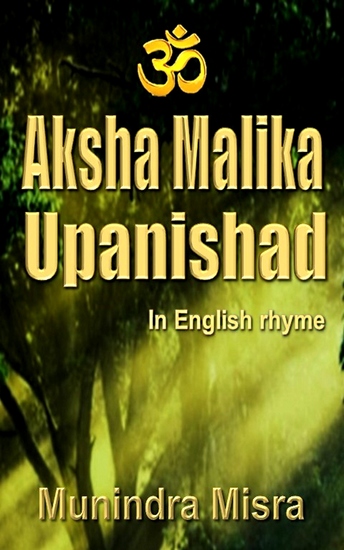
Aksha Malika Upanishad - cover

Aksha Malika Upanishad

Munindra Misra

Publisher: Munindra Misra

  • 0
  • 0
  • 0

Summary

Aksha Malika Upanishad, in English rhyme, with original text from Rig Veda
 
Upanishads are prime portions of the Vedas, They are the foundational theological discourses of Hindu traditions called Vedanta or the conclusion of the Vedas. 
Available since: 05/09/2022.
Print length: 25 pages.

Other books that might interest you

  • Not so Black and White - A History of Race from White Supremacy to Identity Politics - cover

    Not so Black and White - A...

    Kenan Malik

    • 0
    • 0
    • 0
    A powerful new history of the idea of race, forcing us to rethink today’s culture wars. 
     
    Is white privilege real? How racist is the working class? Why has left-wing antisemitism grown? Who benefits most when anti-racists speak in racial terms? 
     
    The ‘culture wars’ have generated ferocious argument, but little clarity. This book takes the long view, explaining the real origins of ‘race’ in Western thought, and tracing its path from those beginnings in the Enlightenment all the way to our own fractious world. In doing so, leading thinker Kenan Malik upends many assumptions underpinning today’s heated debates around race, culture, whiteness and privilege. 
     
    Malik interweaves this history of ideas with a parallel narrative: the story of the modern West’s long, failed struggle to escape ideas of race, leaving us with a world riven by identity politics. Through these accounts, he challenges received wisdom, revealing the forgotten history of a racialised working class, and questioning fashionable concepts like cultural appropriation. 
     
    Not So Black and White is both a lucid history rewriting the story of race, and an elegant polemic making an anti-racist case against the politics of identity.
    Show book
  • First Bull Run: The History of the Civil War’s First Major Battle - cover

    First Bull Run: The History of...

    Jonathan Gianos-Steinberg

    • 0
    • 0
    • 0
    After Fort Sumter, the Lincoln Administration pushed for a quick invasion of Virginia, with the intent of defeating Confederate forces and marching toward the Confederate capitol of Richmond. Lincoln pressed General Irvin McDowell to push forward. Despite the fact that McDowell knew his troops were inexperienced and unready, pressure from Washington politicians forced him to launch a premature offensive against Confederate forces in Northern Virginia.  
    	McDowell’s strategy during the First Battle of Bull Run was grand, and in many ways it was the forerunner of a tactic Robert E. Lee, Stonewall Jackson and James Longstreet executed brilliantly on nearly the same field during the Second Battle of Bull Run in August 1862. McDowell’s plan called for parts of his army to pin down General P.G.T. Beauregard’s Confederate soldiers in front while marching another wing of his army around the flank and into the enemy’s rear, rolling up the line. McDowell assumed the Confederates would be forced to abandon Manassas Junction and fall back to the next defensible line, the Rappahannock River. In July 1861, however, this proved far too difficult for his inexperienced troops to carry out effectively.  
    	As the first major land battle of the Civil War, the First Battle of Bull Run made history in several ways. The two sides fought near the railroad junction at Manassas on July 21, 1861, just 25 miles away from Washington, which was close enough for many civilians from the nation’s capital to come and watch what they expected to be a rout of Confederate forces, and for awhile it appeared as though that might be the case.  
    	McDowell’s strategy ultimately fell apart though, mostly thanks to the use of the railroad. Confederate reinforcements under General Joseph E. Johnston, including a brigade led by Thomas Jonathan Jackson, arrived by train in the middle of the day, a first in the history of American warfare.
    Show book
  • DESTROY Digital Media Platforms - How Competitive Streaming Levels the Playing Field for Creatives - cover

    DESTROY Digital Media Platforms...

    Christopher Grant Sr.

    • 0
    • 0
    • 0
    You take your shot at success and fame. You tell anyone who will listen, “Hey, check me out! I’m on Spotify, Amazon, and YouTube!” Finally, you’re validated. You’re at the table with the big kids — Right? WRONG. 
    YOUR CONTENT EVERYWHERE GETS YOU NOWHERE... 
    Music industry insider Christopher Grant Sr. introduces UnderRepresented Creatives to the groundbreaking concept of Competitive Streaming™  and DESTROYs the idea that creatives must rely on traditional digital media platforms for discovery. He levels the playing field for URCs, as he calls them, to achieve success — regardless of fame, connections, or net worth.  
    “I’m not here to bash traditional digital media platforms like Spotify, Netflix, Amazon, etc., but I know what they’re good at and what they’re not good at. Unfortunately, one thing they’re not good at is making you a star.”        —CGrantSr.                                  
    Christopher Grant, Sr. has nearly 20 years of successful experience in the entertainment industry. As founder and CEO of upstart media company SEVENHORNS, host of the DESTROY Podcast, and founder of TraxBox, Inc., Chris believes in the power of multimedia to impact society for good. One of his lifelong pursuits has been to create and deliver culturally relevant content that challenges the human condition.
    Show book
  • Socrates Meets Kierkegaard - The Father of Philosophy Cross-Examines the Father of Christian Existentialism - cover

    Socrates Meets Kierkegaard - The...

    Peter Kreeft

    • 0
    • 0
    • 0
    In the Socrates Meets series, Peter Kreeft revives the classic method of bringing philosophy to life through dialogue. In eight innovative volumes, he uncovers the principles, assumptions, and sometimes dangerous conclusions of some of history’s most influential minds.  Each dialogue imagines a purgatory where we can listen in on conversations between Socrates and the great thinkers who, centuries later, picked up the philosopher’s torch. Each conversation investigates one of the philosopher’s key works, a short, readable classic that raises central questions both for philosophy and for life. In this volume, Socrates cross-examines Søren Kierkegaard, the father of Christian existentialism and author of Philosophical Fragments, exploring imagination, truth, faith, love, and Jesus Christ.
    Show book
  • Dark Ages - Historical Facts about the Plague the Inquisition and the Knights from the Middle Ages - cover

    Dark Ages - Historical Facts...

    Kelly Mass

    • 0
    • 0
    • 0
    This book contains the following titles: 
    Crusaders - The Crusaders is one of those dark chapters in history that we would rather forget, especially religious people. In name of the church, or other religions, like the Muslim faith, people killed, destroyed, looted, and burned cities to the ground. 
    Middle Ages - In the history of Europe, the Middle Ages or middle ages time period lasted around from the 5th to the late 15th centuries, likewise to the Post-classical period of worldwide history. 
    William Shakespeare - William Shakespeare is the celebrated script writer of the most popular plays in the English language. By writing both tragedies, romances, and comedies in the 16th century, he made a name for himself and became successful in the art of drama. 
    Black Death - Here we have it: We may be looking at the years 2020-2021 and think a certain virus has been bad for the world population. However, what happened in these two years is nothing, proportionally, to the hundreds of millions of people who got wiped out by rat infestations. 
    Anglo-Saxons - In the Early Middle Ages, the Anglo-Saxons were a cultural group that resided in England. They traced their roots back to the arrival of incomers to Britain in the fifth century, who originated from the North Sea coastlands of continental Europe. 
    Viking History - We all have a typical image of Vikings, from the horns on their helmets to the beards and the clothes they wear. Their ships have a certain charm, and their reputation is that they were brutal, raw, and believed in multiple gods. 
    Inquisition - Perhaps you have heard of the horrible stories of the Spanish, Portuguese, or French inquisition, the Catholic body of persecutors who would arrest the supposed “heathens” and accuse them of witchcraft, heresies, blasphemy, adultery, and a whole list of other sins or crimes.
    Show book
  • The Big Ride At The Musical Fair - Come Join Our Musical Journey - cover

    The Big Ride At The Musical Fair...

    Julie Kirchhubel

    • 0
    • 0
    • 0
    The Big Ride At The Musical FairIt’s Fair time for the animals today, and they are all ready in their seats and really looking forward to the Big Ride starting. But the Ride can’t begin just yet. What – or who – are they waiting for?
    Show book