Join us on a literary world trip!
Add this book to bookshelf
Grey
Write a new comment Default profile 50px
Grey
Subscribe to read the full book or read the first pages for free!
All characters reduced
Through Bolshevik Revolution - cover

Through Bolshevik Revolution

Mrs. Philip Snowden

Publisher: Full Well Ventures

  • 0
  • 0
  • 0

Summary

The Viscountess Ethel Snowden (1881-1951), wife of Labour Party politician Viscount Philip Snowden, was a British socialist, human rights activist, and feminist politician. She was a leading campaigner for women’s suffrage before World War I and helped to found The Women’s Peace Crusade to oppose the war and call for a negotiated peace. At the end of the war, she was elected to the National Executive Committee of the Labour Party, which leads her travels in Russia in early 1920, where she was sent to conduct an impartial inquiry into the Bolshevik Revolution. Her findings were presented in a book, “Through Bolshevik Russia.” Although she generally liked Lenin, whom she interviewed while in Russia, she was critical of Bolshevism. She had told a reporter for the “Evening Standard” upon her return that "I oppose Bolshevism because it is not Socialism, it is not democracy and it is not Christianity", and likened working conditions to slavery. Her denunciations of the Soviets made her unpopular and she was soon voted off the National Executive Committee, in 1922. However, she remained active in politics due to her husband’s service in Parliament.
Available since: 12/07/2022.
Other books that might interest you

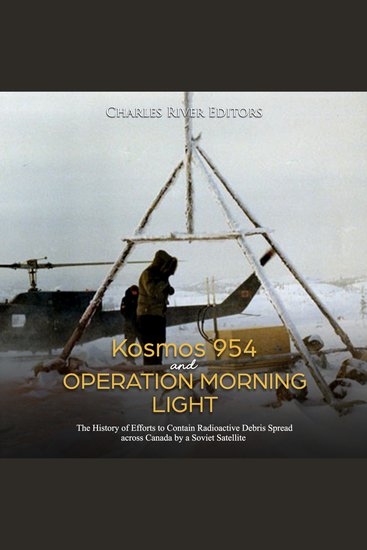
  • Kosmos 954 and Operation Morning Light: The History of Efforts to Contain Radioactive Debris Spread across Canada by a Soviet Satellite - cover

    Kosmos 954 and Operation Morning...

    Charles River Editors

    • 0
    • 0
    • 0
    In the predawn sky of northern Canada on the morning of January 24th, 1978, a long streak of blue fire suddenly rushed across the starry vista northeast of the remote town of Yellowknife. Those out on the bitterly cold night, with a temperature many tens of degrees below zero Fahrenheit, saw a brilliant leading object sheathed in flames, blue or bluish red, and shining with incandescent intensity. Other, smaller objects or fragments shed off it, arcing or tumbling earthwards on their own trajectories. Even in this remote location, a number of individuals saw and reported the unusual phenomenon. Out under the starry dome of the distant north, where celestial objects appeared with burning clarity through the frigid, pure air, they watched the apparition until it vanished in the northeast, somewhere far over Great Slave Lake. 
    	Of the relatively few people who witnessed it, most assumed they witnessed a burning passenger jet crashing. One thought that it might have something to do with lasers after seeing a program about them on television. Others, observing its speed and unusual appearance, recognized they had not seen a crashing aircraft, but had no ready explanation for it at all. 	Conversely, Canadian and American officials knew precisely what the people of Yellowknife and the surrounding areas witnessed. Within a short time, teams of scientists and security experts boarded aircraft to converge on the deep wilderness where the Soviet spy satellite Kosmos 954 had just crashed into the atmosphere and burned up over Great Slave Lake, strewing radioactive debris over an area of approximately 48,000 square miles. Those efforts would kick off one of the most unique environmental operations in history. 
    Kosmos 954 and Operation Morning Light: The History of Efforts to Contain Radioactive Debris Spread across Canada by a Soviet Satellite examines how the satellite malfunctioned, the disastrous results, and the efforts to clean up.
    Show book
  • James I Charles I Commomwealth & Cromwells 1603-1660 - Stuarts Civil War Scaffolds Cromwell and the Odd Beheading (A Comic History of England Bk6) - cover

    James I Charles I Commomwealth &...

    Gilbert Abbott À Beckett

    • 0
    • 0
    • 0
    Step right up for the most uproariously irreverent chapter of Gilbert Abbott A’Beckett’s Comic History of England—where crowns are comedy props and history’s biggest egos trip over their own dogma! 
    Meet James I, the "Wisest Fool in Christendom," who preached divine right while his pet favorite, the Duke of Buckingham, turned the court into a scandalous farce. Then comes Charles I, whose stubbornness cost him his crown (and his head), thanks to a Parliament with a very sharp grievance list—and a little help from the ill-fated Earl of Stafford. 
    Enter Oliver Cromwell, the Puritan party-pooper who banned Christmas, crushed Ireland, and somehow made republicanism duller than a Sunday sermon. But just when you think the chaos can’t get worse, in stumbles Richard Cromwell, his hapless son, who proved that ruling England was not a hereditary talent. Spoiler: The Republic collapses faster than a house of cards in a hurricane. 
    Narrated with wicked wit by Charles Featherstone, this uproarious installment skewers the Stuarts like a royal roast—where kings are klutzes, parliaments are punchlines, and the only thing sacred is the absurdity of power.
    Show book
  • Become Ungovernable - An Abolition Feminist Ethic for Democratic Living - cover

    Become Ungovernable - An...

    H.L.T. Quan

    • 0
    • 0
    • 0
    "Phenomenal . . . Offers us possibilities for rescuing the concept of democracy from its fatal entanglement with racial, heteropatriarchal capitalism." —Angela Y. Davis 


    "A compelling and inspiring book that belongs in our movements and our classrooms." —Chandra Talpade Mohanty, author of Feminism Without Borders 


    Become Ungovernable is a provocative new work of political thought setting out to reclaim "freedom", "justice", and "democracy", revolutionary ideas that are all too often warped in the interests of capital and the state. Revealing the mirage of mainstream democratic thought and the false promises of liberal political ideologies, H. L. T. Quan offers an alternative approach: an abolition feminism drawing on a kaleidoscope of refusal praxes, and on a deep engagement with the Black Radical Tradition and queer analytics. 


    With each chapter anchored by episodes from the long history of resistance and rebellions against tyranny, Quan calls for us to take up a feminist ethic of living rooted in the principles of radical inclusion, mutuality, and friendship as part of the larger toolkit for confronting fascism, white supremacy, and the neoliberal labor regime.
    Show book
  • Jacques Lacan - The Basics - cover

    Jacques Lacan - The Basics

    Calum Neill

    • 0
    • 0
    • 0
    Jacques Lacan: The Basics provides a clear and succinct introduction to the work of Jacques Lacan, one of the key thinkers of the twentieth century. 


    Lacan's ideas are applied in the study of the humanities, politics, and psychology, as well as contemporary media and the arts, but their complexity makes them impenetrable to many. This book is unique in explaining the key concepts and context, from Lacan's understanding of psychoanalysis to drive and desire, in an accessible way without diluting them beyond meaning. Examples from popular culture are used throughout to emphasize the ideas being discussed and a full glossary and list of resources encourages additional exploration. 


    This engaging and accessible text is essential for all those interested in Lacan and his work, as well as students of psychology, psychoanalysis, literature, politics, cultural studies, film studies, and more.
    Show book
  • Facts the Historians Leave Out - A Confederate Primer - cover

    Facts the Historians Leave Out -...

    John S. Tilley

    • 0
    • 0
    • 0
    "Facts the Historians Leave Out" is a book that delves into lesser-known aspects and perspectives of American history, particularly focusing on the Confederate side of the Civil War. This work seeks to shed light on events, figures, and narratives that the author argues have been overlooked or underrepresented in mainstream historical accounts. The book is often regarded as offering a revisionist view, aiming to broaden readers' understanding of the Civil War by including stories and facts that are not commonly featured in traditional historical texts. Its approach to history is controversial, as it challenges established narratives and interpretations of the Civil War, leading to debates about historical accuracy, bias, and the role of historical narrative in shaping collective memory.
    Show book
  • The Age of Reason - cover

    The Age of Reason

    Thomas Paine

    • 0
    • 0
    • 0
    In "The Age of Reason", which is a classic in American literature, Thomas Paine argues for the philosophical position of Deism.  
    It follows in the tradition of 18th century British deism, and challenges institutionalized religion and the legitimacy of the Bible. 
    Paine's work inspired and guided many free thinkers including Thomas Jefferson, Abraham Lincoln, Mark Twain and Bertrand Russell.
    Show book