Rejoignez-nous pour un voyage dans le monde des livres!
Ajouter ce livre à l'électronique
Grey
Ecrivez un nouveau commentaire Default profile 50px
Grey
Abonnez-vous pour lire le livre complet ou lisez les premières pages gratuitement!
All characters reduced
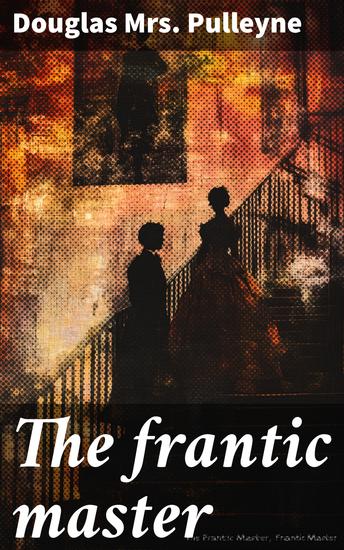
The frantic master - cover

The frantic master

Mrs. Douglas Pulleyne

Maison d'édition: Good Press

  • 0
  • 0
  • 0

Synopsis

In "The Frantic Master," Mrs. Douglas Pulleyne crafts a compelling narrative that delves into the intricacies of human relationships against the backdrop of a rapidly changing society. The book is characterized by a vibrant literary style, blending rich descriptions with a keen psychological insight that reveals the inner turmoil of its characters. Pulleyne constructs a nuanced exploration of madness and obsession, expertly interweaving themes of power dynamics and the quest for identity, all while maintaining a firm grasp on the social mores of her time, thereby situating the work within the larger framework of early 20th-century literature. Mrs. Douglas Pulleyne, a writer and social commentator of her era, was deeply influenced by the shifting attitudes towards mental health and societal expectations of women. Her personal experiences as a suffragette and her keen observations of the struggles within her contemporary environment inform the depth and authenticity of her characters' experiences. Pulleyne's background in social reform and her literary involvement reveal a profound commitment to examining the complexities of personal agency in an unforgiving world. Readers who seek a thought-provoking examination of emotional devastation and the pursuit of self amidst chaos will find "The Frantic Master" an indispensable addition to their literary collections. This novel not only entertains but challenges us to grapple with the weight of our choices and the societal structures that shape our destinies.
Disponible depuis: 02/03/2025.
Longueur d'impression: 140 pages.

D'autres livres qui pourraient vous intéresser

  • A Descent Into the Maelstrom - cover

    A Descent Into the Maelstrom

    Edgar Allan Poe

    • 0
    • 0
    • 0
    A Descent Into The Maelström is a short story by Edgar Allan Poe that first appeared in the May 1841 edition of Graham's Magazine. In the tale, a man recounts how he survived a shipwreck and a whirlpool. It has been grouped with Poe's tales of ratiocination and also labeled an early form of science fiction.
    Voir livre
  • A Complete Recovery - From their pens to your ears genius in every story - cover

    A Complete Recovery - From their...

    Barry Pain

    • 0
    • 0
    • 0
    Barry Eric Odell Pain was born at 3 Sydney Street in Cambridge on 28th September 1864. He was one of 4 children. 
    He was educated at Sedbergh School and then Corpus Christi College, Cambridge. 
    In 1889, Cornhill Magazine published his short story ‘The Hundred Gates’.  This opened the way for Pain to advance his literary career on several fronts. He became a contributor to Punch and The Speaker, as well as joining the staff of both the Daily Chronicle and Black and White.  
    Pain was also a noted and prominent contributor to The Granta and from 1896 to 1928 a regular contributor to the Windsor Magazine. 
    It is often said that Pain was discovered by Robert Louis Stevenson, who compared his work to that of Guy de Maupassant.  It’s an apt comparison. Pain was a master of disturbing prose but was also able to inject parody and light comedy into many of his works.  A simple premise could in his hands suddenly expand into a world very real but somehow emotionally fraught and on the very edge of darkness. 
    Barry Pain died on 5th May 1928 in Bushey, Hertfordshire.
    Voir livre
  • Roughing It (Unabridged) - cover

    Roughing It (Unabridged)

    Mark Twain

    • 0
    • 0
    • 0
    Roughing It is a book of semi-autobiographical travel literature written by American humorist Mark Twain. He wrote it during 1870-71 and published in 1872, as a prequel to his first book The Innocents Abroad (1869). This book tells of Twain's adventures prior to his pleasure cruise related in Innocents Abroad.
    Voir livre
  • The Pace of Youth - A complex yet rewarding story about the challenges of young love - cover

    The Pace of Youth - A complex...

    Stephen Crane

    • 0
    • 0
    • 0
    Stephen Crane was born 1st November, 1871 in Newark, New Jersey and was the eighth surviving child out of fourteen.  Incredibly he began writing at the age of four and was published several times by the age of sixteen.   
     
    Crane only began a full-time education when he was nine but quickly mastered the grades needed to catch up and move forward. Although educated at Lafayette and Syracuse he had little interest in completing university and was keener to move on to a career, declaring college to be ‘a waste of time’.  By twenty he was a reporter and two years later had published his debut novel ‘Maggie: A Girl of the Streets’.  In literary circles this was hailed as the first work of American literary Naturalism.  
     
    Two years later, in 1895, he was the subject of worldwide acclaim for his Civil War novel, written without the benefit of any actual war experiences, ‘The Red Badge of Courage’.  It was indeed a masterpiece and his finest hour.  A year later life began its downwards descent when he became embroiled in a scandal which was to doom his career.  In attempting to help a suspected prostitute being falsely charged by a policeman he became the target of the authorities. 
     
    Later the same year en-route to Cuba as a War Correspondent he met the hotel madam Cora Taylor in Jacksonville, Florida.  This was to become the defining relationship of his life.  Continuing his journey, somewhere between Florida and Cuba his ship sank, and he was cast adrift for several days.  Rescued, he returned to cover conflicts wherever they were situated, some as far away as Greece.  For a time he lived in England with Cora, usually beyond their means, befriending fellow writers such as H G Wells and Joseph Conrad.    
     
    In declining health and beset by money problems, Stephen Crane died of tuberculosis, aged a mere 28 on 5th June 5, 1900, at Badenweiler, Germany. He is buried in New Jersey.
    Voir livre
  • F Scott Fitzgerald - Six of the Best - Their legacy in 6 classic stories - cover

    F Scott Fitzgerald - Six of the...

    F. Scott Fitzgerald

    • 0
    • 0
    • 0
    Six has always been a number we group things around – Six of the best, six of one half a dozen of another, six feet under, six pack, six degrees of separation and a sixth sense are but a few of the ways we use this number. 
     
    Such is its popularity that we thought it is also a very good way of challenging and investigating an author’s work to give width, brevity, humour and depth across six of their very best. 
     
    In this series we gather together authors whose short stories both rivet the attention and inspire the imagination to visit their gems in a series of six, to roam across an author’s legacy in a few short hours and gain a greater understanding of their writing and, of course, to be lavishly entertained by their ideas, their narrative and their way with words. 
     
    These stories can be surprising and sometimes at a tangent to what we expected, but each is fully formed and a marvellous adventure into the world and words of a literary master.
    Voir livre
  • The Child-Who-Was-Tired - cover

    The Child-Who-Was-Tired

    Katherine Mansfield

    • 0
    • 0
    • 0
    The Child-Who-Was-Tired is a short story by Katherine Mansfield: She was just beginning to walk along a little white road with tall black trees on either side, a little road that led to nowhere, and where nobody walked at all, when a hand gripped her shoulder, shook her, slapped her ear. - “Oh, oh, don’t stop me,” cried the Child-Who-Was-Tired. “Let me go.”
    Voir livre