Join us on a literary world trip!
Add this book to bookshelf
Grey
Write a new comment Default profile 50px
Grey
Subscribe to read the full book or read the first pages for free!
All characters reduced
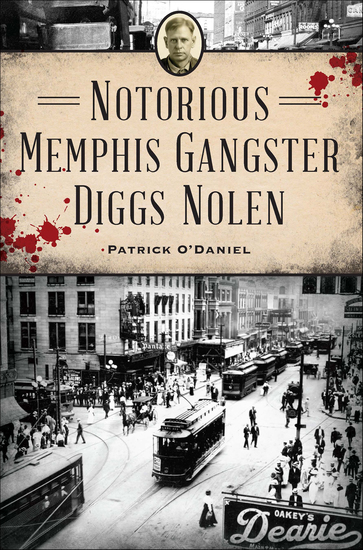
Notorious Memphis Gangster Diggs Nolen - cover

Notorious Memphis Gangster Diggs Nolen

Mr. Patrick O'Daniel

Publisher: The History Press

  • 0
  • 0
  • 0

Summary

The Memphis Underworld King   Diggs Nolen's name was the byword for crime in 1920s Memphis. As a child, he dreamed of becoming a swashbuckling outlaw. He turned his back on a promising career, his family and consorted with the worst elements of society. Under the tutelage of train robber Frank Holloway, Nolen became a notorious con artist. Later, he and his gun-slinging wife built an empire out of selling narcotics and trafficking stolen goods. Law enforcement caught Nolen, but they could not hold him. Nolen escaped from Leavenworth Prison, led the largest jailbreak in Memphis history and confounded prosecutors with legal wranglings. Author Patrick O'Daniel details Nolen's quixotic quest for criminal fame that earned him the title King of the Memphis Underworld.
Available since: 10/23/2023.
Print length: 146 pages.
Other books that might interest you

  • Crime and Punishment - Dostoevsky’s Exploration of Guilt Redemption and Justice - cover

    Crime and Punishment -...

    Fyodor Dostoevsky, Tim Zengerink

    • 0
    • 0
    • 0
    What if you could confront the darkest corners of the human mind, explore the nature of guilt, and uncover the path to redemption? 
    Crime and Punishment: Dostoevsky’s Exploration of Guilt, Redemption, and Justice brings you Fyodor Dostoevsky’s masterpiece of psychological and moral complexity, thoughtfully adapted for today’s listeners. 
    Set in the grim streets of 19th-century St. Petersburg, Crime and Punishment tells the story of Raskolnikov, a young man who commits a terrible crime and descends into a torment of guilt and self-doubt. Through his harrowing journey, Dostoevsky examines morality and desperation, the search for redemption, and the complex nature of justice. 
    This isn’t just a story of crime—it’s a profound exploration of human nature, ethics, and the choices that define us. Whether you’re a lover of classic literature, a student of psychology, or someone seeking a deeply moving and thought-provoking story, Dostoevsky’s masterpiece will challenge and inspire you. 
    What You’ll Discover: 
    - The Depths of Human Psychology: Follow Raskolnikov’s inner turmoil as he grapples with guilt, morality, and consequences. 
    - The Struggle for Redemption: Discover how forgiveness can emerge from the darkest moments of despair. 
    - A Reflection on Justice and Morality: Explore timeless questions about crime, punishment, and atonement. 
    - Accessible for Today’s Listeners: Enjoy Dostoevsky’s storytelling in a clear, modern translation preserving its depth and beauty. 
    Dostoevsky’s Crime and Punishment is a gripping exploration of guilt, justice, and redemption that remains as relevant today as ever. His insights into the human mind reveal universal truths about morality, choices, and the fragile balance between darkness and light within us all. 
    Download your copy today and immerse yourself in Dostoevsky’s timeless masterpiece of the human experience.
    Show book
  • Faulty Reasoning in Cause and Effect - When Correlation Isn’t Causation (2 in 1) - cover

    Faulty Reasoning in Cause and...

    William Rands

    • 0
    • 0
    • 0
    This book consists of the following two titles: 
    - The Correlation-Causation Fallacy: The correlation-causation fallacy is a common error in reasoning where people mistakenly believe that because two events or variables are correlated, one must have caused the other. This fallacy is not only widespread but can have significant consequences in various aspects of life, including science, policy-making, and everyday decision-making. It stems from the human tendency to look for patterns and explanations, often leading us to draw conclusions from observed associations without carefully analyzing the underlying mechanisms at play. 
      
    - The Gambler's Fallacy: The Gambler's Fallacy, also known as the Monte Carlo fallacy, is a common cognitive bias in which individuals believe that past events can influence future random outcomes. It is particularly evident in gambling scenarios, where players wrongly assume that a string of bad or good luck must be followed by a reversal. The core principle of the fallacy lies in the misinterpretation of probability. In reality, the odds of a specific event occurring remain constant, regardless of what happened in the past. This misunderstanding can lead to poor decision-making and increased risks.
    Show book
  • American History for Kids: A Captivating Guide to Major Events in US History - cover

    American History for Kids: A...

    Captivating History

    • 0
    • 0
    • 0
    If you want to discover the captivating history of the United States of America, then keep reading… 
    Howdy, partners! Get ready to travel back in time to when America was first discovered. You’ll learn all about how the United States of America was formed and the most significant events in its history. You’ll be amazed to discover all the incredible things that have shaped the United States into the culture it is today.  
    Here are just a few clues about what you’ll learn:Why were Native Americans called Indians?Christopher Columbus wasn’t the first person to discover America!What would your Native American name be?The unsolved mystery of the missing first American colony.Just why did the first settlers move to America?How tea was responsible for the formation of the United States.“The British are coming!”—or are they?The formation and changes to the US Constitution. How one former slave helped free hundreds of slaves.What caused America to fight amongst itself during the Civil War?They found how much gold during the Gold Rush?!Who were the most famous gunslingers of the Wild West?The incredible inventions that changed the world.Did people really believe the streets of America were paved with gold?What are the most significant wars the United States has fought and why?Depression cake—it’s tastier than it sounds!The Roaring Twenties—learn to dance the Charleston! 
    This Captivating Guide contains fun facts, real-life photographs, interesting maps and images, and helpful pronunciation tips and explanations for those trickier new words. Plus, at the end of each chapter, there are fun and creative activities for you to enjoy.  
    So, what are you waiting for? Let’s be captivated by the history of the United States of America!
    Show book
  • Tarascan Empire - The Fierce Rivals of the Aztecs and Masters of West Mexico - cover

    Tarascan Empire - The Fierce...

    Rolf Hedger

    • 0
    • 0
    • 0
    The Tarascan Empire flourished in the rugged and resource-rich region of western Mexico, primarily in what is now the state of Michoacán. Unlike the arid landscapes of central Mexico dominated by the Aztecs, the Tarascan homeland was defined by volcanic highlands, fertile valleys, and vast lakes, particularly Lake Pátzcuaro, which played a central role in their civilization. The geography of this region not only shaped their way of life but also provided a natural defense against external threats, including the expansionist ambitions of the Aztecs. 
    The varied landscape of Michoacán consisted of towering mountains, deep forests, and fertile plateaus. This diverse terrain allowed the Tarascans to develop a robust agricultural system, cultivating maize, beans, squash, and chili peppers, which formed the foundation of their diet. The presence of rivers and lakes further supported fishing and provided fresh water, making settlements around these water bodies highly strategic. Lake Pátzcuaro, in particular, was not only an economic and social hub but also held deep religious significance. It was believed to be the gateway to the underworld in Tarascan mythology, reinforcing its central role in spiritual life. 
    Natural resources played a crucial role in the rise of the Tarascan Empire. The region was rich in minerals, especially copper and obsidian, which were vital for both tools and weaponry. Unlike the Aztecs, whose military strength relied on wooden clubs and stone blades, the Tarascans developed advanced metalworking techniques, producing copper axes, bronze weapons, and intricate ornaments. This technological advantage gave them a distinct edge in warfare and trade, allowing them to maintain independence from their more dominant neighbors.
    Show book
  • Ministry of Truth - Democracy Reality and the Republicans' War on the Recent Past - Democracy Reality and the Republicans' War on the Recent Past: Democracy Reality and the Republicans' War on the Recent Past: A timely investigation of Republican historical revisionism that examines dan... - cover

    Ministry of Truth - Democracy...

    Steve Benen

    • 0
    • 0
    • 0
    A searing, vital investigation of the Republican Party’s dangerous campaign to rewrite history in real time, from the Emmy Award-winning Rachel Maddow Show producer and bestselling author of The Impostors. 
    “There is nobody…who has more influence on the way I think about politics than Steve Benen.” —Rachel Maddow  
    For as long as historical records have existed, authoritarian regimes have tried to rewrite history to suit their purposes, using their dictatorial powers to create myths, spread propaganda, justify decisions, erase opponents, and even dispose of crimes. 
    Today, as America’s Republican Party becomes increasingly radicalized, it’s not surprising to see the GOP read from a similarly despotic script. Indeed, the party is taking dangerous, aggressive steps to rewrite history—and not just from generations past. Unable to put a positive spin on Trump-era scandals and fiascos, GOP voices and their allies have grown determined to rewrite the stories of the last few years—from the 2020 election results and the horror of January 6th to their own legislative record—treating the recent past as an enemy to be overpowered, crushed, and conquered. The consequences for our future, in turn, are dramatic. 
    Extraordinarily timely and undeniably important, Steve Benen’s new book tells the staggering chronicle of the Republican party’s unsettling attempts at historical revisionism. It reveals not only how dependent they have grown on the tactic, but also how dangerous the consequences are if we allow the party to continue. The stakes, Benen argues, couldn’t be higher: the future of democracy hinges on both our accurate understanding of events and the end of alternative narratives that challenge reality. 
    Supplemental enhancement PDF accompanies the audiobook.
    Show book
  • Cognitive Bias in Self-Perception - Why We Think We're Right (2 in 1) - cover

    Cognitive Bias in...

    William Rands

    • 0
    • 0
    • 0
    This book contains the following titles: 
    - The Overconfidence Bias: Overconfidence is a cognitive bias that affects the way we perceive our abilities, knowledge, and future outcomes. It leads individuals to overestimate their competence and the precision of their knowledge, often resulting in flawed decision-making. At its core, overconfidence is an inflated sense of self-assurance that distorts reality. While a certain level of confidence is essential for success, excessive confidence can cloud judgment and lead to risky choices. 
    - The Dunning-Kruger Effect: The Dunning-Kruger effect is a cognitive bias that leads individuals with limited knowledge or ability in a particular area to overestimate their competence. Named after psychologists David Dunning and Justin Kruger, who first identified this phenomenon in 1999, the effect reveals a paradox in human cognition: the less people know, the more likely they are to believe they know everything. Conversely, experts in a field tend to underestimate their abilities, assuming that others possess the same level of expertise. This bias is not only fascinating from a psychological standpoint but also carries significant implications for personal, professional, and societal development.
    Show book