Join us on a literary world trip!
Add this book to bookshelf
Grey
Write a new comment Default profile 50px
Grey
Subscribe to read the full book or read the first pages for free!
All characters reduced
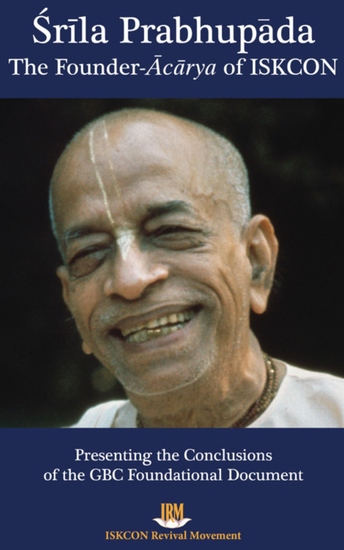
Srila Prabhupada The Founder-Acarya of ISKCON - Presenting the Conclusions of the GBC Foundational Document - cover

Srila Prabhupada The Founder-Acarya of ISKCON - Presenting the Conclusions of the GBC Foundational Document

Movement ISKCON Revival

Publisher: ISKCON Revival Movement

  • 0
  • 0
  • 0

Summary

Presenting the Conclusions of the GBC Foundational Document
 
ISKCON’s GBC (Governing Body Commission) has issued a Foundational Document on the position of Srila Prabhupada, a document which it has declared to be “historic” and required reading by everyone in ISKCON. In the spirit of cooperation, this book published by the ISKCON Revival Movement (IRM) offers the conclusions of that GBC Foundational Document. These conclusions establish that Srila Prabhupada’s position as the Founder-Аcarya of ISKCON remains unchanged, which means that his position as ISKCON’s only diksa (initiating) guru also remains unchanged throughout ISKCON’s lifetime.
 
The GBC’s Foundational Document is therefore in accordance with the IRM’s own foundational document, The Final Order, which was published and presented to the GBC in 1996, and thus such concordance is indeed “historic”.
 
This book is not meant for casual reading but for implementation.
Available since: 01/05/2023.
Print length: 48 pages.

Other books that might interest you

  • Eat Sleep Save the World - Words of Encouragement for the Special Needs Parent - cover

    Eat Sleep Save the World - Words...

    Jamie Sumner

    • 0
    • 0
    • 0
    An encouraging and empowering read, Eat, Sleep, Save the World reminds every parent of a child with special needs that they are, in fact, superheroes.  Parenting is hard—for everyone. And it takes a lot of inner pep talk and prayer to be the kind of parent your child needs. Eat, Sleep, Save the World is the rallying voice for the parenting special needs community. It highlights the exceptional qualities God has gifted you with, so that you can take care of your exceptional children. It is a celebration, a hallelujah, a high five for what you are doing right. And it offers peace in God for what you feel you lack.  With a mixture of humor, honesty, and hope, Jamie Sumner brings comfort to other parents like herself who need to hear that God has made them more than capable to raise their special kids.
    Show book
  • Learn how to love yourself unconditionally - A guided meditation - DST Hypno with Stu Newman - cover

    Learn how to love yourself...

    Stuart Newman

    • 0
    • 0
    • 0
    If you want to learn how to love yourself unconditionally, then DST Hypno with Stu Newman is the perfect place to begin.  
    With his specialized hypnotherapy techniques and years of experience in helping people discover their true potential, Stu will help you uncover your self-worth and find a newfound appreciation for who you are.  
    Through this journey of self-discovery, he'll teach you how to accept yourself as well as others around them - no matter what anyone else thinks or says about them.  
    You'll come away from these sessions feeling empowered and confident in your own skin!  
    So if loving yourself unconditionally is something that's important to you, don't hesitate any longer - sign up for DST Hypno with Stu Newman today!
    Show book
  • The Investiture Controversy - Church Vs State - cover

    The Investiture Controversy -...

    Harris Ropes

    • 0
    • 0
    • 0
    The Investiture Controversy, one of the most defining struggles of the medieval period, had its roots in the growing tension between the secular rulers of Europe and the spiritual authority of the Church. This conflict emerged in a time when power structures were deeply intertwined, and the boundaries between church and state were neither clear nor firmly established. At the heart of the controversy was the question of who held the authority to appoint, or "invest," bishops and abbots—the emperor or the pope. 
    The Church had grown significantly in power and influence during the early Middle Ages, accumulating wealth, land, and political clout. By the 11th century, popes were increasingly assertive, seeking to reform the Church and free it from secular interference. The papacy, under reform-minded leaders, aimed to elevate the moral and spiritual authority of the Church above that of earthly rulers. This push was partly a response to widespread abuses, such as simony—the buying and selling of church offices—and lay investiture, where secular leaders granted religious titles and symbols of office to church officials. 
    On the other side, the Holy Roman Emperors viewed themselves as divinely appointed protectors of Christendom. They believed it was their right and duty to appoint bishops within their realms, not just as spiritual leaders but also as loyal administrators of imperial lands. In many parts of the empire, bishops held significant secular power and governed vast territories, making their appointment a matter of political importance as much as religious concern. For emperors like Henry IV, relinquishing control over these appointments threatened to weaken imperial unity and reduce their ability to govern effectively.
    Show book
  • The Insider - How the Kiplinger Newsletter Bridged Washington and Wall Street - cover

    The Insider - How the Kiplinger...

    Rob Wells

    • 0
    • 0
    • 0
    When Willard M. Kiplinger launched the groundbreaking Kiplinger Washington Letter in 1923, he left the sidelines of traditional journalism to strike out on his own. With a specialized knowledge of finance and close connections to top Washington officials, Kiplinger was uniquely positioned to tell deeper truths about the intersections between government and business. With careful reporting and insider access, he delivered perceptive analysis and forecasts of business, economic, and political news to busy business executives, and the newsletter's readership grew exponentially over the coming decades. 


    More than just a pioneering business journalist, Kiplinger emerged as a quiet but powerful link between the worlds of Presidents Hoover and Roosevelt, and used his Letter to play a little-known but influential role in the New Deal. Part journalism history, part biography, and part democratic chronicle, The Insider offers a well-written and deeply researched portrayal of how Kiplinger not only developed a widely read newsletter that launched a business publishing empire but also how he forged a new role for the journalist as political actor.
    Show book
  • An Enemy of the Crown - The British Secret Service Campaign against Charles Haughey - cover

    An Enemy of the Crown - The...

    David Burke

    • 0
    • 0
    • 0
    In the early 1970s, Sir Maurice Oldfield of the British Secret Service, MI6, embarked upon a decade-long campaign to derail the political career of Charles Haughey. The English spymaster believed Haughey was a Provisional IRA godfather, therefore, a threat to Britain. Oldfield was assisted by unscrupulous British agents and by a shadowy group of conspirators inside the Irish state's security apparatus, all sharing his distrust of Haughey. Escaping scrutiny for their actions until now, Enemy of the Crown examines more than a dozen instances of their activities.
    Oldfield was conspiratorial by nature and lacked a moral compass. Involved in regime change plots and torture in the Middle East, in the Republic of Ireland he engaged with convicted criminals as agent provocateurs as well as the exploitation of pedophile rings in Northern Ireland. He and his spies engaged in dirty tricks as they ran vicious smear campaigns in Ireland, Britain and the US. MI6 and IRD intrigues were deployed to impede Haughey's bid to secure a position on Fianna Fáil's front bench and any return to respectability.
    London's hateful drive against Haughey saw no let-up after Fianna Fáil's triumphal return to power in 1977 which saw them win a large majority of seats in the Dáil. When Haughey sought a place at Cabinet, Oldfield and his spies devised more dirty tricks to impede him. While Haughey was suspicious of MI6 interference, he had no inkling of the full extent of London's clandestine efforts to destroy him. By circulating lurid stories about him, they played a major part in trying to prevent him succeed Jack Lynch as Taoiseach in 1979. This book attempts to shed light on some of the anti-Haughey conspiracies which took place during the period of the late 1960s right through to the early 1980s.
    Show book
  • The Sociology of Education - How Schools and Education Systems Influence Society - cover

    The Sociology of Education - How...

    Fred Grandsen

    • 0
    • 0
    • 0
    Education is more than just a means of acquiring knowledge; it is a fundamental institution that shapes societies, influences social structures, and reinforces cultural norms. From a sociological perspective, education is not only about individual development but also about the reproduction of societal values, the maintenance of social order, and the facilitation of social mobility. By analyzing education through a sociological lens, we can better understand its role in shaping human interactions, economic opportunities, and power dynamics within a society. 
    Sociologists view education as both a social institution and a socializing agent. It transmits knowledge, skills, and values that prepare individuals to participate in society. However, education is not a neutral entity. The way it is structured, the content it delivers, and the access it provides can reinforce existing inequalities or serve as a tool for social change. Theories within the sociology of education, such as functionalism, conflict theory, and symbolic interactionism, offer different perspectives on how education operates in society. 
    Functionalists argue that education serves a critical role in maintaining social cohesion. It provides individuals with the necessary knowledge and skills to contribute to the economy while also instilling shared values that create a sense of unity. From this perspective, schools function as meritocratic institutions, rewarding effort and ability regardless of social background. However, critics argue that this perspective overlooks the ways in which education can reproduce social inequalities.
    Show book