Join us on a literary world trip!
Add this book to bookshelf
Grey
Write a new comment Default profile 50px
Grey
Subscribe to read the full book or read the first pages for free!
All characters reduced
Mindset Reset How to Reprogram Your Thoughts - cover

Mindset Reset How to Reprogram Your Thoughts

Mohsin Abbas

Publisher: Publishdrive

  • 0
  • 0
  • 0

Summary

This ebook is a powerful, step-by-step guide to breaking free from limiting beliefs and rewiring your brain for success, confidence, and clarity. Mindset Reset blends science, psychology, and practical tools to help you shift your thinking, overcome negativity, and take control of your inner dialogue. Perfect for anyone ready to stop surviving on autopilot and start thriving with intention.
Available since: 08/03/2025.
Print length: 29 pages.
Other books that might interest you

  • Vardi da mull - cover

    Vardi da mull

    Jaswinder singh manochahal

    • 0
    • 0
    • 0
    The book "Vardi Da Mull", a collection of short stories written by Jaswinder Singh Manochahal, contains a total of 14 stories. These stories revolve around various social issues, depicting the everyday struggles of common people. The themes include police excesses, the plight of poor farmers, the growing corruption in political systems, the exploitation of laborers, the hardships faced by working women, the rising drug menace in society, the suffering of tenants in cities, fractured relationships, the sorrows of rural laborers, and the issue of unemployment
    Show book
  • Death Glitch - How Techno-Solutionism Fails Us in This Life and Beyond - cover

    Death Glitch - How...

    Tamara Kneese

    • 0
    • 0
    • 0
    An accessible yet erudite deep dive into how platforms are remaking experiences of death 


    Since the internet's earliest days, people have died and mourned online. In quiet corners of past iterations of the web, the dead linger. But attempts at preserving the data of the dead are often ill-fated, for websites and devices decay and die, just as people do. Death disrupts technologists' plans for platforms. It reveals how digital production is always collaborative, undermining the entrepreneurial platform economy and highlighting the flaws of techno-solutionism. 


    Big Tech has authority not only over people's lives but over their experiences of death as well. Ordinary users and workers, though, advocate for changes to tech companies' policies around death. Drawing on internet histories along with interviews with founders of digital afterlife startups, caretakers of illness blogs, and transhumanist tinkerers, the technology scholar Tamara Kneese takes listeners on a vibrant tour of the ways that platforms and people work together to care for digital remains. What happens when commercial platforms encounter the messiness of mortality?
    Show book
  • Beauty and Imitation - A Philosophical Reflection on the Arts - cover

    Beauty and Imitation - A...

    Daniel McInerny

    • 0
    • 0
    • 0
    The human person is a truth seeker, and one of the most compelling ways human beings pursue truth is through the arts. In Beauty and Imitation: A Philosophical Reflection on the Arts, Daniel McInerny argues for an understanding of art as a form of inquiry into truth that proceeds by way of sensible beauty.  Drawing upon the thought of Aristotle and St. Thomas Aquinas, McInerny argues for the unfashionable yet philosophically compelling view that art is essentially “mimetic,” imitative of human action. But what does it mean for art to imitate human action? It means that art imitates the way human beings by nature quest for fulfillment, or happiness. In questing for fulfillment, human life takes the form of a story, and so the arts—all the arts, from painting to music, from fiction to film—are storytelling arts whose beauty reveals the truth about human happiness.  The first part of the book features a renewed defense of the ancient Aristotelian claim that art is mimetic and that its imitation of the human story takes the form of a moral argument. The second part shows how audiences are transformed by the moral arguments the mimetic arts make, and the third concludes with a guided tour of the mimetic arts, where specific arts are considered in light of the Aristotelian and Thomistic principles advanced earlier.
    Show book
  • The New Urban Crisis - How Our Cities Are Increasing Inequality Deepening Segregation and Failing the Middle Class—and What We Can Do about It - cover

    The New Urban Crisis - How Our...

    Richard Florida

    • 0
    • 0
    • 0
    In recent years, the young, educated, and affluent have surged back into cities, reversing decades of suburban flight and urban decline. And yet all is not well, Richard Florida argues in The New Urban Crisis. Florida, one of the first scholars to anticipate this back-to-the-city movement in his groundbreaking The Rise of the Creative Class, demonstrates how the same forces that power the growth of the world’s superstar cities also generate their vexing challenges: gentrification, unaffordability, segregation, and inequality. Meanwhile, many more cities still stagnate, and middle-class neighborhoods everywhere are disappearing. Our winner-take-all cities are just one manifestation of a profound crisis in today’s urbanized knowledge economy. 
    A bracingly original work of research and analysis, The New Urban Crisis offers a compelling diagnosis of our economic ills and a bold prescription for more inclusive cities capable of ensuring growth and prosperity for all.
    Show book
  • Confederacy on the Brink The: The History and Legacy of the Battles that Saved the Confederate Cause in 1862 - cover

    Confederacy on the Brink The:...

    Editors Charles River

    • 0
    • 0
    • 0
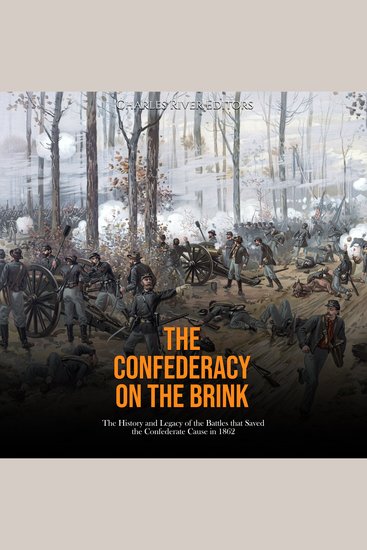
    As Union commander George McClellan moved the Army of the Potomac up the Peninsula in early 1862, the Union army had a nearly 2-1 advantage in manpower, so Army of Northern Virginia commander Joseph E. Johnston continued to gradually pull his troops back to a line of defense nearer Richmond as McClellan advanced. In conjunction, the Union Navy began moving its operations further up the James River, until it could get within 7 miles of the Confederate capital before being opposed by a Southern fort.  
    It was at this point that Johnston got uncharacteristically aggressive at the end of May, perhaps because he had run out of breathing space for his army. By the time the Battle of Seven Pines was over, nearly 40,000 had been engaged on both sides, making it the biggest battle in the Eastern theater to date, and Johnston was injured, bringing Robert E. Lee to command. 
    Despite not losing, the fighting rattled McClellan, but even after Lee pushed McClellan’s Army of the Potomac away from Richmond and back up the Peninsula in late June, he then had to swing his army north to face a second Union army: John Pope’s Army of Virginia. Correctly assuming that he needed to strike out before the Army of the Potomac successfully sailed back to Washington and linked up with Pope’s army, Lee daringly split his army to threaten Pope’s supply lines, forcing Pope to fall back to Manassas to protect his flank and maintain his lines of communication. At the same time, it left half of Lee’s army (under Stonewall Jackson) potentially exposed against the larger Union army until the other wing (under James Longstreet) linked back up. Thus, in late August 1862, the Army of Northern Virginia and the Army of Virginia found themselves fighting over nearly the exact same land the North and South fought over in the First Battle of Bull Run 13 months earlier. 
    Show book
  • Crime and Civilization - The Birth of Criminology in the Early Nineteenth Century - cover

    Crime and Civilization - The...

    Janne Kivivuori

    • 0
    • 0
    • 0
    In 1827 the first modern national crime statistics were published: the Compte général de l'administration de la justice criminelle en France. Before the onset of data criminology, the perception of crime relied on sources from classical antiquity, rational philosophical thought, travellers' observations, and unsystematic observations by criminal justice practitioners. With the new concept of national crime statistics, it became possible to test theories and hypotheses about crime using a shared data instrument, leading to an unprecedented avalanche of crime research by continental scholars. 


    Crime and Civilization: The Birth of Criminology in the Early Nineteenth Century explores the rise of data-based criminology as an intellectual field in continental Europe in the early nineteenth century. Janne Kivivuori creates a new interpretation of the era of "first criminology," one approached from the perspective of data and instruments, thus complementing the traditional story based on theories and explanatory shifts from "classicism" to "positivism" and beyond. Drawing on original French, German, and English publications, the book contextualizes the rise of criminology in wider cultural history, spanning from Enlightenment philosophers to the general rise of science in society.
    Show book