Join us on a literary world trip!
Add this book to bookshelf
Grey
Write a new comment Default profile 50px
Grey
Subscribe to read the full book or read the first pages for free!
All characters reduced
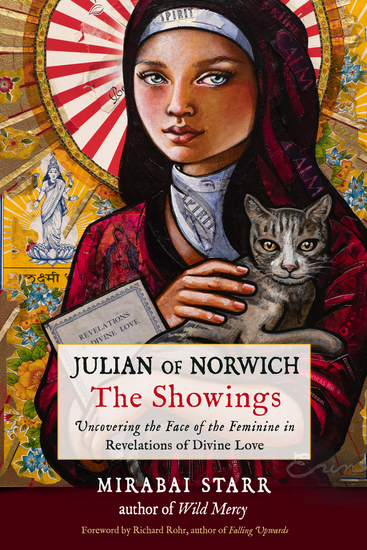
Julian of Norwich: The Showings - Uncovering the Face of the Feminine in Revelations of Divine Love - cover

Julian of Norwich: The Showings - Uncovering the Face of the Feminine in Revelations of Divine Love

Mirabai Starr

Publisher: Hampton Roads Publishing

  • 0
  • 0
  • 0

Summary

"As a major fan and promoter of Julian of Norwich, whom I call 'my favorite mystic', it is genuinely exciting to find such a faithful but freeing translation of Julian's long-lost Showings. Now they are no longer lost—for anyone!" —Fr. Richard Rohr, O.F.M., Center for Action and ContemplationIn this contemporary translation of one of the most beloved and influential mystical texts of all time, Julian of Norwich: The Showings brings the message and spirituality of this 14th-century mystic to 21st-century readers. Revelations of Divine Love, the first book published in English attributed to a woman, is also included.Julian of Norwich, a contemporary of Geoffrey Chaucer, was an English anchoress in East Anglia. At the age of 30, suffering from a severe illness and believing she was on her deathbed, Julian had a series of intense visions of Jesus, which she recorded and then expanded on later in her life. In her visions, God was not angry and wrathful. Instead, the three properties of God were presented as life, love, and light, and all of His creation was good, including his servant, man. In Julian's version, man is not to blame for his sin; sin is something that he must experience and overcome in his spiritual journey with God.Her message for today's readers is simply this:She reveals the feminine face of the Divine and reminds us to see God there.All our failings are an opportunity to learn and grow; they should be honored, but not dwelled upon.God's love has nothing to do with love and retribution and everything to do with love and compassion.In spite of all appearances, all is well. This book contains some of the most profound spiritual writing ever written and remains a perennial favorite among Christians.This book was previously published as The Showings of Julian of Norwich. This new edition includes a foreword by Richard Rohr, author of Falling Upwards.
Available since: 04/01/2022.
Print length: 256 pages.

Other books that might interest you

  • Big Boys' Rules - The SAS and the Secret Struggle Against the IRA - cover

    Big Boys' Rules - The SAS and...

    Mark Urban

    • 0
    • 0
    • 0
    In 2007, after almost 40 years of operations, the SAS ceased operations in Northern Ireland and ended the longest operational commitment in the unit's history. It had been a brutal and ruthless conflict on both sides with the SAS famously describing its attitude to the use of lethal force as 'Big Boys' Rules'. Anyone suspect caught with a gun or bomb could expect to be shot without question.Starting in 1969, Mark Urban reveals the extraordinary history of the special forces' operations in Northern Ireland and the unenviable dilemmas faced by intelligence chiefs engaged in a daily struggle against one of the world's most sophisticated terrorist organisations.'This is a book that needed to be written and which fulfils the essentials of any Ulster story; it expands understanding beyond fragmented jingoism and newspaper headlines.' Sunday Times
    Show book
  • Critias - The Lost Story of Atlantis – A Fragment on Power Decline and Civilization - cover

    Critias - The Lost Story of...

    Plato, Tim Zengerink

    • 0
    • 0
    • 0
    What if the lost world of Atlantis was more than just a legend—what if it was a prophecy? 
    In Critias, Plato recounts the rise and fall of Atlantis—an empire of incredible wealth and power that crumbled due to its own moral failure. Though only a fragment remains, its impact is enduring. 
    What you'll discover inside: 
    •	The Myth of Atlantis – One of the earliest and most powerful visions of a lost civilization. 
    •	A Moral and Political Allegory – A deep reflection on the perils of corruption and unchecked ambition. 
    •	Philosophical and Historical Significance – An essential part of Plato’s political thought and a foundational myth of Western culture. 
    •	A Timeless Warning – Relevant to any age facing questions of leadership, balance, and societal decay. 
    •	Critias is more than a myth—it’s a haunting vision of what we stand to lose when wisdom is cast aside for power. 
    Start listening today and unlock the secrets of Atlantis.
    Show book
  • My March Through Hell - A Young Girl's Terrifying Journey to Survival - cover

    My March Through Hell - A Young...

    Halina Kleiner, Edwin Stepp

    • 0
    • 0
    • 0
    A young girl is suddenly all alone and on the run from the Nazis in her hometown in Poland. Having survived an aktion that was intended to completely rid Czestochowa of all the Jews, she and her father try to make their way back to their home during the late hours of the night. 


    Confronted by a policeman, Halina Goldberg unexplainably runs away from her father and begins her long journey of survival. When tired of fleeing, she volunteers to go into a work camp. That decision buys her some time because the Germans need labor for the war effort. Halina works in three different camps from the Fall of 1943 to January 1945. At first, the camps are bearable, even though the prisoners are worked hard and fed very little. But as the Germans begin to lose the war, the conditions turn deathly. The Jews become overrun with disease and their captors grow crueler and crueler. 


    As it becomes clear that the war is lost, the SS empty the camps and set over 2,000 women on a four-month long march that would cover over 800 kilometers during one of Europe's coldest winters on record. Halina was one of the only 300 who survived the Volary Death March and finally felt the need to record her hellish story of survival.
    Show book
  • Dr Heidigger's experiment - From their pens to your ears genius in every story - cover

    Dr Heidigger's experiment - From...

    Nathaniel Hawthorne

    • 0
    • 0
    • 0
    Nathaniel Hawthorne was born on 4th July 1804 in Salem, Massachusetts, a town synonymous with the earlier Salem Witch Trials. It was instrumental in Hawthorne’s later use of American Gothic and dark romanticism in his writing. 
    He was a mere four years old when his father died and his mother took him and his two sisters to live with her family and then on to their own home in Raymond, Maine. The young Hawthorne had a passion for fiction and poetry and voraciously read the works of Ann Radcliffe, Henry Fielding and Lord Byron.  
    He was sent to college at his maternal uncle’s insistence. During these years he met and befriended Henry Wadsworth Longfellow and future U S president Franklin Pierce. These friendships were lifelong and to have a crucial impact on his writings and career.  
    At college Hawthorne had made attempts at writing short stories and essays but without opportunities to publish. It was only in 1828 that he finally published his novel ‘Franshawe’ to little success and so he began work as editor for the American Magazine of Useful and Entertaining Knowledge.  
    Hawthorne’s short stories were first published in magazines but in 1837 were collected and published as ‘Twice-Told Tales’. A steady literary career still did not come his way and so he worked in a good position at Salem’s port and married the love of his life Sophia Peabody. They moved to live in ‘The Old Manse’ at Concord, Massachusetts.   
    Finally. in 1850 came spectacular literary and commercial success with ‘The Scarlet Letter’ followed by ‘The House of the Seven Gables’ the following year.  
    In 1852, Hawthorne published a biography of presidential candidate Franklin Pierce. After Pierce’s victory he was appointed consul in Liverpool, a position that offered prestige, money and fame. At the end of this appointment he returned several times to Europe before settling in Massachusetts and resuming writing and publication. 
    During the early 1860’s his health declined and on 19th May 1864 during a trip to Plymouth, New Hampshire. He was 59 and was buried in Sleepy Hollow Cemetery in Concord, Massachusetts.
    Show book
  • Small Steps Long Journey - cover

    Small Steps Long Journey

    Eric Inouye

    • 0
    • 0
    • 0
    In August of 1985, a drunk driver torpedoed through his red light and blasted into my smaller mini truck. Instantly I fell comatose for nine weeks, but the real story is in my tenacity to overcome obstacles in my life that were not there before. 
    As an athlete through school, I succumbed to a life far different than the playing field. Faced with difficulties that were taken for granted, suddenly my world became a battlefield just to survive. I take the reader on a voyage into the unknown disabled community, where I candidly express my emotions. The accident left me vulnerable, which allowed my father in close. We were both too stubborn to show weakness and that kept us apart. 
    My hopes are to share my story and inspire those who are injured everyday, whether it is doctors & nurses or families & friends of those who receive care. I take the reader on a journey where hopefully you can find comfort in one person's survival.
    Show book
  • Will I Hate Myself? - A Story About Going For It - cover

    Will I Hate Myself? - A Story...

    Pat Treuer

    • 0
    • 0
    • 0
    What if chasing your dream didn’t lead to fame or fortune—but to something far more honest? 
    At 36, Pat Treuer had the life people post about: six-figure job, corporate status, an apartment with a skyline view—and a quiet voice in his head screaming, “Is this it?” So he did what any rational person would do: he walked away from it all to tell jokes in bars for drink tickets and half-interested crowds. 
    Then came the pandemic. Pat launched a comedy business that brought in a million dollars—then reinvested every penny into a YouTube series that made exactly zero. Not a typo. Zero. 
    By 42, he found himself not chasing the next punchline, but rebuilding a life from scratch. On purpose, this time. 
    Will I Hate Myself is a hilariously raw, painfully honest memoir about risking everything, failing gloriously, and learning to create a life that actually fits. It’s part comedy crash reel, part spiritual sledgehammer. 
    If you’ve ever wondered whether you waited too long to change your life, felt stuck in a “successful” version of someone else’s dream, or asked yourself, “Is this all there is?”—this book is for you. 
    Through panic attacks, bad gigs, and moments of absurd grace, Pat offers more than laughs—he offers proof that it’s never too late to go off-script and start telling the truth. 
    This isn’t about making it. It’s about making it count.
    Show book