Join us on a literary world trip!
Add this book to bookshelf
Grey
Write a new comment Default profile 50px
Grey
Subscribe to read the full book or read the first pages for free!
All characters reduced
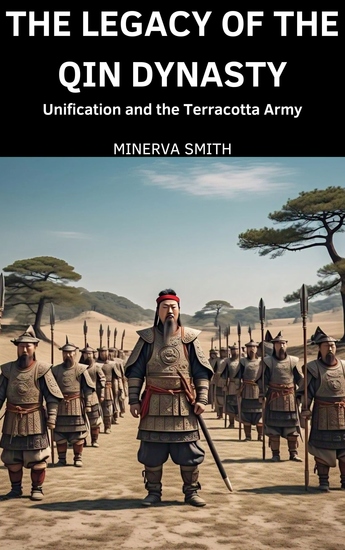
The Legacy of the Qin Dynasty - Unification and the Terracotta Army - cover

The Legacy of the Qin Dynasty - Unification and the Terracotta Army

Minerva Smith

Publisher: Heritage Books

  • 0
  • 0
  • 0

Summary

The Qin Dynasty was short-lived, but its impact on China was nothing short of revolutionary. From the unification of warring states to the construction of the Great Wall's first sections, the Qin laid the foundation for an empire that would endure for centuries. This book explores the rise and rule of Qin Shi Huang, China's first emperor, whose vision transformed a fragmented land into a powerful state.


At the heart of this legacy stands the awe-inspiring Terracotta Army, a vast underground force built to guard the emperor in the afterlife. Through historical analysis and archaeological discoveries, this book brings to life the military strategies, governance, and cultural advancements that defined the Qin era.


Step into the world of ancient China and uncover how one dynasty changed the course of history forever.
Available since: 02/12/2025.
Print length: 62 pages.

Other books that might interest you

  • Historical Mysteries - Unraveling the Secrets of the Past (9 in 1) - cover

    Historical Mysteries -...

    John Harpoon

    • 0
    • 0
    • 0
    This book contains 9 mysterious cases and stories from real life: 
    - The Amelia Earhart Mystery 
    - The Shakespeare Conundrum 
    - Rewriting the History of the Black Death 
    - Royal Tragedy Revisited 
    - History's Most Eccentric Rulers 
    - History of Assassins 
    - The Most Enigmatic Woman in History 
    - The Most Fascinating Man in the World 
    - The Great Beyond
    Show book
  • Revisiting the Titanic: The Exploration of the Wreck and Current Controversies Surrounding the World’s Most Famous Ship - cover

    Revisiting the Titanic: The...

    Editors Charles River

    • 0
    • 0
    • 0
    In the over 100 years since it sank on its maiden voyage, the Titanic has been the subject of endless fascination, as evidenced by the efforts to find its final resting spot, the museums full of its objects, and the countless books, documentaries, and movies made about the doomed ocean liner. Thanks to the dramatization of the Titanic’s sinking and the undying interest in the story, millions of people are familiar with various aspects of the ship’s demise, and the nearly 1,500 people who died in the North Atlantic in the early morning hours of April 15, 1912. The sinking of the ship is still nearly as controversial now as it was over 100 years ago, and the drama is just as compelling.  
    	In the century since the Titanic sank, public interest in the ship and its history has waxed and waned on a regular basis. There was a flurry of activity right after it went down, as people tried to wrap their minds around what happened, but the World Wars pushed attention elsewhere. Then, during the 1950s, scientists had the time and money to become interested in it again. While there were numerous attempts to find that ship during the 1970s, the mighty ship still kept her secrets, her dead and their possessions safely at the bottom of the sea, where only strange creature comfortable in the depths could disturb them. 
    	As it turned out, the most famous wreck in the world would not be located until 1985, over 70 years after the ship sank that fateful April night. The discovery ignited a new flurry of interest in Titanic, including an interest in what the wreck still held, who those items belonged, to and what should be done with them. The 1997 blockbuster movie about the ship only stirred up more interest and controversy, both of which continue to this day. 
    Show book
  • Transformative Horizons - Exploring the Future of Online Education - cover

    Transformative Horizons -...

    Nova Wilde

    • 0
    • 0
    • 0
    Whether you are an educator, a student, a parent, or simply a curious mind, "Transformative Horizons: Exploring the Future of Online Education" offers a compelling vision of how digital learning is reshaping our world. Embrace the possibilities, challenge the status quo, and join the conversation about the future of education.
    Show book
  • Wait Five Minutes - Weatherlore in the Twenty-First Century - cover

    Wait Five Minutes - Weatherlore...

    Shelley Ingram, Willow G. Mullins

    • 0
    • 0
    • 0
    The weather governs our lives. It fills gaps in conversations, determines our dress, and influences our architecture. No matter how much our lives may have moved indoors, no matter how much we may rely on technology, we still monitor the weather. Wait Five Minutes: Weatherlore in the Twenty-First Century draws from folkloric, literary, and scientific theory to offer up new ways of thinking about this most ancient of phenomena. 


    Weatherlore is a concept that describes the folk beliefs and traditions about the weather that are passed down casually among groups of people. From detailing personal experiences at picnics and suburban lawns to critically analyzing storm stories, novels, and flood legends, contributors offer engaging multidisciplinary perspectives on weatherlore. 


    As we move further into the twenty-first century, an increasing awareness of climate change and its impacts on daily life calls for a folkloristic reckoning with the weather and a rising need to examine vernacular understandings of weather and climate. Weatherlore helps us understand and shape global political conversations about climate change and biopolitics at the same time that it influences individual, group, and regional lives and identities. We use weather, and thus its folklore, to make meaning of ourselves, our groups, and, quite literally, our world.
    Show book
  • The Antichrist - cover

    The Antichrist

    Friedrich Nietzsche

    • 0
    • 0
    • 0
    "The Antichrist" is a philosophical work by Friedrich Nietzsche, written in 1888 as part of his critique of organized religion, particularly Christianity. In this book, Nietzsche sharply criticizes the morality and values of Christianity, presenting his ideas on the concept of the "Antichrist" as a figure opposed to Christian doctrine and morality. He delves into topics such as the decline of Christianity, the nature of morality, the will to power, and the reevaluation of values.
    Show book
  • The Nile's Gift - The Story of Ancient Egypt - cover

    The Nile's Gift - The Story of...

    Priyank Agrawal

    • 0
    • 0
    • 0
    The Nile's Gift: The Story of Ancient Egypt is an immersive journey through one of the world’s most fascinating and enduring civilizations. From the lush banks of the Nile to the towering pyramids and majestic temples, this book explores the rich tapestry of ancient Egyptian history, culture, and religion. It delves into the lives of the pharaohs, the complexities of their society, and the grandeur of their architectural and artistic achievements. 
    In vivid detail, this work uncovers the mysteries of Egypt’s monumental past, from the unification of Upper and Lower Egypt to the rise of the New Kingdom, and the profound influence of Egyptian mythology, art, and science on the modern world. The book also explores the rich legacy of ancient Egypt in shaping contemporary architecture, art, religion, and governance. 
    Through captivating storytelling and scholarly analysis, The Nile’s Gift paints a comprehensive portrait of Egypt’s glory and its lasting impact on the world. With a focus on both historical figures like the boy king Tutankhamun and the visionary Hatshepsut, and the secrets of daily life, religion, and the afterlife, this book invites readers to discover why Egypt’s story still matters today. Rich in detail, deeply researched, and beautifully written, it is a celebration of a civilization that continues to captivate and inspire people across the globe.
    Show book