Join us on a literary world trip!
Add this book to bookshelf
Grey
Write a new comment Default profile 50px
Grey
Subscribe to read the full book or read the first pages for free!
All characters reduced
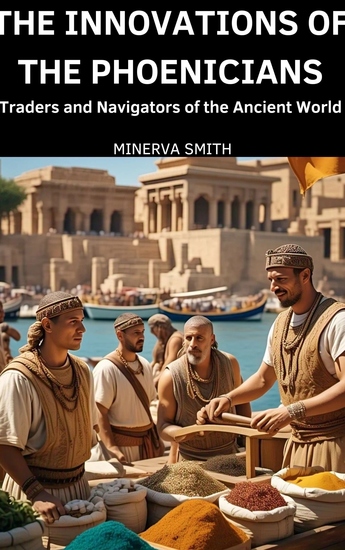
The Innovation of the Phoenicians - Traders and Navigators of the Ancient World - cover

The Innovation of the Phoenicians - Traders and Navigators of the Ancient World

Minerva Smith

Publisher: Heritage Books

  • 0
  • 0
  • 0

Summary

The Phoenicians were more than just legendary seafarers. They were innovators who revolutionized trade, navigation, and communication in the ancient world. From perfecting maritime technology to developing one of history’s first alphabets, their influence stretched across the Mediterranean, shaping the civilizations that followed.


This book explores the groundbreaking achievements of the Phoenicians, their advanced shipbuilding techniques, extensive trade networks, and the cultural exchanges that connected distant lands. Discover how these master traders laid the foundations for modern commerce, inspired future explorers, and left a lasting legacy that still echoes in today’s world.


For history enthusiasts, maritime scholars, and anyone fascinated by ancient ingenuity, this compelling account brings to life the Phoenicians’ remarkable contributions to human progress.
Available since: 02/06/2025.
Print length: 57 pages.

Other books that might interest you

  • Lysis - A Philosophical Inquiry into Friendship – What Does It Mean to Truly Love Another? - cover

    Lysis - A Philosophical Inquiry...

    Plato, Tim Zengerink

    • 0
    • 0
    • 0
    What if the most meaningful love wasn’t romantic—but philosophical? 
    In Lysis, Plato invites us into one of his most tender and insightful dialogues—a search for the essence of friendship. As Socrates speaks with the youthful Lysis and Menexenus in a schoolyard setting, what begins as a lighthearted exchange becomes a profound meditation on affection, admiration, and the soul’s need for connection. 
    This modern audiobook adaptation offers a heartfelt and accessible journey into one of the most enduring philosophical questions: what does it mean to truly love a friend? 
    What you’ll discover inside: 
    •	A gentle philosophical dialogue exploring the foundation of friendship 
    •	A soulful meditation on what makes relationships meaningful and lasting 
    •	Timeless questions about affection, virtue, and self-knowledge 
    •	A fluid, modern translation perfect for contemplation and connection 
    Whether you're reflecting on lifelong friends or seeking deeper connection, Lysis is a lyrical and lasting companion.
    Show book
  • God's Own Gentlewoman - The Life of Margaret Paston - cover

    God's Own Gentlewoman - The Life...

    Diane Watt

    • 0
    • 0
    • 0
    The remarkable story of Margaret Paston, whose letters form the most extensive collection of personal writings by a medieval English woman. 
     
    Drawing on the largest archive of medieval correspondence relating to a single family in the UK, God's Own Gentlewoman explores what everyday life was like during the turbulent decades at the height of the Wars of the Roses. Covering topics including political conflicts and familial in-fighting; forbidden love affairs and clandestine marriages; bloody battles and sieges; fear of plague and sudden death; friendships and animosity; and childbirth and child mortality, Margaret's letters provide us with unparalleled insight into all aspects of life in late medieval England. 
     
    Diane Watt is a world expert on medieval women's writing, and God's Own Gentlewoman explores how Margaret's personal archive provides an insight into her activities, experiences, emotions and relationships, as well as the life of a medieval woman who was at times absorbed by the mundane and domestic, but who found herself caught up in the most extraordinary situations and events.
    Show book
  • Influence - cover

    Influence

    Robert Cialdini

    • 0
    • 0
    • 0
    This work provides a concise synthesis of the key insights and analysis from Influence. It is an independent summary, not the original book, and has no affiliation with or endorsement from the original publication. Created for readers who want a clear, thought-provoking overview, it distills the central themes and ideas while preserving the depth and relevance of the work. 
    A classic exploration of the psychology of persuasion, explaining the key principles that make people say “yes” in sales, marketing, politics and everyday life. Drawing on experiments and real-world examples, it reveals how reciprocity, social proof, liking, authority, scarcity and consistency shape our choices, often without our awareness.
    Show book
  • From Tension to Transformation - A Leader's Guide to Generative Change - cover

    From Tension to Transformation -...

    Janet M. Harvey

    • 0
    • 0
    • 0
    How do we embrace being generative to sustain excellence in the workplace?The modern working world doesn't leave much time for reflection. Leaders in particular are encouraged to speed ahead, make quick decisions, and seek swift solutions to any problem that may arise. However, the full-speed-ahead approach can backfire. By taking time to pause and reflect, it’s possible to notice new pathways and develop innovative solutions that allow for impactful results.Executive coach Janet M. Harvey has worked with leaders and teams around the world to explore the common tensions that arise in the workplace. Her conclusion? Tension in the workplace is inevitable. It’s how you navigate it that determines whether you will sustain excellence—or flame out.In this book, Janet explores the vehicle of generative change as one way to navigate tension in the workplace. Using real-life case studies and personal anecdotes, she compiles decades of her work as a coach to introduce readers to the vehicle of generative change. Each chapter includes activities and reflection exercises, making this an actionable guide that anyone can use to explore the value of generative change for themselves.
    Show book
  • How to Make a Home - An Ancient Guide to Style and Comfort - cover

    How to Make a Home - An Ancient...

    Vitruvius

    • 0
    • 0
    • 0
    An entertaining and enlightening collection of ancient Roman writings about home design and decoration 


    The idea that our homes can communicate professional as well as personal identities may seem as new as the work-from-home revolution. But it was second nature to the ancient Romans, for whom the home was in many ways the center of public and private life. Roman authors saw infinite practical and symbolic value in houses, and they have much to say about them. How to Make a Home presents some of the best Roman writings on houses—from buying and selling to designing and decorating. 


    Edited and elegantly translated by Marden Fitzpatrick Nichols, How to Make a Home gathers selections by Cicero, Vitruvius, Seneca, and others. These writings reveal the pleasures and pitfalls of the Roman practice of making one's home a cornerstone of self-expression. While the ideal home enshrined Roman virtues and could make a career, lavish building projects could lead to financial ruin and moral condemnation. These authors memorably describe such travails as deceptive staging, decorators run amok, know-it-all owners, unsupervised contractors, and buyer's remorse. Along the way, they also explain why simplicity is bliss, privacy is for nobodies, a neglected house is a sign of a neglected soul, and much more.
    Show book
  • The Han Dynasty - Golden Age of Chinese Civilization - cover

    The Han Dynasty - Golden Age of...

    Jun Liu

    • 0
    • 0
    • 0
    The Han Dynasty, one of the most influential periods in Chinese history, emerged from the collapse of the Qin Dynasty in 206 BCE. After years of harsh rule under Qin Shi Huang, widespread unrest and rebellion led to the fall of the Qin. In the power vacuum that followed, Liu Bang, a commoner-turned-military leader, rose to prominence and ultimately established the Han Dynasty. His leadership and political acumen laid the foundation for a dynasty that would last over four centuries, shaping China’s governance, culture, and identity. 
    Liu Bang, later known as Emperor Gaozu, was originally a minor official under the Qin. Unlike his aristocratic rivals, he came from humble origins, making him a unique figure in Chinese history. As the Qin administration crumbled due to heavy taxation and forced labor policies, numerous factions vied for control. The most significant of these was the Chu-Han Contention, a prolonged struggle between Liu Bang and Xiang Yu, a powerful general of noble descent. Liu Bang, known for his ability to rally support from various social classes, ultimately defeated Xiang Yu at the Battle of Gaixia in 202 BCE. This victory marked the official beginning of the Han Dynasty, with Liu Bang declaring himself emperor. 
    Once in power, Liu Bang sought to distance his rule from the harsh legalist policies of the Qin. He adopted a more lenient and pragmatic approach, blending Confucian ideals with centralized governance. Although he retained elements of Qin’s bureaucratic structure, he reduced the severity of laws and punishments, earning the trust of the people. To ensure stability, he granted land and titles to his loyal followers, creating a semi-feudal system that allowed regional kings to govern under the central authority of the emperor. This balance between centralization and decentralization was a defining characteristic of early Han rule.
    Show book