Join us on a literary world trip!
Add this book to bookshelf
Grey
Write a new comment Default profile 50px
Grey
Subscribe to read the full book or read the first pages for free!
All characters reduced
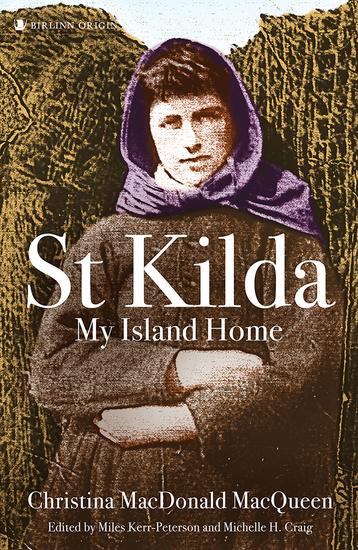
St Kilda: My Island Home - Christina MacDonald MacQueen - cover

St Kilda: My Island Home - Christina MacDonald MacQueen

Miles Kerr-Peterson, Michelle H Craig

Publisher: Origin

  • 0
  • 0
  • 0

Summary

Christina MacDonald MacQueen (1884–1959) was born on St Kilda and grew up there at the close of the 19th century. Yearning for the bright modern world beyond the island, she was the first woman to leave of her own accord in 1909, settling in Glasgow. During the crisis that led to the islands' evacuations in 1929-30, she wrote a series of passionate articles about her childhood and the history of the islands. These writings about St Kilda offer a personal and uniquely female perspective on the island's story and its imminent abandonment.
This book includes all seventeen of her articles, which tell the full history of the island as she understood it, and sets their publication against the dates of the evacuation. These are complemented by a historical introduction and commentary. Despite extensive literature on the story of St Kilda, Christina's contributions have been largely overlooked by historians, though they offer valuable insights into the island's history and the evacuation's impact. To compliment the articles written by Christina, this volume includes a collection of photographs taken by her husband, Robert Chalmers, in 1930.
Available since: 04/24/2025.
Print length: 176 pages.
Other books that might interest you

  • The Half-life of Snails - cover

    The Half-life of Snails

    Philippa Holloway

    • 0
    • 0
    • 0
    'a novel that shimmers with compassion... the author has crafted a tale that will linger longer than the half-life of many other books you will read this year.' – Alex Lockwood, author of The Chernobyl Privileges
    'A careful, tender and arresting story that explores how we're formed by the places we think we own – I was moved by this suspenseful and delicate novel.' – Jenn Ashworth, author of Ghosted
    Two sisters, two nuclear power stations, one child caught in the middle...
    When Helen, a self-taught prepper and single mother, leaves her young son Jack with her sister for a few days so she can visit Chernobyl's Exclusion Zone, they both know the situation will be tense. Helen opposes plans for a new power station on the coast of Anglesey that will take over the family's farmland, and Jennifer works for the nuclear industry and welcomes the plans for the good of the economy.
    But blood is thicker than heavy water, and both want to reconnect somehow, with Jack perhaps the key to a new understanding of one another.
    Yet while Helen is forced to face up to childhood traumas, and her worst fears regarding nuclear disaster, during a trip that sees her caught up in political violence and trapped in Chernobyl's Exclusion Zone during the 2014 Euromaidan revolution, Jennifer too must discover that even the smallest decision can have catastrophic and long-lasting effects, both within the nuclear industry, and within the home.
    And Jack isn't like other five-year olds... as they will both discover with devastating consequences.
    Show book
  • Do the Birds Still Sing in Hell? - cover

    Do the Birds Still Sing in Hell?

    Horace Greasley

    • 0
    • 0
    • 0
    Even in the most horrifying places on earth, hope still lingers in the darkness, waiting for the opportunity to take flight. 


    When war was declared Horace Greasley was just twenty-years old. After seven weeks' training with the 2/5th Battalion, the Royal Leicestershire Regiment, Horace found himself facing the might of the German Army in a muddy field south of Cherbourg, in northern France, with just thirty rounds in his ammunition pouch. 


    Horace's war didn't last long . . . On May 25, 1940 he was taken prisoner and so began the harrowing journey to a prisoner-of-war camp in Poland. Those who survived the grueling ten-week march to the camp were left broken and exhausted, all chance of escape seemingly extinguished. 


    But when Horace met Rosa, the daughter of one of his captors, his story changed; fate, it seemed, had thrown him a lifeline. Horace risked everything in order to steal out of the camp to see his love, bringing back supplies for his fellow prisoners. In doing so he offered hope to his comrades, and defiance to one of the most brutal regimes in history.
    Show book
  • World Citizen Journeys of a Humanitarian - cover

    World Citizen Journeys of a...

    Jane Olson

    • 0
    • 0
    • 0
    These stories are about light and hope in the midst of unimaginable human suffering in war zones and places of extreme poverty around the world. Important lessons from a childhood in rural western Iowa are woven throughout, as are examples of human strength and resiliency. Each chapter can be read as a complete experience. Intimate details recorded by the author in journals and on film take the reader on memorable journeys with international human rights and humanitarian organizations. Despite being plunged into war zones, crowded refugee camps, and some of the poorest and most disease-affected places on the planet, we learn the life-saving impact of humanitarian intervention, the healing power of community, the importance of justice, and the truth that one caring person can indeed make a difference. To be a World Citizen is to embrace and champion the Universal Declaration of Human Rights, knowing that all lives are valuable and equally deserving of protection and support.
    Show book
  • A Rare Recording of Jim Garrison - cover

    A Rare Recording of Jim Garrison

    Jim Garrison

    • 0
    • 0
    • 0
    Jim Garrison (1921-1992) was the District Attorney of Orleans Parish, Louisiana, from 1962 to 1973. He is best known for his investigations into the assassination of President John F. Kennedy. Garrison was able to subpoena the Zapruder film from Life magazine. As a result, the American public was able to see the film for the first time. Garrison made the case that the Kennedy assassination was too complex to be carried out by Oswald alone. Later, he was played by Kevin Costner in Oliver Stone's 1991 feature film, "JFK." This recording is part of a speech he gave on the assassination.
    Show book
  • Boring Ancient Civilization Facts for Sleep - cover

    Boring Ancient Civilization...

    Drowsy Facts

    • 0
    • 0
    • 0
    Drift off to sleep while exploring the most intriguing and surprisingly dull details of ancient civilizations. This audiobook gently guides you through the fascinating yet unhurried world of early human societies, making it the perfect companion for bedtime listening. Each fact is crafted to be calm, slow-paced, and easy to follow—just right for soothing your mind and helping you relax. 
    From the humble beginnings of farming communities to the rise of mighty empires, you’ll uncover unusual yet non-dramatic tidbits about the Sumerians, Egyptians, Mayans, Greeks, Romans, and more. Learn about forgotten inventions, obscure rituals, ancient tools, and daily routines that shaped early human life. These facts are intentionally presented without suspense or urgency, helping you unwind and let go of the day’s stress. 
    Whether you’re a history enthusiast looking for a tranquil way to learn or simply someone who struggles to fall asleep, this audiobook provides a gentle journey into the distant past. Close your eyes, breathe deeply, and let these calming stories of ancient civilizations ease you into a restful night’s sleep.
    Show book
  • Australian Frontier Wars The: The History of the Conflicts Between Indigenous Groups and Colonists across Australia - cover

    Australian Frontier Wars The:...

    Editors Charles River

    • 0
    • 0
    • 0
    A land of almost 3 million square miles has lain since time immemorial on the southern flank of the planet, so isolated that it remained entirely outside of European knowledge until 1770. However, the first human footprints on this vast territory were felt 70,000 years earlier, as people began to cross the periodic land bridges and the short sea crossings from Southeast Asia. 
    The history of the indigenous inhabitants of Australia, known in contemporary anthropology as the “Aboriginal and Torres Strait Islander people of Australia,” is a complex and continually evolving field of study, and it has been colored by politics. For generations after the arrival of whites in Australia, the Aboriginal people were disregarded and marginalized, largely because they offered little in the way of a labor resource, and they occupied land required for European settlement. 
    At the same time, it is a misconception that indigenous Australians meekly accepted the invasion of their country by the British, for they did not. They certainly resisted, but as far as colonial wars during that era went, the frontier conflicts of Australia did not warrant a great deal of attention. Indigenous Australians were hardly a warlike people, and without central organization, or political cohesion beyond scattered family groups, they succumbed to the orchestrated advance of white settlement with passionate, but futile resistance. In many instances, aggressive clashes between the two groups simply gave the white colonists reasonable cause to inflict a style of genocide on the Aborigines that stood in the way of progress. 
    Show book