Join us on a literary world trip!
Add this book to bookshelf
Grey
Write a new comment Default profile 50px
Grey
Subscribe to read the full book or read the first pages for free!
All characters reduced
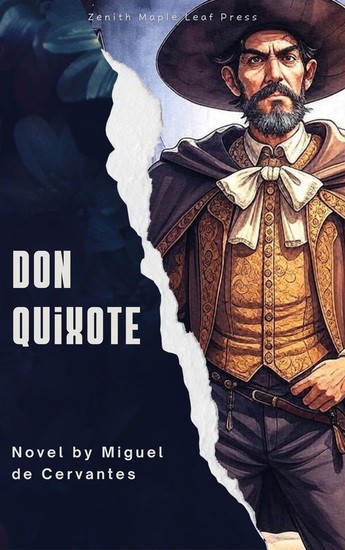
Don Quixote - The Timeless Masterpiece of Chivalry Humor and Humanity - cover

Don Quixote - The Timeless Masterpiece of Chivalry Humor and Humanity

Miguel de Cervantes, Zenith Maple Leaf Press

Publisher: Zenith Maple Leaf Press

  • 0
  • 0
  • 0

Summary

"A dreamer, a knight, and a story that changed literature forever."

Miguel de Cervantes' Don Quixote is widely regarded as the first modern novel and one of the greatest works in world literature. Published in two parts (1605 and 1615), this enduring classic follows the misadventures of Don Quixote de la Mancha, a gentleman so enchanted by tales of knighthood that he sets out to revive chivalry—accompanied by his loyal squire, Sancho Panza.

Their journey is filled with comic encounters, mistaken identities, and timeless reflections on idealism, love, and the blurred line between reality and imagination. From tilting at windmills to heartfelt lessons on honor, loyalty, and hope, Cervantes blends humor with deep human insight in a way that remains fresh and powerful centuries later.

🌟 Why Readers Love This Book:

Hailed as one of the greatest novels ever written by critics and scholars.

A rich mix of humor, satire, and profound philosophy.

A timeless tale of dreams, madness, and the human spirit.

This edition brings you Cervantes' immortal masterpiece—a work that has inspired countless writers, artists, and thinkers throughout history.

🎯 Embark on the unforgettable journey of Don Quixote and Sancho Panza—Click "Buy Now" to own this literary treasure today!
Available since: 08/19/2025.
Print length: 1274 pages.

Other books that might interest you

  • The Power of Citizenship - Why John F Kennedy Matters to a New Generation - cover

    The Power of Citizenship - Why...

    Scott D. Reich

    • 0
    • 0
    • 0
    Fifty years after John F. Kennedy's death, we find ourselves enmeshed in an era of political division and cynicism, where politicians talk past one another and the spirit of “Ask not what your country can do for you—ask what you can do for your country"" is less visible than it should be. We seem to have forgotten that we're all on the same team. Fortunately, Scott D. Reich has given us The Power of Citizenship, a timely book to bring us back on track. 
    Reich asserts that the most powerful element of Kennedy's legacy is his emphasis on the theme of citizenship, and that a rededication to the values Kennedy promoted will shine a bright path forward for our country. Evoking the hopes and aspirations of the 1960s, Reich recaptures the excitement of the Kennedy era. But what truly sets this book apart is the unique way it blends the romance of Camelot with the new frontiers of today—not only identifying modern challenges, but also offering a tangible blueprint for how we can improve our public discourse, be good citizens, and lift our nation to new heights of greatness. 
    Part history and part call to action, The Power of Citizenship hones in on the very essence of what made JFK so inspirational and timeless, reminding us once again that we must ask what we can do for our country. This is a must-read for Americans of all generations.
    Show book
  • Dome of the Rock and the Church of the Holy Sepulchre The: The History of Medieval Jerusalem’s Most Famous Sites - cover

    Dome of the Rock and the Church...

    Charles River Editors

    • 0
    • 0
    • 0
    The most famous church in Jerusalem for nearly 2,000 years, the Church of the Holy Sepulchre, often called the Church of the Resurrection, was built in the era of St. Constantine, and the church as a structure has no history separable from the city of Jerusalem and its environs. It is venerated as being on the site where Jesus was crucified and buried, and naturally, making it a crucial pilgrimage site for Christians, and it is now the home of the Greek Orthodox Jerusalem Patriarchate. Moreover, it was the site of many important councils, some of which altered Christian history forever. In short, the Sepulchre was and is synonymous with Jerusalem, and it was essentially the nodal center of the city.  
    Naturally, the Church has had a turbulent history just as Jerusalem has. The evidence that Christ's tomb was at that location was backed by the apostolic tradition and basic common sense. The local population had venerated this site since apostolic times, but so much had been destroyed in the ensuing centuries that records which might have been consulted were likely long lost already.  
    	Among the world’s most recognizable man-made structures, the Dome of the Rock – known in Arabic as the Qubbat as-Sakara – is also one of its most mysterious. Although much of the Dome’s construction, reconstruction, and later additions are well-known from historical texts and archeological work, what it represents, why it was built where it was, and even its use remain the subject of scholarly controversy. Known for its immense size and beauty, and also for being located in the middle of Jerusalem, one of the world’s holiest cities, the Dome of the Rock has been the focus of political leaders who wished to legitimize their rule, religious warriors who believed that it empowered their weapons, and pilgrims who thought it was a site of salvation and enlightenment.
    Show book
  • Pansy - A Black American Memoir - cover

    Pansy - A Black American Memoir

    Jasper Joyner, Jaz Joyner

    • 0
    • 0
    • 0
    "A captivating ode to the constant work of becoming—and understanding—oneself." PUBLISHERS WEEKLY 
    PANSY is a non-linear, episodic story that combines poetry, cultural criticism, and essays. It follows Black transmasc, southern writer Jasper as they fumble through an awkward Memphis upbringing in the 90s and early aughts, an insufferable Nashville PWI, and a fierce NYC queer awakening, all with a poignant throughline on Black exceptionalism, focused on Jasper's wildly agonizing first publishing experience with JUNIPER LEAVES.
    Show book
  • Successful Introvert in Extroverted World - Complete guide for introverts who want to make friends be social and build leadership abilities and developing powerful skills - cover

    Successful Introvert in...

    Brian Gibson

    • 0
    • 0
    • 0
    This audiobook is narrated by an AI Voice.   
    We often seem to be living in an extroverted world—it is the route to attention. We teach our children to speak up, not be shy, and encourage them to be bold. Even our parents would tell us that “the squeaky wheel gets the oil!” The media tells us that the person willing to be the loudest will win the reality show, get the recording contract, get hits on YouTube… Growing up, we were encouraged to find our voice, choose a research area, and set the framework for a lifetime profession. 
    Many claims that Americans live in an “extroverted society” that rewards extroverted behavior and rejects introversion. This is because the United States is currently a culture of personality, whereas other cultures are cultures of character. Being an introvert in an extrovert’s world is doable—maybe even pleasant. And maybe the world does not truly belong to one or the other, but to the symbiosis between the two. The most important point to remember is that both types are equally important in their worth and contributions to society. Introverts should not be viewed as the “underdog” or disadvantaged because they are less outgoing or verbal. We have all heard of famous introverts such as Bill Gates, Steven Spielberg, J. K. Rowling, Albert Einstein, Jane Austen, Thomas Jefferson, and Mahatma Gandhi, individuals who, through their quiet ways, have made a tremendous impact on human culture. 
    In this book, you will learn all about introverted and extroverted personalities, the right way to communicate, and the solutions to success today.
    Show book
  • August: The Novel - cover

    August: The Novel

    Cole Lantyrn

    • 0
    • 0
    • 0
    “two ways 
    still even today 
    written on a stone 
    as the black bird  
    flies above the tomb 
    out back  
    in the field of  
    blue and berries 
    that old woman still  
    stomping on his remains 
    over a misbehaved   
    no one has to hold the blame 
    heard he left  
    her mistake 
    guess she had 
    the whole town convinced  
    till the walking dead 
    said they need the land 
    for a parking space 
    to build something grand 
    So the city said 
    almost took a bullet to her head 
    Until she realized  
    she is not better off dead  
    so she whispered to chip 
    come snow come rain  
    I shall never leave this grave 
    and then she prayed  
    as the son gave 
    her another chance  
    to choose one of 
    two ways”
    Show book
  • The Thermidorian Reaction - Backlash against Robespierre - cover

    The Thermidorian Reaction -...

    Amara Blackwood

    • 0
    • 0
    • 0
    Maximilien Robespierre was one of the most influential figures in the French Revolution, known for his uncompromising ideals and his central role in the Reign of Terror. His journey to power began in the late 18th century when he became involved in political life during the early stages of the Revolution. Robespierre’s rise was fueled by his belief in the revolutionary principles of liberty, equality, and fraternity, which he argued should be upheld at any cost, even if that meant the use of violence. 
    Born in 1758 in Arras, Robespierre came from a relatively humble background. He was educated at the College of Louis-le-Grand in Paris, where he developed an interest in law and politics. His education and his early career as a lawyer played a significant role in shaping his later political philosophy. He was known for his eloquence and his ability to persuade others, often advocating for social justice, the rights of the common people, and opposition to corruption. These early convictions aligned with the revolutionary ideals that emerged in the wake of the financial crisis and political instability that plagued France in the late 18th century. 
    In 1789, when the Estates-General convened, Robespierre became a representative of the Third Estate, which included the common people of France. He quickly gained attention for his passionate speeches advocating for reforms, such as universal suffrage and the abolition of the monarchy. His ideas resonated with many of the revolutionaries who sought to overturn the existing political system. Robespierre’s reputation grew as he joined the Jacobin Club, a political group that played a central role in shaping the revolutionary agenda. His alliance with the Jacobins and his tireless advocacy for the principles of equality and justice won him a position as a member of the Committee of Public Safety, the body responsible for overseeing the defense of the revolution.
    Show book