Join us on a literary world trip!
Add this book to bookshelf
Grey
Write a new comment Default profile 50px
Grey
Subscribe to read the full book or read the first pages for free!
All characters reduced
Desolate splendour - cover

Desolate splendour

Michael Sadleir

Publisher: Good Press

  • 0
  • 0
  • 0

Summary

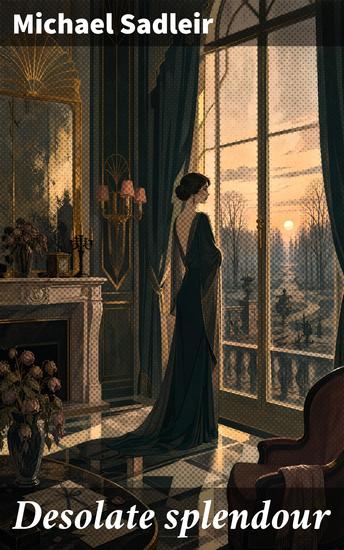
Michael Sadleir's Desolate Splendour is a historical novel of psychological and social refinement, set against the fading brilliance of aristocratic and cultivated life. Characteristically elegant in style, it combines acute observation of manners with a melancholy awareness of decline, exploring the tensions between beauty, privilege, emotional frustration, and moral exhaustion. The novel belongs to the English tradition of sophisticated early twentieth-century fiction, where aesthetic polish and social analysis work together to reveal the fragility beneath worldly glamour. Sadleir was uniquely equipped to write such a book. Known not only as a novelist but also as an important bibliographer, collector, publisher, and critic, he possessed an intimate knowledge of Victorian and Edwardian culture. His scholarly engagement with the nineteenth century, especially with the literature of society, sensation, and status, informed his fiction with unusual historical sensitivity. Desolate Splendour reflects both his antiquarian intelligence and his novelist's interest in the emotional costs of cultivated surfaces. This is a book for readers who value literary subtlety over spectacle. Those interested in social history, the decline of inherited worlds, and the fine textures of English prose will find it especially rewarding. Desolate Splendour deserves attention as both an accomplished novel and a revealing expression of Sadleir's rare dual authority as scholar and imaginative writer.
Available since: 06/29/2026.
Print length: 242 pages.

Other books that might interest you

  • The Brothers Karamazov - cover

    The Brothers Karamazov

    Fyodor Dostoevsky

    • 0
    • 0
    • 0
    The Brothers Karamazov, also translated as The Karamazov Brothers, is the last novel by Russian author Fyodor Dostoevsky. Dostoevsky spent nearly two years writing The Brothers Karamazov, which was published as a serial in The Russian Messenger from January 1879 to November 1880.
    Show book
  • It Happened in Egypt - A Nile Voyage and a Hidden Treasure - cover

    It Happened in Egypt - A Nile...

    C. N. Williamson, A. M. Williamson

    • 0
    • 0
    • 0
    A Nile steamer, a party of tourists and a treasure hunt in the desert, with a chaperone and two impostors aboard. The Williamsons moved their formula from the road to the river and the Egypt in it was drawn from a season they spent there. This edition is bound with 59 plates of paintings, among them works by David Roberts, Edvard Munch and Martin Snape.
    Show book
  • The Rewards of Industry - In China a child uses chess to gain his fathers approval - cover

    The Rewards of Industry - In...

    Richard Garnett

    • 0
    • 0
    • 0
    Richard Garnett C.B. was born on the 27th February 1835.  
     
    Educated in Bloomsbury he then joined the nearby British Museum as an assistant librarian in 1851, shortly after his father’s death.  
     
    He was continuously promoted to high-ranking positions at the British Library until his retirement in 1899. 
     
    In his personal life he married Olivia Narney Singleton in 1863 and was the father to six surviving children.  Despite the constant call of work and family he found time to translate many titles from their original Greek, German, Italian, Spanish, and Portuguese.   
     
    As an author he wrote several volumes of verse, a book of short stories and several biographies and history books. 
     
    In 1901, Garnett was elected as a member to the American Philosophical Society. 
     
    Richard Garnett died on the 13th April 1906.  He was 71.
    Show book
  • The Juniper Tree - cover

    The Juniper Tree

    Jacob Grimm, Wilhelm Grimm

    • 0
    • 0
    • 0
    One of the Grimm Brothers’ most unsettling tales, The Juniper-Tree is a gothic fable of jealousy, murder, and miraculous return. When a stepmother commits an unthinkable crime, a grieving sister lays her brother’s bones beneath a sacred tree—and a radiant, magical bird rises to sing the truth. Its haunting song gathers a gold chain, a pair of red shoes, and a millstone for a reckoning that will set a broken family right. Eric Shipley’s resonant performance honors the tale’s old-world cadence while sharpening its dark suspense. With crisp pacing, textured character voices, and a storyteller’s hush, he guides listeners from kitchen hearth to cobbler’s shop to the turning mill, until justice thunders down and a child is restored. Perfect for fans of classic folklore, dark fairy tales, and gothic morality plays, this faithful, atmospheric recording preserves the tale’s shiver and soul. At once chilling and cathartic, The Juniper-Tree reminds us that even in the bleakest woods, truth finds its voice—and sings.
    Show book
  • 813 - Lupin Hunts Himself - cover

    813 - Lupin Hunts Himself

    Maurice Leblanc

    • 0
    • 0
    • 0
    A murder in a Paris hotel, a scrap of paper with three digits and a letter, and a manhunt in which Lupin plays both the criminal and the chief of the detective bureau hunting him. Leblanc wrote it in 1910 as a serial for Le Journal and let his hero lose, badly, before the end. The secret behind the number is a matter of European politics. Fifty-six plates from 1820 to 1920, among them Schuch and Bogoliouboff, trace the streets, bridges and city nights that shadow Lupin's chase.
    Show book
  • Idyl of London An - From their pens to your ears genius in every story - cover

    Idyl of London An - From their...

    Beatrice Harrenden

    • 0
    • 0
    • 0
    The bookshelves of British literature are incredible collections that have gathered together centuries of very talented authors.  From these Isles their fame spread and whilst among their number many are now forgotten or neglected their talents endure.  Among them is Beatrice Harrenden.
    Show book