Unisciti a noi in un viaggio nel mondo dei libri!
Aggiungi questo libro allo scaffale
Grey
Scrivi un nuovo commento Default profile 50px
Grey
Iscriviti per leggere l'intero libro o leggi le prime pagine gratuitamente!
All characters reduced
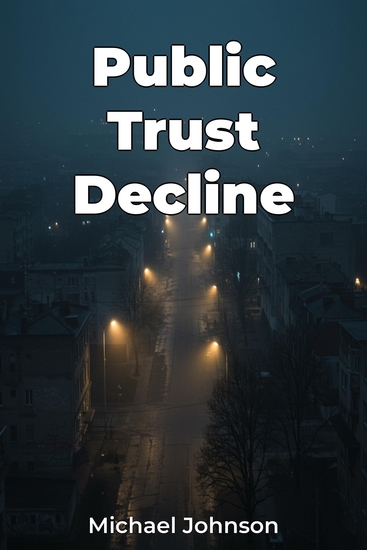
Public Trust Decline - cover

Public Trust Decline

Michael A. Johnson

Traduttore A AI

Casa editrice: Publifye

  • 0
  • 0
  • 0

Sinossi

Public Trust Decline examines the widespread erosion of confidence in institutions like government and media, a crucial issue as societal health depends on trust. The book uniquely offers a comparative analysis across different countries, revealing that declining public trust isn't a singular issue but a complex mix of perceived corruption, lack of transparency, and a disconnect between citizens and those in power. Intriguingly, the rise of social media and economic inequality significantly contribute to this decline, fueling political polarization and hindering effective governance. 

 
The book adopts an analytical and objective approach, drawing from diverse sources like public opinion surveys and case studies. Initially, it establishes a historical context, then analyzes survey data to compare trends across various institutions. Subsequent chapters explore specific factors like the role of media, political polarization, and economic inequality. 

 
The final chapters propose actionable solutions, emphasizing transparency, accountability, and ethical leadership to restore faith in institutions, aiming to inform policymakers, journalists, and engaged citizens.
Disponibile da: 21/02/2025.
Lunghezza di stampa: 85 pagine.

Altri libri che potrebbero interessarti

  • The Unraveling - Reflections on Politics without Ethics and Democracy in Crisis - cover

    The Unraveling - Reflections on...

    Bob Bauer, Jon Meacham

    • 0
    • 0
    • 0
    Essential for anyone interested in modern American politics, get the book that former President Barack Obama on X calls "a deeply thoughtful book" and says, "couldn't be a more timely read." 


    Part memoir, part rumination on the declining moral compass of the American political class, The Unraveling is the first book to place restoring political ethics at the center of the renewal of American democracy. Politics is a brutal game, but Bauer asks where does the line fall between the "hardball" of politics and attacks on the very foundation of democracy? Looking back on foryt-six years in the political arena, Bauer tries to better grasp what has gone wrong and to understand what shaped his own decisions and actions. He offers anecdotes, perspectives, and insights that are vitally relevant in our world today, including efforts in 2020 (and 2024) to defend our democratic system of elections from attack and distrust, and the struggles with social media, such as Meta, to combat disinformation in a post-truth politics. He writes about the various personal experiences along the way—the highs, the lows, and the absurd. Bauer presents a smart and serious look at our political culture and the role that he has played in shaping it. The Unraveling will be essential for anyone interested in American politics of the last fifty years—and the next.
    Mostra libro
  • Law Overload: The Hidden Human Cost - "Ace your test with engaging audio lessons from Law Overload: The Hidden Human Cost!" - cover

    Law Overload: The Hidden Human...

    Elliot Voss

    • 0
    • 0
    • 0
    Law Overload: The Hidden Human Cost 
      
    ⭐⭐ Simplified Audio Guide ⭐⭐ 
    Are you curious about the profound impact of excessive laws on our daily lives?   
    Do you need a comprehensive guide that elucidates the hidden human costs of legal overload?   
    Your search ends here!   
    This audiobook serves as your definitive companion for deepening your understanding, expanding your knowledge, and engaging in thought-provoking analysis. Get ready to uncover the realities behind the veil of legal complexities.   
    Updated for the latest structures and analysis methodologies.   
    Key features of this enriched guide:   
    - Profound insights about the impact of excessive laws on human lives 
    - Detailed explanation of various legal complexities 
    - Effective strategies for understanding and analyzing the hidden costs of over-regulation   
    Our guide distinguishes itself through in-depth coverage, which is essential for grasping the true essence of legal overload. Concepts aren't merely skimmed; they are delved into with precision.   
    Please note that this audiobook is not affiliated with any official legal entity and is purely an independent resource for your benefit.   
    Designed with a clear structure and easy-to-understand language, "Law Overload: The Hidden Human Cost" ensures smooth transitions between topics. Say goodbye to dense jargon and welcome clear, precise, and technically accurate content.   
    So, why wait? Click the BUY NOW button, secure your guide, and begin your journey to understanding the profound human cost of excessive laws!
    Mostra libro
  • The Man Behind The Fascist Doctrine - cover

    The Man Behind The Fascist Doctrine

    Benito Mussolini

    • 0
    • 0
    • 0
    “It’s better to live one day as a lion than 100 years as a sheep.” 
     
    "I am the most terrible animal that's ever existed." 
     
    "Democracy is beautiful in theory; in practice, it is a fallacy. You in America will see that someday." 
     
    "It's good to trust others but, not to do so is much better." 
     
    “I feel, when we have no friends upon whom to lean, or to look for moral guidance." (Mussolini) 
     
    The Doctrine of Fascism" is an essay attributed to Benito Mussolini. In truth, the first part of the essay, entitled "Idee Fondamentali", was written by the Italian philosopher Giovanni Gentile, while only the second part is the work of Mussolini himself. 
     
    Benito Amilcare Andrea Mussolini, born on July 29, 1883, who went by the nickname “Il Duce” (“the Leader”), was a deeply unbalanced tyrannical Italian dictator who created the dreaded Fascist Party in 1919. Eventually, he held all power in Italy as the country’s prime minister from 1922 to 1943. An ardent socialist as a youth, Mussolini followed in his father's political footsteps but was expelled by the party for his overt support of World War I. As an evil dictator during World War II (even murdering his own son by lethal injection) he greatly overextended his forces and was eventually killed by his own people in Mezzegra, Italy. Here, for the first time, are the words of the great dictator himself in his twisted manifesto on the political movement he started and is still so feared to this very day. A rare audiobook adventure in politics, history, and outrage!
    Mostra libro
  • One World Government - Threat Or Solution? - cover

    One World Government - Threat Or...

    H. Wayne White

    • 0
    • 0
    • 0
    The effort to form a One-World Government that rules the world is not new; in fact, it goes back thousands of years. The big difference today is the size of that world. There was a time, a long time ago, that one person could rule the world. Today, it takes a large cartel made up of politicians, corporations, and liberal academics. This book will cover the last few centuries. To what extent is it genuine, and what impact might it have on the world? Several attempted to test the idea and gauge the tolerance for it. The League of Nations and the United Nations both sought to promote peace among nations. Considering the world's conflicts, its success is doubtful. This book follows this effort from the very early start right up to today's efforts. How much has it accomplished so far, and has it been beneficial for America or the world? Who's involved and why? The book aims to educate you sufficiently so that you can make an informed decision about whether a one-ruling entity should be in our future or not.
    Mostra libro
  • Policing Gun Violence - Strategic Reforms for Controlling Our Most Pressing Crime Problem - cover

    Policing Gun Violence -...

    Anthony A. Braga, Philip J. Cook

    • 0
    • 0
    • 0
    In many US cities, gun violence is the most urgent crime problem. High rates of deadly violence make a city less livable, dragging down quality of life, economic development, and property values. 


    How can police departments find the right balance between over- and under-policing of high-violence areas? What are the best practices for police to preempt and deter gun violence, while engendering support and cooperation from the public? 


    Drawing on fifty years of research and practical experience, Policing Gun Violence argues that it is possible for the police to create greater public safety while respecting the rights of individuals and communities. While gun violence can be attributed to various systemic causes, Anthony A. Braga and Philip J. Cook make the case that violence is itself a root cause of social disparity and future violence. Effective law enforcement is a vital component of a just society. They review and synthesize the evidence in several key areas: enforcement of gun laws, policing hot spots, controlling high-risk groups through focused deterrence, enhancing investigations to increase the arrest and conviction rate, preventing officer-involved shootings, and disrupting underground gun markets. Policing Gun Violence serves as a guide to how the police can better utilize their considerable resources to make cities safer.
    Mostra libro
  • Comeback - Routing Trumpism Reclaiming the Nation and Restoring Democracy’s Edge - cover

    Comeback - Routing Trumpism...

    M. Steven Fish, Laila M. Aghaie

    • 0
    • 0
    • 0
    The fate of American democracy now hinges on the Democrats' ability to defeat the Republicans for the foreseeable future. But for the Democrats to win consistently, they must reestablish their credentials as fearless leaders, tough fighters, and fierce patriots. 
    Comeback delivers a bold new take on democracy’s crisis. Many liberals think that escalating economic anxieties and cultural backlash drove voters to Trump. But a crush of data shows this thinking to be deeply flawed. It also strikes working-class voters as condescending and repellent. And while the Democrats stick to “kitchen table” issues and showing how much they care, voters care more about strength and commitment to principle than prescription drug prices. 
    Politics is a dominance game and a contest to capture the flag. Politicians who seem to be the strongest leaders and most passionate patriots hold the advantage. The Republicans get it. The Democrats don't. 
    Republicans have a high-dominance political style. They take risks, savor conflict, and use provocative language. Democrats have a low-dominance style. They’re risk-averse, afraid to engage on cultural issues—and more than a little boring. Republicans hammer away at their patriotism, even as they betray the nation and shred American values. Democrats are loyal to American values but have grown squeamish about patriotism and have no national story. 
    Ordinary people often don’t recognize themselves in the stories liberal politicians tell about them, while the authoritarians speak a language of dominance and national greatness that connects. The Democrats need a new approach to messaging. Comeback spells it out—and provides a roadmap for trouncing Trumpism.
    Mostra libro