Join us on a literary world trip!
Add this book to bookshelf
Grey
Write a new comment Default profile 50px
Grey
Subscribe to read the full book or read the first pages for free!
All characters reduced
Political Works Usage - cover

Political Works Usage

Michael Johnson

Translator A AI

Publisher: Publifye

  • 0
  • 0
  • 0

Summary

Political Works Usage examines how political books influence public opinion, policy preferences, and electoral outcomes beyond mere sales figures. It investigates the role of political literature in shaping discourse, the motivations behind readership, and the tangible effects on voting behavior, providing a data-driven analysis of the impact of political books on civic engagement.The book uniquely combines quantitative data, such as Nielsen BookScan data and LexisNexis searches, with qualitative insights derived from social media analysis using natural language processing. One intriguing finding explores how book sales fluctuate around significant political events, indicating a direct engagement with political ideas during key moments. Another insight delves into how media coverage and social media trends amplify or diminish the impact of these books.The book progresses by first introducing theoretical frameworks like agenda-setting and framing theory to understand the role of political literature. It then presents case studies of influential political books, analyzing sales data, media mentions, and public opinion shifts. Finally, it explores practical implications for political actors and publishers.By focusing on fact-based, non-fiction works, the book offers a rigorous analysis valuable for political scientists, communication scholars, and anyone interested in understanding the dynamics of public opinion and political engagement in current events.
Available since: 02/19/2025.
Print length: 67 pages.
Other books that might interest you

  • You Shall Be as Gods - Pagans Progressives and the Rise of the Woke Gnostic Left - cover

    You Shall Be as Gods - Pagans...

    Erick son

    • 0
    • 0
    • 0
    Our country doesn't have a partisan problem, a political problem, a social problem, or an economic problem. We have a spiritual problem. 


    As Christianity has been pushed aside, the Progressive Left has developed a new pagan religion. But the radical roots of the new secular religion are ancient. We've seen it all before. In You Shall Be as Gods, Erick Erickson traces the religion's roots from Paganism and Gnosticism through the Age of Enlightenment all the way into the Postmodernism of the twenty-first century. At the heart of the ancient religion is a self-centered culture. 


    The Christian church today has been weakened by compromising with the neo-pagan religion, leaving the faithful ill-prepared to counter the claims of society's present-day doctrine. Yet there remains a significant remnant in America that refuses to bow to the rising belief system. 


    Just as in Rome and countless societies throughout history, the religions present two opposing stories of reality which necessitates conflict. In an era where the "Christian thing" to do seems to be to go along and get along, Erickson makes clear that the two cultures cannot peacefully coexist and calls the listener to speak the truth in love.
    Show book
  • Whistleblowing for Change - Exposing Systems of Power and Injustice - cover

    Whistleblowing for Change -...

    Tatiana Bazzichelli

    • 0
    • 0
    • 0
    The courageous acts of whistleblowing that inspired the world over the past few years have changed our perception of surveillance and control in today's information society. But what are the wider effects of whistleblowing as an act of dissent on politics, society, and the arts? How does it contribute to new courses of action, digital tools, and contents? This urgent intervention based on the work of Berlin's Disruption Network Lab examines this growing phenomenon, offering interdisciplinary pathways to empower the public by investigating whistleblowing as a developing political practice that has the ability to provoke change from within.
    Show book
  • Trust Signals - cover

    Trust Signals

    Scott Baradell

    • 0
    • 0
    • 0
    What is a trust signal?Let’s say you’re interested in a book you aren’t familiar with—this book, for example. Before you buy it, you wonder, “Can I trust this author?” Can you trust that their book will be worth your money and your time?The author, in turn, tries to prove their trustworthiness in a number of ways:An accomplished and relevant biographyGlowing praise from well-known people on the coverFive-star reviews on AmazonAcclaim on social media by people you followCoverage in news media outlets you know and respectThese are examples of trust signals, the points of evidence that individuals, companies, and brands use to win one another’s trust.Mastering these signals is the single best way to build, grow, and protect your brand in today’s post-truth world—where trust is the most precious commodity of all.
    Show book
  • Politics for Everybody - Reading Hannah Arendt in Uncertain Times - cover

    Politics for Everybody - Reading...

    Ned O'Gorman

    • 0
    • 0
    • 0
    In this age of nearly unprecedented partisan rancor, you’d be forgiven for thinking we could all do with a smaller daily dose of politics. In his provocative and sharp book, however, Ned O’Gorman argues just the opposite: Politics for Everybody contends that what we really need to do is engage more deeply with politics, rather than chuck the whole thing out the window. In calling for a purer, more humanistic relationship with politics—one that does justice to the virtues of open, honest exchange—O’Gorman draws on the work of Hannah Arendt (1906–75). As a German-born Jewish thinker who fled the Nazis for the United States, Arendt set out to defend politics from its many detractors along several key lines: the challenge of separating genuine politics from distorted forms; the difficulty of appreciating politics for what it is; the problems of truth and judgment in politics; and the role of persuasion in politics. O’Gorman’s book offers an insightful introduction to Arendt’s ideas for anyone who wants to think more carefully.
    Show book
  • Tricking Power into Performing Acts of Love - How Tricksters Through History Have Changed the World - cover

    Tricking Power into Performing...

    Shepherd Siegel

    • 0
    • 0
    • 0
    Tricking Power into Performing Acts of Lovetells the history of tricksters who challenged the boundaries of doctrine to light the way to a more peaceful and playful society.
    Show book
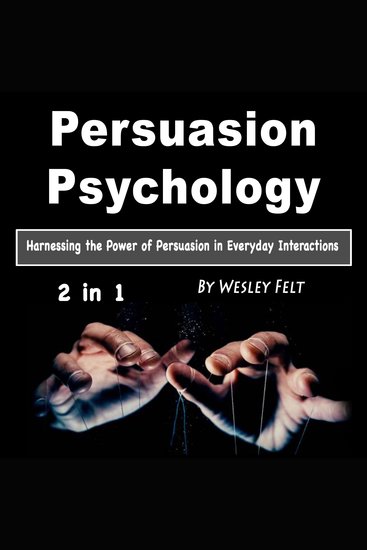
  • Persuasion Psychology - Harnessing the Power of Persuasion in Everyday Interactions - cover

    Persuasion Psychology -...

    Wesley Felt

    • 0
    • 0
    • 0
    This book contains two titles. Here are some snippets of what you can find in there: 
    Book 1 - Why does understanding a psychological risk lead to physical reactions? The answer lies in human anatomy, specifically in the mechanisms behind real pain. Is mental pain comparable to physical pain? How does intense pain manifest? When it comes to physical pain, the process is straightforward. We rarely consider the basic motor reflexes controlled by the spine. 
    During physical sensation, a nervous impulse is transmitted through the nerves to the corresponding part of the brain, which then sends a response impulse to an organ. But how does mental pain occur? Our bodies possess a self-regulation function for all physiological processes. In essence, the brain responds to changes in the body's chemical processes. 
    Book 2 - Many believe that the most successful people in the world have mastered the ability to use their minds to attract what they desire. Imagine being able to draw what you want most into your life effortlessly, without having to take direct action. Imagine being able to manifest your goals and desires through the discipline of your thoughts. 
    Everything begins with thoughts, which most people don’t fully grasp, as actions are rooted in these ideas. Before diving into the methods that harness the power of the mind, it’s important to ask: What is the subconscious mind? 
    The subconscious is a part of the mind that, while not fully conscious, influences a person’s actions and feelings. Some view the subconscious as connected to the spirit or soul, capable of shaping your reality based on the messages it receives from your actions and beliefs.
    Show book