Join us on a literary world trip!
Add this book to bookshelf
Grey
Write a new comment Default profile 50px
Grey
Subscribe to read the full book or read the first pages for free!
All characters reduced
Stop Press - cover

Stop Press

Michael Innes

Publisher: Open Road Media Mystery & Thriller

  • 0
  • 0
  • 0

Summary

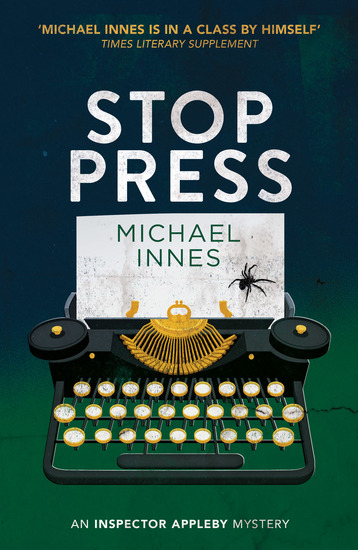
A London detective investigates after a fictional character seems to come to life to harass his creator in this classic British mystery. Richard Eliot began writing crime novels to fund his son’s education. The protagonist, known as “the Spider,” started off as a notorious criminal and later transformed into a private investigator. Now, after thirty-eight entries in the series, Eliot is considering putting the Spider to bed. Someone else, however, has a different idea. At first, Eliot’s manuscripts are rewriting themselves overnight. Then neighbors are burglarized, sinister messages appear, and soon someone is recreating storylines that the author never shared with anyone. With the situation reaching a fever pitch, Eliot calls upon Insp. John Appleby to investigate. Now Scotland Yard’s best must determine who is the mastermind behind this puzzling plot before the Spider strikes again . . .Originally published under the title The Spider Strikes. “For careful, dignified and at the same time unfailingly witty writing it would be hard to beat and the characterization . . . is admirable.” —The Times Literary Supplement “An erudite and curious novel . . . not to be missed by connoisseurs.” —The Times (London)
Available since: 05/30/2023.
Print length: 464 pages.
Other books that might interest you

  • The Return of the Native - cover

    The Return of the Native

    Thomas Hardy

    • 0
    • 0
    • 0
    'She was at that modulating point between indifference and love, at the stage called having a fancy for. It occurs once in the history of the most gigantic passions, and it is a period when they are in the hands of the weakest will.'
    
    One of Thomas Hardy's most controversial yet highly regarded novels, The Return of the Native is a classic tragedy that uncompromisingly explores sexual politics, repressed desire and the hypocrisies of society.
    
    When the beautiful and restless Eustacia Vye dreams of escaping the rural village of Edgon Heath, the return of Clym Yeobright, a successful diamond merchant previously working in Paris, sparks hope. But with the opportunity of a new life comes reckless desire and ruin, as Eustacia and Clym find themselves bound by love, yet driven by ambition, grappling with the suffocating expectations thrust upon them by society. As jealousies flare and choices grow more impulsive, their small town becomes a hotbed of betrayal, misunderstanding and tragedy. As haunting as it is daring, The Return of the Native reveals how pride, superficiality and stubborn hearts can spiral into devastating loss.
    Thomas Hardy (1840 – 1928) was an English poet and novelist. Heavily influenced by the Romantic and Victorian Realist movements, his writing is characterised by evocative language, rich imagery and innovative narrative structures. Hardy was socially conscious and highly critical of Victorian society, often using his writing to depict the lives of people living in deprived rural areas of England.
    Show book
  • Beowulf - The Original Manuscript - cover

    Beowulf - The Original Manuscript

    Unknown Unknown

    • 0
    • 0
    • 0
    Beowulf is an Old English epic poem in the tradition of Germanic heroic legend consisting of 3,182 alliterative lines. It is one of the most important and most often translated works of Old English literature. The date of composition is a matter of contention among scholars; the only certain dating is for the manuscript, which was produced between 975 and 1025. Scholars call the anonymous author the "Beowulf poet". The story is set in pagan Scandinavia in the 6th century. Beowulf, a hero of the Geats, comes to the aid of Hrothgar, the king of the Danes, whose mead hall in Heorot has been under attack by the monster Grendel. After Beowulf slays him, Grendel's mother attacks the hall and is then defeated. Victorious, Beowulf goes home to Geatland and becomes king of the Geats. Fifty years later, Beowulf defeats a dragon but is mortally wounded in the battle. After his death, his attendants cremate his body and erect a tower on a headland in his memory. Scholars have debated whether Beowulf was transmitted orally, affecting its interpretation: if it was composed early, in pagan times, then the paganism is central and the Christian elements were added later, whereas if it was composed later, in writing, by a Christian. Beowulf is written mostly in the West Saxon dialect of Old English, but many other dialectal forms are present, suggesting that the poem may have had a long and complex transmission throughout the dialect areas of England.No definite sources or analogs of the poem can be proven, but many suggestions have been made, including the Icelandic Grettis saga, the Norse story of Hrolf Kraki and his bear-shapeshifting servant Bodvar Bjarki, the international folktale the Bear's Son Tale, and the Irish folktale of the Hand and the Child. Persistent attempts have been made to link Beowulf to tales from Homer's Odyssey or Virgil's Aeneid. More definite are Biblical parallels, with clear allusions to the books of Genesis, Exodus, and Daniel. 
    Show book
  • The Small House at Allington Volume 2 - cover

    The Small House at Allington...

    Anthony Trollope

    • 0
    • 0
    • 0
    The Small House at Allington by Anthony Trollope is a poignant novel of love, social constraint, and quiet endurance in Victorian England. Set in the rural village of Allington, it follows the lives of two sisters, Lily and Bell Dale, who live with their widowed mother in a modest cottage. When two brothers, Adolphus and Bernard Crawley, rent nearby, romance blooms—especially between shy, beautiful Lily and the kind Adolphus. But Lily’s heart belongs to the charming yet unreliable Dr. John Crofts, creating emotional turmoil. Trollope masterfully explores unrequited love, familial duty, and the limited choices available to women. With empathy and subtle irony, the novel captures the heartbreak of hopes deferred and the dignity found in ordinary lives.
    Show book
  • A Christmas Carol - cover

    A Christmas Carol

    Charles Dickens

    • 0
    • 0
    • 0
    A master of language, moral lessons, and capturing the beauty of the everyday, Charles Dickens also brings elements of magic and wonder to this tale along with, of course, the meaning and joy of the Christmas season. Expecting to be able to bask in the nostalgia of the holiday, the character of Ebenezer Scrooge exists in stark contrast and is instantly despised. Dickens chooses Scrooge as his protagonist to take his audience through the selfish and narrow-sighted distractions of this world. A cautionary tale with a heartwarming twist, A Christmas Carol was and is a beloved classic for good reason.This series, published by ONE audiobooks, seeks to produce Classic Christian titles read by well known and loved Christian audiobook narrators. ONE takes great care to cast these titles with readers who will provide an unmatched listening experience for these important works.Paul Michael brings his passion to every performance and is considered to be one of the top audiobook narrators in the industry.
    Show book
  • The Sun Also Rises - cover

    The Sun Also Rises

    Ernest Hemingway

    • 0
    • 0
    • 0
    A restless generation. A love that can't be named. A journey searching for meaning in a world left broken by war.
    In Hemingway's groundbreaking debut novel, a group of expatriates wander from the cafés of Paris to the bullrings of Spain—drinking, dancing, longing, and hurting in ways they struggle to understand. At the center is Jake Barnes, whose unspoken love for the dazzling Lady Brett Ashley haunts every moment of their reckless, intoxicating life abroad. Amid festivals, tension, passion, and escape, they reveal the wounds and desires of a generation trying to feel alive again.
    
    Praised as "a novel that defined a century," this masterpiece captures Hemingway's signature clarity, emotional restraint, and unforgettable sense of place. Readers cherish its atmosphere, complex relationships, and the aching beauty in every silence.
    
    If you love literary fiction filled with longing, conflict, and moments that echo long after the final page, this essential classic delivers.
    
    Open the book—and follow the Lost Generation into the heart of what it means to live, love, and endure.
    Show book
  • The Facts in the Case of Monsieur Valdemar - From their pens to your ears genius in every story - cover

    The Facts in the Case of...

    Edgar Allan Poe

    • 0
    • 0
    • 0
    Edgar Poe was born in Boston Massachusetts on 19th January 1809. His father abandoned his family the following year and within a year his mother had died leaving him an orphan.   
    He was taken in by the Allan family but never formally adopted although he now referred to himself as Edgar Allan Poe.  His father alternatively spoiled or chastised him and tension was frequent over gambling debts and monies for his education.  His university years to study ancient and modern languages was cut short by lack of money and he enlisted as a private in the army claiming he was 22, it is more probable he was 18. After 2 years he obtained a discharge in order to take up an appointment at the military academy, West Point, where he failed to become an officer. 
    Poe had released his 1st poetry volume in 1827 and after his 3rd turned to prose and placing short stories in several magazines and journals.  At age 26 he obtained a licence to marry his cousin.  She was a mere 13 but they stayed together until her death from tuberculosis 11 years after. 
    In January 1845 ‘The Raven’ was published and became an instant classic.  Thereafter followed the prose works for which he is now so rightly famed as a master of the mysterious and the macabre. 
    Edgar Allan Poe died at the tragically early age of 40 on 7th October 1849 in Baltimore, Maryland. Newspapers at the time reported Poe's death as ‘congestion of the brain’ or ‘cerebral inflammation’, common euphemisms for death from disreputable causes such as alcoholism but the actual cause of death remains a mystery.
    Show book