Join us on a literary world trip!
Add this book to bookshelf
Grey
Write a new comment Default profile 50px
Grey
Subscribe to read the full book or read the first pages for free!
All characters reduced
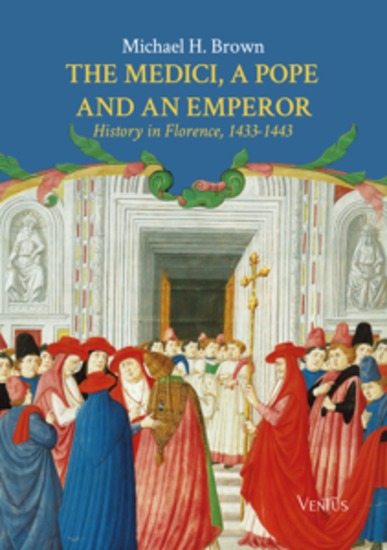
The Medici a Pope and an Emperor: History in Florence 1433-1443 - cover

The Medici a Pope and an Emperor: History in Florence 1433-1443

Michael H. Brown

Publisher: Ventus

  • 0
  • 0
  • 0

Summary

During a seminal decade (1433–1443), Florence became a crossroads of cultural, political, and ecclesiastical significance, hosting an exiled pope and a desperate Roman emperor while embracing the rise of Cosimo de’ Medici as de facto prince. The Medici, a Pope and an Emperor traces the historical arcs of the Commune of Florence, the Medici, the Catholic Church and Byzantium. The intersection of these histories transformed Florence into a unique stage upon which occurred some of the most important events of the early Italian Renaissance.
Available since: 03/25/2025.
Print length: 190 pages.

Other books that might interest you

  • Random Thoughts for a Friday Morning - A Collection of Contemporary Essays - cover

    Random Thoughts for a Friday...

    Kathryn L. Hunter

    • 0
    • 0
    • 0
    This engaging collection of essays was originally published in The Daily Post Athenian newspaper during the tumultuous 2-year period of 2020-2021. The author, Kathryn L. Hunter, who holds a masters degree in Forestry from Yale University, deftly weaves natural science with social commentary into each article, creating a result that is both entertaining and wise.
    Show book
  • 3 Dirty Gay Men Paranormal Erotic Stories - Vampires Werewolves Gangbang Babysitter and Cowboy - cover

    3 Dirty Gay Men Paranormal...

    Bobby Large, Jim Right

    • 0
    • 0
    • 0
    Delve deep into 3 filthy gay men paranormal fantasies. 
    Titles included are: 
    The Babysitter’s Vampire Night: 
    Setting up a babysitter service is a way for Harvey to make some money, but a call coming in when no one is available leaves him with little choice but to take the job himself. The house he arrives at is no different from the others on a quiet street, but he enters to find out there’s no child. The occupant then reveals his real reason for making the call. A vampire with a babysitter fetish seems insane, but Harvey gives in to a torrid encounter with Mr. Doyle to find out just how sexy a vampire can be. 
    Wild Werewolf on the Prairie: 
    A successful delivery of steers end with Cody making his way back across the open prairie alone. A late start setting out necessitates overnight camping and the howls he hears turn out not to be buffalo wolves. What comes out of the darkness is a legend, but the werewolf doesn’t want to take a life. Its interest is in something much more primal and Cody finds himself having a full moon encounter with an aroused beast. 
    Back Alley Vampire Gangbang: 
    Walking home after a heavy night out is Wesley’s first mistake. Taking a shortcut is his second. He’s not complaining at first when he bumps into Conrad, but a kiss with a handsome guy in a back alley turns crazy when two more men come out of the darkness. There’s no escape when the three men reveal what they really are, but giving in completely brings on as much pleasure as pain when vampire bites turn him on in a way he never expected.
    Show book
  • Strangers to Ourselves - Unsettled Minds and the Stories That Make Us - cover

    Strangers to Ourselves -...

    Rachel Aviv

    • 0
    • 0
    • 0
    A New York Times Book Review Ten Best Books of 2022 A Wall Street Journal Ten Best Books of 2022 The acclaimed, award-winning New Yorker writer Rachel Aviv offers a groundbreaking exploration of mental illness and the mind, and illuminates the startling connections between diagnosis and identity. In Strangers to Ourselves, a powerful and gripping debut, Rachel Aviv raises fundamental questions about how we understand ourselves in periods of crisis and distress. Drawing on deep, original reporting as well as unpublished journals and memoirs, Aviv writes about people who have come up against the limits of psychiatric explanations for who they are. She follows an Indian woman, celebrated as a saint, who lives in healing temples in Kerala; an incarcerated mother vying for her children’s forgiveness after recovering from psychosis; a man who devotes his life to seeking revenge upon his psychoanalysts; and an affluent young woman who, after a decade of defining herself through her diagnosis, decides to go off her meds because she doesn’t know who she is without them. Animated by a profound sense of empathy, Aviv’s exploration is refracted through her own account of living in a hospital ward at the age of six and meeting a fellow patient with whom her life runs parallel—until it no longer does. Aviv asks how the stories we tell about mental disorders shape their course in our lives. Challenging the way we understand and talk about illness, her account is a testament to the porousness and resilience of the mind.
    Show book
  • A Rare Recording of Robert Kennedy’s Speech on the Assassination of Martin Luther King Jr - cover

    A Rare Recording of Robert...

    Robert F. Kennedy

    • 0
    • 0
    • 0
    Robert Francis Kennedy (November 20, 1925 - June 6, 1968), also known by his initials RFK and by the nickname Bobby, was an American politician and lawyer. He served as the 64th United States Attorney General from January 1961 to September 1964, and as a U.S. Senator from New York from January 1965 until his assassination in June 1968, when he was running for the Democratic presidential nomination. 
    Show book
  • European Imperialism in China: The History and Legacy of the European Powers’ Attempts to Establish Chinese Trade Routes - cover

    European Imperialism in China:...

    Editors Charles River

    • 0
    • 0
    • 0
    During the 15th century, China had become economically and technologically advanced compared to civilizations in Europe at the time, and its fleet, which had reached a total of 3,500 ships, was unmatched by any other world power. Nevertheless, after conducting several trade expeditions with the massive fleet, the Chinese ships were either burned in the docks or left to rot. With that, China began to revert to the xenophobic policies of its past and reduce its presence in other lands. By 1525, the largest naval fleet in the world had essentially been destroyed or dismantled by China itself.  
    While China was in the process of isolating itself from the rest of the world, the European explorers were beginning to discover new lands, such as North America and South America. Among the countries doing the most exploring during this time were the Portuguese. The Portuguese had reached India in 1498, and by 1509 they had established part of their empire in India. This allowed the Portuguese to have a base of operations to further expand east into Asia. In 1511, the Portuguese captured the large spice trading center of Malacca in Malaysia, and like their base in India, Malacca allowed the Portuguese to have a foothold, thereby providing access to China and Southeast Asia. 
    The location of Macau was beneficial and strategically chosen by the Portuguese, as it was in close communication with Guangzhou and connected via a river system. In contrast to their earlier dealings with the Chinese, the Portuguese attempted to appear more humble and comply with the wishes of the Chinese rather than with force. As it turned out, the policy, in conjunction with increased European activities in the region, would help the Portuguese Empire hold on to Macau even as its fortunes dwindled everywhere else across the world.
    Show book
  • Reports From The First World War - Articles written while crossing the wastelands of 1919 (Nowadays Tales of War and Unhappy Far-Off Things) - cover

    Reports From The First World War...

    Lord Dunsany

    • 0
    • 0
    • 0
    Includes the collections Nowadays, Tales of War, & Unhappy Far-Off Things The great fantasy writer Lord Dunsany wrote very little in the way of fantasy after the onset of the First World War. This was partly because he was busy, having volunteered in 1915 and becoming a Captain in the Royal Inniskilling Fusiliers in Derry. However, the reality of the world bore in on our hero at this time, and it is not difficult to imagine that his heart moved to more serious concerns.Dunsany’s days of high fantasy, it seems, ended with the emergence of civil unrest in his nation. This is why the non-fiction section is included at the end of this collection; while he wrote the odd fantasy work in later years, they were written by a distinctly different man, with a very different life. For a week, he lay in a hospital bed, listening to the sounds of the riots as the British forces became increasingly violent and shelled the centre of Dublin with artillery. His military belt was left in the hospital, and eventually buried with the Nationalist leader Michael Collins.This, it seems, was the trigger for his change of heart, as expressed in ‘Nowadays’, towards poetry as the essence of writing. “In January 1917, under the stimulant of shellfire, I turned to poetry and wrote two poems in Plug-Street Wood”.After initially being refused forward positioning, he eventually served in the trenches. In this time, his literary output was focused on writing propaganda material for the War Office, some of which is collected in the non-fiction section of this volume.
    Show book