Join us on a literary world trip!
Add this book to bookshelf
Grey
Write a new comment Default profile 50px
Grey
Subscribe to read the full book or read the first pages for free!
All characters reduced
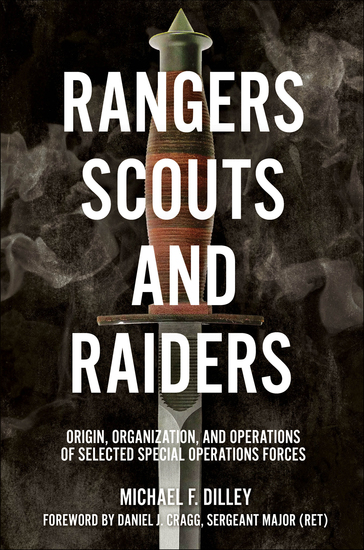
Rangers Scouts and Raiders - Origin Organization and Operations of Selected Special Operations Forces - cover

Rangers Scouts and Raiders - Origin Organization and Operations of Selected Special Operations Forces

Michael F. Dilley

Publisher: Casemate

  • 0
  • 0
  • 0

Summary

"Well-written and meticulously researched, the book is an excellent example of truth being more interesting than fiction. It is easy to read with photos, charts and maps that help the reader keep pace with the action." — ARMY MagazineThroughout history there has always been a need, in military forces, for special units. In the past, these units have usually been ad hoc formations that were disbanded after their mission was complete. It has only been since the early 1950s that such units have remained active, but even in recent times special purpose, special mission units have been organized and used for a period of time or for a specific mission and then either deactivated or replaced by other units.  This unique approach to the history of American special forces examines their development through a number of operations, ranging from the French and Indian War in the 18th century through to the Vietnam War. From the Son Tay raid to the Force at la Difensa and Rogers’ Rangers, the operations are diverse in both organization and purpose, but all contributed to the overall mission of their theater or larger organization, thus proving the continuing need for special units throughout history and even today.
Available since: 04/20/2023.
Print length: 240 pages.

Other books that might interest you

  • Dead Sea and the Dead Sea Scrolls The: The History of the Unique Lake and Its Ancient Jewish Manuscripts - cover

    Dead Sea and the Dead Sea...

    Charles River Editors

    • 0
    • 0
    • 0
    If the world had a navel, it would be the Dead Sea, the lowest point on Earth where one can still stand on dry land. The photographs of this unique lake seem to be taken from a science fiction movie, or a land devastated after a nuclear holocaust. To others, the fluffy shores could remind them of Antarctica although it is in one of the warmest spots on the planet. Its white, creamy masses, scattered along golden beaches, are not ice floes or frozen water, but effervescent salt formations. The famous Jordan River, where the Hebrew people entered the Promised Land and Jesus was baptized, flows into the lake, but the basin is so deeply sunk into the face of the planet that the waters never leave, as if they had fallen into a small black hole where nothing can escape.  
    	The Dead Sea is also an archaeological site loaded with history. Known among the first civilizations in the region as "Sea of Asphalt" and “Salt Sea,” innumerable myths and legends lend it an air of mystery, as if it attracted sterility and misfortune while eradicating all life from its waters. It was perhaps the inhospitable feel of the place, the almost total desolation surrounding it, which led the writer of the Pentateuch to imagine that many years ago, a cataclysm sent to annihilate perverted people had taken place there.  
    	In the mid-20th century, one of the most important religious discoveries of all time was made in a series of caves near the Dead Sea, which had hidden remnants of nearly 1,000 texts, some of which were included in the Hebrew Bible and others which were extra-biblical. In addition to being the oldest surviving copies of such documents, the mixture of languages and different kinds of papers helped shed light on the people in the region at the time, making the Dead Sea Scrolls vitally important to the world’s major religions. 
    Show book
  • How Schools Really Matter - Why Our Assumption about Schools and Inequality Is Mostly Wrong - cover

    How Schools Really Matter - Why...

    Douglas B. Downey

    • 0
    • 0
    • 0
    Most of us assume that public schools in America are unequal—that the quality of the education varies with the location of the school and that as a result, children learn more in the schools that serve mostly rich, white kids than in the schools serving mostly poor, black kids. But it turns out that this common assumption is misplaced. As Douglas B. Downey shows in How Schools Really Matter, achievement gaps have very little to do with what goes on in our schools. Not only do schools not exacerbate inequality in skills, they actually help to level the playing field. The real sources of achievement gaps are elsewhere.
    
    A close look at the testing data in seasonal patterns bears this out. It turns out that achievement gaps in reading skills between high- and low-income children are nearly entirely formed prior to kindergarten, and schools do more to reduce them than increase them. And when gaps do increase, they tend to do so during summers, not during school periods. So why do both liberal and conservative politicians strongly advocate for school reform, arguing that the poor quality of schools serving disadvantaged children is an important contributor to inequality? 
    It’s because discussing the broader social and economic reforms necessary for really reducing inequality has become too challenging and polarizing—it’s just easier to talk about fixing schools.
    
    How Schools Really Matter offers a firm rebuke to those who find nothing but fault in our schools, which are doing a much better than job than we give them credit for. It should also be a call to arms for educators and policymakers: the bottom line is that if we are serious about reducing inequality, we are going to have to fight some battles that are bigger than school reform—battles against the social inequality that is reflected within, rather than generated by—our public school system.
    Show book
  • The History of the Standard Oil Company - cover

    The History of the Standard Oil...

    Ida Tarbell

    • 0
    • 0
    • 0
    The classic of muckraking journalism that exposed the inner workings of a Gilded Age business empire—with a new introduction by Elizabeth Catte. Cleveland oil tycoon John D. Rockefeller formed the Standard Oil Company of Ohio in 1870. Over the next four decades, he turned the business into a behemoth, systematically driving his competitors out of business or buying them outright. His vast fortune made him one of the nation’s most powerful men.  But his private empire was nearly undone by the tireless journalism of a single, determined woman, Ida Tarbell. Originally published in 1904, The History of the Standard Oil Company exposed Rockefeller’s monopolistic tactics, eventually resulting in the company’s dismantling in 1911. More than simply a monumental piece of reporting; it is a deft, engrossing portrait of business in America—both its virtues and excesses.
    Show book
  • Rome’s Best Emperors: The History and Legacy of the Roman Empire’s Most Able Leaders - cover

    Rome’s Best Emperors: The...

    Editors Charles River

    • 0
    • 0
    • 0
    The importance of Gaius Julius Caesar Augustus (or as he was known from birth, Gaius Octavius “Octavian” Thurinus) to the course of Western history is hard to overstate. His life, his rise to power, his political, and his social and military achievements all laid the foundations for the creation of an empire which would endure for almost five centuries, and whose traditions, laws, architecture and art continue to influence much of Europe and the world today. Octavian was the first true Roman Emperor, and the first man since the Etruscan Tarquins five centuries earlier to establish a successful hereditary ruling dynasty in what had been a proud Republic for over half a millennium. He was a canny strategist, an excellent orator, a fine writer, a generous patron of the arts and enthusiastic promoter of public works, but above all he was a master politician. Octavian’s great-uncle (and adoptive father) Julius Caesar was a great general, and his rival Mark Antony was a great soldier, but as a politician Octavian outmatched them all. He still stands in bronze on Rome’s Via dei Fori Imperiali to this day, along with the likes of Caesar, Hadrian, Trajan and Marcus Aurelius, and he is forever immortalized in all Western calendars as the patron of the month of August, which was dedicated to him when he was deified, following his death, as Divus Augustus.  
    	“The Five Good Emperors,” a reference to the five emperors who ruled the Roman Empire between 96 and 180 CE (Nerva, Trajan, Hadrian, Antoninus Pius, and Marcus Aurelius), was a term first coined by Machiavelli and later adopted and popularized by historian Edward Gibbon, who said that under these men, the Roman Empire “was governed by absolute power under the guidance of wisdom and virtue.” This period of 84 years is generally regarded as the high point of the Roman Empire, at least after Augustus.
    Show book
  • Why Did That Happen? - Aristotle Has Four Answers and None of Them Are Helpful - cover

    Why Did That Happen? - Aristotle...

    Sophia Blackwell

    • 0
    • 0
    • 0
    Why Did That Happen? Aristotle Has Four Answers and None of Them Are Helpful is your brutally sarcastic, surprisingly educational crash course in Aristotelian philosophy—specifically his theory of causality, aka why things happen according to a man who thought everything, including acorns and chairs, had a spiritual destiny. 
    In this delightfully vicious breakdown of Aristotle’s metaphysics, Sophia Blackwell (author of Kant You Not) drags you through the Four Causes—material, formal, efficient, and final—with all the reverence of a philosopher who’s had enough. Whether it’s trees yearning to be trees, tables having identity crises, or humans trying to find meaning while simultaneously sabotaging themselves, this book dissects Aristotle’s ancient framework with modern sarcasm and a side of existential dread. 
    Inside, you’ll get: 
    A roast of Aristotle’s greatest hits: substance, essence, and metaphysical overkill 
    Why your coffee mug apparently has purpose and moral character 
    How causality shows up in nature, ethics, AI, and your inability to commit 
    A final cause that dares to ask if you have one (spoiler: Aristotle thinks you should) 
    And a walk through the philosophical ruins of teleology, where purpose and pretension meet 
    Perfect for philosophy students, intellectual masochists, or anyone who’s ever asked “Why did that happen?” and gotten four wildly overcomplicated answers in response. 
    This is not your professor’s Aristotle. This is Aristotle, but make it bearable
    Show book
  • Victory in Papua - cover

    Victory in Papua

    Samuel Milner

    • 0
    • 0
    • 0
    "Victory in Papua" is a pivotal volume in the comprehensive "The Green Books" series, chronicling the United States Army's extensive involvement in World War II. Authored by Samuel Milner, this book delves into the critical campaign in Papua New Guinea, offering a detailed examination of the strategic battles, operational challenges, and the indomitable spirit of the Allied forces tasked with halting Japanese expansion in the Southwest Pacific. Through meticulous research and compelling narrative, Milner captures the harsh realities of jungle warfare, the strategic significance of the region, and the extraordinary efforts of the soldiers who fought there. This volume stands as a testament to the complexities of military strategy, the harshness of the battle conditions, and the strategic importance of Papua New Guinea in the broader context of World War II.
    Show book