Join us on a literary world trip!
Add this book to bookshelf
Grey
Write a new comment Default profile 50px
Grey
Subscribe to read the full book or read the first pages for free!
All characters reduced
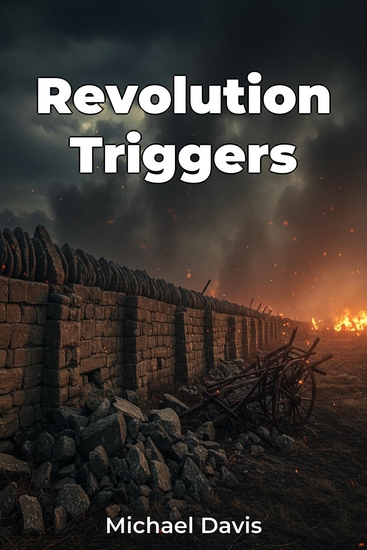
Revolution Triggers - cover

Revolution Triggers

Michael Davies

Translator A AI

Publisher: Publifye

  • 0
  • 0
  • 0

Summary

Revolution Triggers explores the multifaceted origins of revolutions, arguing they arise from the convergence of eroded political legitimacy, stark economic inequality, and fractured social cohesion. The book posits that revolutions aren't spontaneous outbursts but rather the culmination of deep-seated systemic failures. Consider, for example, how a government perceived as corrupt can lose the trust of its citizens, or how vast wealth disparities can fuel resentment and instability.

 
The book examines historical events like the French and Russian Revolutions to illustrate these principles, offering a sociological perspective. It progresses by first defining revolution and then systematically analyzing the erosion of political legitimacy, the exacerbation of economic inequality, and the breakdown of social cohesion across different chapters. This approach emphasizes the interconnectedness of political, economic, and social factors, providing a framework for assessing the risk of revolution in various societies.
Available since: 03/29/2025.
Print length: 64 pages.


Other books that might interest you

  • A Rare Recording of the 1972 Title Fight Between Muhammad Ali and Floyd Patterson - cover

    A Rare Recording of the 1972...

    Muhammad Ali, Floyd Patterson

    • 0
    • 0
    • 0
    This is the audio recording of the second Muhammad Ali vs. Floyd Patterson boxing match contested on September 20, 1972, for the NABF championship. It followed Patterson's victory over Oscar Bonavena in February 1972. The fight lasted 7 rounds. After the ringside doctor inspected eye between rounds, referee Arthur Mercante Sr. stopped Patterson from coming out for the eighth round, giving Ali a RTD (retired) victory. This was the final fight of Patterson's career.
    Show book
  • The Gunner and the Grunt - Two Boston Boys in Vietnam With the First Calvary Division Airmobile - cover

    The Gunner and the Grunt - Two...

    Peter Burbank, Michael L. Kelley

    • 0
    • 0
    • 0
    The Gunner and the Grunt is written in the voices of two soldiers who fought in the same battles as members of the same recon unit but from different angles. Michael Kelley, the "Gunner," was flying in an armed helicopter above the jungle providing suppressive fire support, while Peter Burbank, the "Grunt," was down in the jungle on foot patrol involved in fire fights with Viet Cong and North Vietnamese Army troops. 


    The book follows these two Boston boys from army training through deployment to the war zone and the shock of first combat missions, to helicopter air assault "Search and Destroy" operations from the Cambodian border to the sands of the South China Sea.
    Show book
  • From Terrain to Brain - Forays into the Many Sciences of Wine - cover

    From Terrain to Brain - Forays...

    Erika Szymanski

    • 0
    • 0
    • 0
    In From Terrain to Brain, Professor Erika Szymanski makes wine science accessible to non-experts. Rather than approach wine science as body of facts about wine, Szymanski explores how wine science can open up multiple ways of seeing, understanding, and appreciating wine. 


    Too often, wine science is presented as a comprehensive body of knowledge that enthusiasts aiming to become experts should memorize. This book instead uses scientific research to explore wine as an endlessly rich cultural phenomenon. By foregrounding recent research and developments in wine science, From Terrain to Brain presents wine science as a work-in-progress rather than a codified body of knowledge. 


    Each chapter takes listeners on a journey or "foray" through a topic in wine science, such as minerality, climate, microbiome, and yeast. Chapters are organized from "terrain" (geography, terroir, soil) and cell "membrane" (microbiology) through "brain" (the experience of tasting) and "drain" (sustainability). Throughout, From Terrain to Brain emphasizes that wine science, wine culture, and tradition are interconnected and places scientific research in social and historical context.
    Show book
  • Enviroment in Times of War - Climate and Energy Challenges in the Post-Soviet Region - cover

    Enviroment in Times of War -...

    Aldo Ferrari, Eleonora Tafuro...

    • 0
    • 0
    • 0
    The impact of Russia's war against Ukraine has been devastating both politically and environmentally. On top of the environmental damage directly caused by military operations, the invasion has put an abrupt end to the EU-Russia "green cooperation", which had previously raised many hopes. At the same time, it has also shifted international attention away from climate and environmental concerns, which are particularly acute in the post-Soviet region.
    This Report analyses some of the main climate change and environmental issues in the post-Soviet space, providing an initial assessment of the invasion's impact. The bulk of the latest scholarly and policy production on these matters focuses on Russia – given the country's geopolitical and energy relevance. However, this analysis finds that environmental disasters such as the desertification of the Aral Sea transcend state borders and require a broader approach both from an analytic and policy standpoint.
    Show book
  • Mao's Army Goes to Sea - The Island Campaigns and the Founding of China's Navy - cover

    Mao's Army Goes to Sea - The...

    Toshi Yoshihara

    • 0
    • 0
    • 0
    From 1949 to 1950, the People's Liberation Army (PLA) made crucial decisions to establish a navy and secure China's periphery. The civil war had been fought with a peasant army, yet in order to capture key offshore islands from the Nationalist rival, Mao Zedong needed to develop maritime capabilities. Mao's Army Goes to Sea is a ground-breaking history of the founding of the Chinese navy and Communist China's earliest island-seizing campaigns. 


    In this definitive account of a critical moment in China's naval history, Toshi Yoshihara shows that Chinese leaders refashioned the stratagems and tactics honed over decades of revolutionary struggle on land for nautical purposes. Despite significant challenges, the PLA ultimately scored important victories over its Nationalist foes as it captured offshore islands to secure its position. 


    Drawing extensively from newly available Chinese-language sources, this book reveals how the navy-building process, sea battles, and contested offshore landings had a lasting influence on the PLA. Even today, the institution's identity, strategy, doctrine, and structure are conditioned by these early experiences and myths. This book will help US policymakers and scholars place China's recent maritime achievements in proper historical context—and provide insight into how its navy may act in the future.
    Show book
  • Lost Civilizations of Mesoamerica - Quest for the Ancient Origins of the Olmecs and other Mysterious Cultures - cover

    Lost Civilizations of...

    Norah Romney

    • 0
    • 0
    • 0
    The phenomenon of the Olmec Heads and their Mysterious origins is observed in the Coast of the Gulf of Mexico, in the early pre-classic period, with the development of the Olmec culture. The first representations of political power are witnessed there, expressed through monumental sculpture and large-scale architecture. The dominant figure of the rulers appears and alludes to forms of government exercised by individuals who can convene to populations through ideological management and other coercion mechanisms. 
    The socio-political complexity thus emerged encouraged the development of similar forms in other areas of Mesoamerica, which would later lead to the appearance of the first stratified societies made up of actual states, such as the cases of Teotihuacan in the Mexican highlands, Monte Albán in Oaxaca and the city-states of the Maya area during the classical period. The corollary of this process was made up by some societies of the post-classic period that reached supra-state levels, as happened with the Mexica who settled in the Mexican highlands and came to establish a true pan-Mesoamerica empire.
    Show book