Join us on a literary world trip!
Add this book to bookshelf
Grey
Write a new comment Default profile 50px
Grey
Subscribe to read the full book or read the first pages for free!
All characters reduced
National Governance Systems - cover

National Governance Systems

Michael Davies

Translator A AI

Publisher: Publifye

  • 0
  • 0
  • 0

Summary

"National Governance Systems" offers a comprehensive exploration of how governments function at the national level, impacting the lives of citizens through their structural design, operational mechanisms, and policy impact. The book traces the historical evolution of national governance, from early statehood to modern political systems. It posits that a government's effectiveness hinges on balancing power, accountability, and adaptability to societal changes. Did you know that understanding the architecture of government is fundamental to comprehending political systems, and this book will help you do just that?

 
The book progresses systematically, beginning with core concepts like the rule of law and citizen participation, then moves into analyzing constitutional designs and policymaking processes. Comparative case studies from around the globe provide in-depth analyses of various national governance systems. By integrating theoretical frameworks with practical examples, this book avoids disciplinary jargon, making it accessible to students, policymakers, and engaged citizens alike who want to understand political systems and public policy.
Available since: 02/21/2025.
Print length: 83 pages.

Other books that might interest you

  • Blood Brothers - To Battleground Smokeshell and Back - cover

    Blood Brothers - To Battleground...

    Deon Lamprecht

    • 0
    • 0
    • 0
    On 10 June 1980, during the Border War, the SADF's 61 Mechanised Battalion Group attacked a complex of Swapo military bases in southern Angola. A long day of bloody fighting ensued.
    Second Lieutenant Paul Louw led Platoon 1, in four Ratel infantry fighting vehicles, to an objective called Smokeshell. After emerging from a dry riverbed, the young national servicemen suddenly found themselves facing a heavily defended enemy position and under deadly fire.
    In the ensuing chaos of that day, 12 troopies of Louw's platoon of 44 were killed and he himself was wounded. The 18-year-old HP Ferreira was shot through the pelvis by a 14,5 mm anti-aircraft round and also hit by AK-47 bullets. He miraculously survived.
    Blood Brothers records the dramatic events of that horrific day, in the words of the survivors of the battle, and follows members of Louw's platoon on their long journey of healing and recovery. It investigates the human cost of war after the last shots have been fired and follows the veterans as they return to the battleground four decades later in search of peace.
    Show book
  • A Rare Recording of Navajo Code Talker Dan Akee - cover

    A Rare Recording of Navajo Code...

    Dan Akee

    • 0
    • 0
    • 0
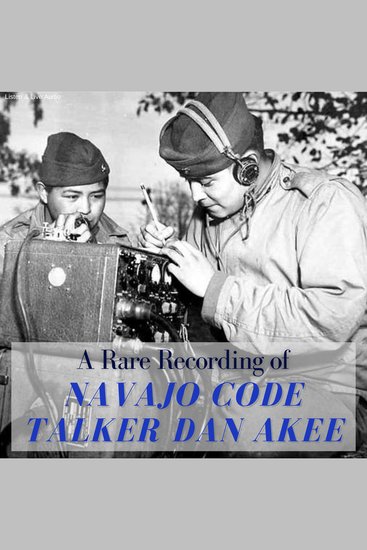
    Dan Akee was part of the Navajo code talker units of the US Marine Corps that relayed radio and phone messages in their native dialect during World War II operations.
     
    The method was fast and indecipherable to enemy eavesdroppers, as Navajo is an unwritten language of extreme complexity - with its syntax, tonal qualities, and various dialects - making it unintelligible to anyone without extensive exposure and training. It has no alphabet or symbols, and is spoken only on the Navajo lands of the American Southwest. By one estimate, at the time of World War II, the Navajo language was understood by fewer than 30 non-Navajos.
     
    Approximately 400 Navajo code talkers took part in every assault the US Marines conducted in the Pacific from 1942 to 1945. They served in all six Marine divisions, Marine Raider battalions, and Marine parachute units, transmitting messages by telephone and radio in their native language. The code was never broken by the Japanese, and its security has been credited with contributing significantly to the capture of Iwo Jima in 1945.
     
    The following are two recordings from code talker Dan Akee.
    Show book
  • Trail of Tears: An Enthralling Guide to the Choctaw and Chickasaw Removal the Seminole Wars Creek Dissolution and Forced Relocation of the Cherokee Tribe - cover

    Trail of Tears: An Enthralling...

    Billy Wellman

    • 0
    • 0
    • 0
    The removal of the Native Americans west of the Mississippi River during the 1800s to clear the way for settlers is a tragic story that involves human suffering on a grand scale.  
    The policy of Manifest Destiny said America was a morally superior nation that had the right to build an empire from the East Coast to the West Coast, much to the detriment of the Native Americans who stood in the way. This book will document the Trail of Tears, bringing to light many events that occurred in the background while describing a few prominent Native American chiefs, such as Seminole Chief Abiaka and Cherokee Chief John Ross, and some of the European-Americans with whom they clashed.  
    We will also go beyond standard history and take a closer look at the assimilation that occurred between the white settlers and the Native Americans. The unique characteristics of the tribes that met the Spanish settlers who arrived in Florida and the other European settlers who arrived on the East Coast are often not fully realized. We will take a closer look at this blending of cultures to give you a clearer picture of what the Cherokee, Chickasaw, Choctaw, Creek, and Seminoles were like by the time of the Trail of Tears. 
    Here are just some of the things you will discover in this book:Why tribes developed various forms of ChristianityThe reasons behind chiefs signing treaties to give away native landsGeorge Washington’s views on the Native AmericansThe Five Civilized Tribes and how they differed from each otherHow the average person viewed Native Americans in the 19th centuryDavey Crockett’s opinion on the relocation of Native AmericansThe Indian Removal Act of 1830 and how it impacted the Trail of TearsAnd so much more! 
    Scroll up and click the “add to cart” button to begin learning more about the Trail of Tears!
    Show book
  • The Stoic Path - The Golden Sayings - cover

    The Stoic Path - The Golden Sayings

    Epictetus

    • 0
    • 0
    • 0
    This program is read by an AI-based synthesized voice.Potent wisdom from the one of the greatest Stoic philosophers  The Stoic Path is your essential guide to a better life. Countless leaders, athletes, and thinkers have been shaped by the tenants of Stoicism, with its rational acceptance of the present moment and uncompromising insistence on virtue. The principles that form the backbone of Stoic thought are timeless—offering a refreshingly honest clarity to the complexity of modern life.The Stoic Path is a collection of the wisdom of Epictetus, one of the greatest Stoic philosophers of antiquity. Hastings Crossley translated the original text from Greek and compiled Epictetus’s most potent wisdom to create an accessible, compelling distillation of stoic thought. Originally published as The Golden Sayings of Epictetus, this new edition has been redesigned to appeal to modern audiences while maintaining the authenticity of the original translation.A Macmillan Audio production from St. Martin's Press Essentials.
    Show book
  • Sting and The Police - Walking in Their Footsteps - cover

    Sting and The Police - Walking...

    Aaron J West

    • 0
    • 0
    • 0
    “An excellent look at how the Police accomplished success . . . West is especially good at examining how the band used the nascent MTV to define themselves.” ―Publishers Weekly   During the 1980s, The Police were one of the biggest bands in the world. Yet after only five albums—and at the peak of their popularity—they disbanded, and Sting began a solo career that made him a global pop star. Today, artists from Puff Daddy to Gwen Stefani credit The Police and Sting as major influences on their own work.   In this book, Aaron J. West explores the cultural and musical impact of Stewart Copeland, Andy Summers, and Sting. West details the distinctive hybrid character of The Police’s musical output, which would also characterize Sting’s post-Police career. Sting’s long-lived solo career embodies the power of the artful appropriation of musical styles, while capitalizing on the modern realities of pop music consumption. The Police—and Sting in particular—were pioneers in music video, modern label marketing, global activism, and the internationalization of pop music.  Sting and The Police: Walking in Their Footsteps is a feast for fans—and by placing the band within its various musical, cultural, commercial, and historic contexts, it’s also fascinating reading for anyone interested in global popular music culture.
    Show book
  • Mystics of the Empire - Magic and Rule in Ancient Rome - Volume 2 - cover

    Mystics of the Empire - Magic...

    Davis Truman

    • 0
    • 0
    • 0
    In Mystics of the Empire, this groundbreaking study delves into the often-overlooked relationship between Roman emperors and magic, offering a fresh perspective on how sorcery and power intersected in the ancient world. While the lives and reigns of emperors have long captivated scholars, the fascinating role of magic in their rule remains a largely unexplored area of historical inquiry. This book examines how emperors were depicted as patrons of magical practices and as victims and persecutors of sorcery, revealing the complex political, social, and religious ramifications of magic in the Roman Empire. 
    From the mystical associations of the early emperors to the later, more controversial reigns of figures like Elagabalus, Mystics of the Empire analyzes the twofold nature of magic’s role — whether it was used as a tool for imperial authority or as a threat to Roman stability. The book explores how emperors employed magicians for their purposes and how their engagement with magic could be a source of political intrigue and downfall. Drawing on ancient sources and case studies, the narrative illuminates how these magical associations shaped the representation of emperors while also addressing the motivations behind these portrayals. 
    By offering a detailed examination of the magical context from the establishment of the Principate to the end of the Severan dynasty, Mystics of the Empire reveals the intricate interplay between the mystical and the political in ancient Rome. This work challenges traditional understandings of Roman governance, providing readers with a deeper appreciation of how magic was used as a tool of power, control, and subversion in one of history’s most enduring empires.
    Show book