Begleiten Sie uns auf eine literarische Weltreise!
Buch zum Bücherregal hinzufügen
Grey
Einen neuen Kommentar schreiben Default profile 50px
Grey
Jetzt das ganze Buch im Abo oder die ersten Seiten gratis lesen!
All characters reduced
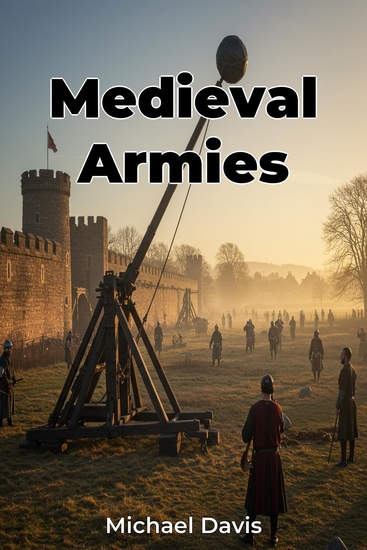
Medieval Armies - cover

Medieval Armies

Michael Davies

Übersetzer A AI

Verlag: Publifye

  • 0
  • 0
  • 0

Beschreibung

Medieval Armies explores the multifaceted nature of warfare throughout the Middle Ages, challenging common perceptions of battlefield dynamics. Rather than solely focusing on knights, the book investigates the roles of infantry, siege engineers, and the crucial logistics that sustained military campaigns. The book reveals how the composition, weaponry, and battle strategies of medieval armies were deeply entwined with the political and social structures of the time, from the feudal system's impact to the rise of mercenaries. Beginning with the fragmented warbands of the early Middle Ages, the book traces the evolution of military organization to the more professional forces of the later period. It emphasizes the integration of diverse troop types and strategic adaptability as key factors in an army's success. Case studies of key battles and campaigns, supported by historical sources and archaeological findings, illustrate the principles discussed, providing a balanced view of medieval warfare. The book uniquely connects military history with social, economic, and technological factors, offering a comprehensive view of medieval armies as complex systems. By considering the economic impact of warfare, such as the cost of equipping armies and the effects of raiding, it provides fresh perspectives relevant to students, military history enthusiasts, and anyone interested in the realities of medieval war history.
Verfügbar seit: 29.03.2025.
Drucklänge: 68 Seiten.

Weitere Bücher, die Sie mögen werden

  • Greece Against Rome - The Fall of the Hellenistic Kingdoms 250–31 BC - cover

    Greece Against Rome - The Fall...

    Philip Matyszak

    • 0
    • 0
    • 0
    The acclaimed ancient world historian examines the centuries-long decline of Greek powers in the face of the growing Roman threat. 


    Towards the middle of the third century BC, the Hellenistic kingdoms were near their peak. In terms of population, economy, and military power, each was vastly superior to Rome, not to mention in fields such as medicine, architecture, science, philosophy, and literature. But over the next two and a half centuries, Rome would eventually conquer these kingdoms while adopting so much of Hellenistic culture that the resultant hybrid is known as "Graeco-Roman." 


    In Greece Against Rome, Philip Matyszak relates this epic tale from the Hellenistic perspective. At first, the Romans appear to be little more than another small state in the barbarian west as the Hellenistic powers are consumed by war amongst themselves. It is a time of assassinations, double crosses, dynastic incest, and warfare. By the time they turn their attention to Rome, it is already too late.
    Zum Buch
  • Redefining Racism - How Racism Became "Power + Prejudice" - cover

    Redefining Racism - How Racism...

    Joseph (Jake) Klein

    • 0
    • 0
    • 0
    Have you heard that racism requires more than just prejudice, but also “power”? 
    Have you been told the dictionary definition of racism isn’t correct? 
    Where did this all come from? And why is it being taught at your school or workplace? 
    The rabbit hole goes deeper than you might have imagined. Joseph (Jake) Klein’s Redefining Racism tells the story of the group of radical white “anti-racist” corporate and high-school educators who in the late 1960s and early 70s, taking inspiration from the anti-integrationist Marxist-Leninist Stokely Carmichael, funded by an organization seeking to pay off rioters to stop, and using manipulative techniques developed in part by U.S. intelligence’s director of the “psychological warfare center for the Far East,” created and spread the “Power + Prejudice” redefinition. And the late famed crack-addicted serial bank robber “Zombie Bandit” played a role too. 
    In tracing the history of this redefinition, Redefining Racism also tells the story of the origins of “Racism Awareness Training,” today frequently called “diversity training,” in the tradition of Robin DiAngelo and White Fragility that have taken American corporations, schools, and universities by storm. 
    Redefining Racism is the definitive rebuttal for why racism is not best defined as “Power + Prejudice” and a damning origin story for much of the modern so-called “anti-racist” movement, reminding us why the best way to be an anti-racist is to look at the content of one’s character and not the color of their skin. 
    “For anyone genuinely committed to realizing an American future where race, racism, and ‘anti-racism,’ cease to be the tools used to divide us, this is an indispensable text. With Redefining Racism, Jake Klein has provided a national service.” — Thomas Chatterton Williams, author of Self-Portrait in Black and White and Losing My Cool
    Zum Buch
  • African Americans and the Gettysburg Campaign - cover

    African Americans and the...

    James M Paradis

    • 0
    • 0
    • 0
    The Sesquicentennial edition of African Americans and the Gettysburg Campaign updates the original 2006 edition, as James M. Paradis introduces readers to the African-American role in this famous Civil War battle. In addition to documenting their contribution to the war effort, it explores the members of the black community in and around the town of Gettysburg and the Underground Railroad activity in the area.
    Zum Buch
  • Japanese History - a comprehensive history of the land of the rising sun - cover

    Japanese History - a...

    Will Forrest

    • 0
    • 0
    • 0
    Fascinated by samurai, honor-bound warriors of Japan's past? 
    Wonder about World War II's impact and Japan's rebirth? 
    If so, this book is for you! 
    Embark on a thrilling odyssey through Japan's riveting history, catapulting from the ancient realm of samurai and shoguns into the cutting-edge prowess that defines this extraordinary nation. Plunge headfirst into the elegance of timeless art forms, relive the thunderous echoes of feudal clashes, and witness the indomitable spirit that forged Japan's fate. 
    This book is your gateway to the past, weaving electrifying narratives that unravel the enigmatic layers of Japan's heritage. Its pages ignite history before your eyes. Whether you're a daring explorer or an unwavering history devotee, this volume thrusts you into the heart of Japan's captivating saga. 
    Together we will explore:Ancient Shinto Roots: Origins and Imperial LineageFeudal Epoch: Samurai, Shoguns, and IsolationEdo's Cultural Renaissance: Art, Geisha, and KabukiZen Philosophy: Influence and Inner ContemplationMeiji Rebirth: Modernization, Global ReachPost-War Resurgence: Reconstruction and InnovationAnime and Manga: Modern Creative OutpouringTimeless Traditions: Tea Ceremonies, Craftsmanship MasteryTechnological Advancements: Innovations and High-Tech ProwessPop Culture Impact: J-Pop, Cosplay, and BeyondAnd Much More! 
    Unearth the well-guarded secrets of a culture masterfully blending tradition and innovation. Venture forth now, and embark on an exhilarating expedition through the currents of time! Buy this book now!
    Zum Buch
  • Jacobites The: The History and Legacy of the Movement to Restore the Stuart Dynasty to the British Throne - cover

    Jacobites The: The History and...

    Editors Charles River

    • 0
    • 0
    • 0
    The Jacobites conjure up many images to 21st century Britons, including romantic heroism, the Outlander series, and Bonnie Prince Charlie as the doomed hero of the cause, but Jacobitism was a cause that had far reaching consequences across 18th century Europe. The Jacobites were not only supporters of the exiled Stuart monarchy, but also against the political and religious settlements agreed to across the British Isles. As Jacobite historians such as Daniel Szechi and Frank McLynn have noted, the specter of the Jacobite threat was present for the British government and monarchy in their dealings with European powers throughout the 18th century.[1] This was especially true in France, the country that supported the exiled Stuarts and gave them a home until 1714. This soured the French monarchy’s relationship with Britain, and the Hanoverian kings who replaced the Stuarts were always aware of French and Spanish attempts to return the British throne to the Catholic Stuarts.  
    	The Jacobite court in exile regularly issued propaganda detailing the policies they would enact if restored, and this often reflected the agitations of anyone opposed to the political status quo in Britain at any given time. The Jacobites after 1707 in Scotland were often associated with the repeal of the Treaty of Union, mostly as that coincided with popular opinion. Szechi has noted over the years that Jacobitism was fairly politically radical in its objectives, from religious toleration to freely elected Parliaments and curbs on political corruption.[2] The restoration of the Stuarts would also have seen a return to multi-kingdom monarchy in Britain and Ireland, and it would have changed the European alliances which were forged in the many wars fought during this period.  
    	Given all that, it’s no surprise the Jacobites continue to interest so many people, as do the plot twists, near misses, and “what-ifs” involved.
    Zum Buch
  • To Her Credit - Historic Achievements—and the Women Who Actually Made Them Happen - cover

    To Her Credit - Historic...

    Kaitlin Culmo, Emily McDermott

    • 0
    • 0
    • 0
    You may think you know the stories behind the world's most well-known, groundbreaking achievements, but To Her Credit is here to make you reevaluate our collective story. This book celebrates the stories of women, from ancient times until the 1990s, whose contributions have been overwritten and accredited to men. 


    The pattern of female achievements being stolen, overwritten, or straight-up ignored is as old as time. Authors Kaitlin Culmo and Emily McDermott reclaim the work of these heroines and offer reminders of what we lose when we don't question history as it has been written. 


    ● We're often told that Cervantes "invented fiction" with the novel Don Quixote in seventeenth-century Europe, but what about Lady Murasaki's The Tale of Genji in eleventh-century Japan? 


    ● Elvis Presley is considered "The King" and the inventor of rock and roll music. But what about Sister Rosetta Tharpe, who was the first to engineer the rock and roll sound, or Big Mama Thornton, for whom the song "Hound Dog" was explicitly written? 


    It's time to talk about the thousands of years' worth of art, inventions, innovations, and world-changing achievements made by women that have been ascribed to men.
    Zum Buch