Junte-se a nós em uma viagem ao mundo dos livros!
Adicionar este livro à prateleira
Grey
Deixe um novo comentário Default profile 50px
Grey
Assine para ler o livro completo ou leia as primeiras páginas de graça!
All characters reduced
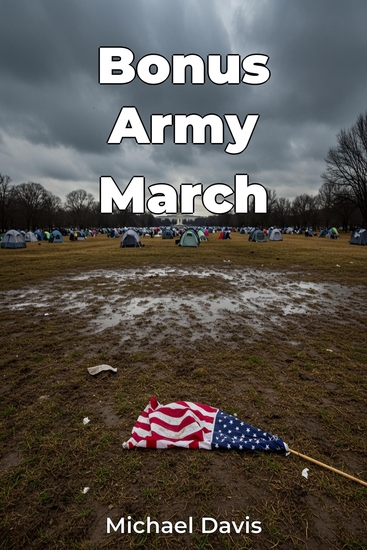
Bonus Army March - cover
LER

Bonus Army March

Michael Davies

Tradutor A AI

Editora: Publifye

  • 0
  • 0
  • 0

Sinopse

"Bonus Army March" examines the 1932 protests in Washington D.C., where World War I veterans sought early payment of their promised bonuses amid the Great Depression. This book uniquely connects the economic desperation of veterans, the political debates surrounding the bonus bill, and the severe consequences of the government's response. The narrative reveals how the Hoover administration's actions contributed to its unpopularity. The book traces the veterans' journey to Washington, their establishment of encampments, and their interactions with Congress. It highlights that the initial bonus legislation was the World War Adjusted Compensation Act in 1924, but as economic hardship intensified, veterans demanded immediate relief. Supported by primary sources like letters and government documents, the book progresses from establishing the historical context of WWI, through the march on Washington, and culminates in the government's controversial eviction of the veterans. It provides a comprehensive account of a pivotal moment in American history, detailing the social movements, veterans' affairs, and the government’s handling of the economic hardship. The book provides a balanced perspective on the events and encourages readers to consider the ongoing debate about the government’s responsibility to its veterans.
Disponível desde: 27/02/2025.
Comprimento de impressão: 62 páginas.

Outros livros que poderiam interessá-lo

  • The Legacy of the Roman Empire - cover

    The Legacy of the Roman Empire

    Rogan Fish

    • 0
    • 0
    • 0
    The rise of Rome is one of the most remarkable stories in world history, transforming from a small settlement on the banks of the Tiber River into one of the most powerful empires the world has ever seen. The foundation of Rome is traditionally dated to 753 BCE, attributed to the legendary figure Romulus. Over time, Rome evolved through three major phases: the monarchy, the republic, and the empire, each contributing to its dominance. The city's location played a crucial role in its growth, offering natural protection, fertile land, and access to trade routes that facilitated economic and military expansion. 
    During the period of the Roman Kingdom, Rome was ruled by a series of kings, who laid the groundwork for its legal and social structures. However, dissatisfaction with monarchical rule led to the establishment of the Roman Republic in 509 BCE. This new form of government introduced a complex system of checks and balances, with power divided among elected officials, including consuls, senators, and popular assemblies. The republic was built on the idea of civic duty and military service, which helped unify its citizens under a shared sense of identity. It was during this time that Rome expanded its influence, conquering neighboring territories through strategic military campaigns. The Roman legions, known for their discipline and tactical superiority, played a key role in these conquests. 
    Rome’s transition from a republic to an empire was marked by internal conflicts and power struggles. As Rome’s territories expanded, so did the challenges of governance. The late republic saw growing economic inequality, political corruption, and civil wars between powerful leaders. Figures like Julius Caesar, Pompey, and Crassus sought control, leading to the eventual downfall of the republic. The assassination of Caesar in 44 BCE created further instability, but it ultimately paved the way for the rise of Augustus, who became the first emperor in 27 BCE.
    Ver livro
  • School Communities of Strength - Strategies for Educating Children Living in Deep Poverty - cover

    School Communities of Strength -...

    Jr. Peter W. Cookson, David C....

    • 0
    • 0
    • 0
    In School Communities of Strength, Peter W. Cookson, Jr., lays out a blueprint for providing equitable educational opportunities for students from all socioeconomic strata, and particularly for the five million American children who live with the extreme material hardship known as deep poverty. This work issues an urgent call to action for K–12 schools to put in place the policies, practices, and programs that enable economically vulnerable students to thrive. 


    Drawing from up-to-date findings in the science of learning and development as well as analyses of schools that serve students in poverty, Cookson pinpoints success strategies that can help schools improve their poverty responsiveness. He shows how these strategies can help educators create the culturally responsive, inclusive environments that provide a base of safety from which students can better engage with their education. 


    Offering astute analysis, Cookson notes that school communities of strength require adequate funding and also meaningful collaboration among families, neighborhood partners, and educators. This book amplifies the idea that communities working together can drive transformative change, and it brings into focus three primary policy initiatives that can advance educational equity.
    Ver livro
  • Behave - cover

    Behave

    Robert Sapolsky

    • 0
    • 0
    • 0
    This is an independent summary & analysis of Behave by Robert Sapolsky. It is not the original book. All trademarks and copyrights belong to their respective owners. For the full experience, please support the original work. 
    Why do we lash out in one moment and show kindness in the next? Why do some people stay calm under pressure while others implode? This powerful 15-minute summary of Behave takes you on a journey backward in time through every action you take—from the split-second firing of neurons, to the hormones flowing through your body, to your childhood, culture, and even evolutionary history. The author reveals how brain circuits, stress, habit, and social context combine to shape what you do, feel, and decide.
    Ver livro
  • The Religion of American Greatness - What's Wrong with Christian Nationalism - cover

    The Religion of American...

    Paul D. Miller

    • 0
    • 0
    • 0
    ECPA Top Shelf Award Winner
    Long before it featured dramatically in the 2016 presidential election, Christian nationalism had sunk deep roots in the United States. From America's beginning, Christians have often merged their religious faith with national identity. But what is Christian nationalism? How is it different from patriotism? Is it an honest quirk, or something more threatening?
    Paul D. Miller, a Christian scholar, political theorist, veteran, and former White House staffer, provides a detailed portrait of—and case against—Christian nationalism. Building on his practical expertise not only in the archives and classroom but also in public service, Miller unravels this ideology's historical importance, its key tenets, and its political, cultural, and spiritual implications.
    Miller shows what's at stake if we misunderstand the relationship between Christianity and the American nation. Christian nationalism—the religion of American greatness—is an illiberal political theory, at odds with the genius of the American experiment, and could prove devastating to both church and state. Christians must relearn how to love our country without idolizing it and seek a healthier Christian political witness that respects our constitutional ideals and a biblical vision of justice.
    Ver livro
  • Atlantis Mermaids Pixies Giants and our untold History - Everything is connected! - cover

    Atlantis Mermaids Pixies Giants...

    Ian Paterson

    • 0
    • 0
    • 0
    Introducing "Atlantis, Mermaids, Pixies, Giants, and Our Untold History," the highly anticipated sequel to the bestselling "Black Op's, Aliens, Spirits, Bigfoot, and Our Untold History," which garnered widespread acclaim in both paperback and audiobook formats. Building upon the foundation laid by its predecessor, this new book delves even deeper into the mysteries of the unknown, exploring not only the enigmatic subjects outlined in the title but also delving into a plethora of captivating topics such as the Bermuda Triangle, telepathy, and the origins of the great flood.
    Ver livro
  • Dark Psychology - Mental Manipulation and Psychosocial Tricks to Influence Others - cover

    Dark Psychology - Mental...

    Wesley Felt

    • 0
    • 0
    • 0
    Why does understanding a psychological risk lead to physical reactions? The answer lies in human anatomy, specifically in the mechanisms behind real pain. Is mental pain comparable to physical pain? How does intense pain manifest? When it comes to physical pain, the process is straightforward. We rarely consider the basic motor reflexes controlled by the spine. 
      
    During physical sensation, a nervous impulse is transmitted through the nerves to the corresponding part of the brain, which then sends a response impulse to an organ. But how does mental pain occur? Our bodies possess a self-regulation function for all physiological processes. In essence, the brain responds to changes in the body's chemical processes. 
      
    It’s likely that emotions cause some form of change in the body, such as in the blood’s composition. This change is then transmitted to the brain, which sends a response impulse to an organ, resulting in real pain. This phenomenon is known as the psychological cause of real pain. 
      
    For example, if you’re afraid of the dark, you might experience discomfort or a choking sensation in your throat. It feels as if something is obstructing your breathing. The fear isn’t of the darkness itself but of what might be lurking within it. This fear is based on information you've gathered throughout your life. A child, for instance, doesn’t fear the dark until they’re told what might be in it. This is what we call conscious fear.
    Ver livro