Join us on a literary world trip!
Add this book to bookshelf
Grey
Write a new comment Default profile 50px
Grey
Subscribe to read the full book or read the first pages for free!
All characters reduced
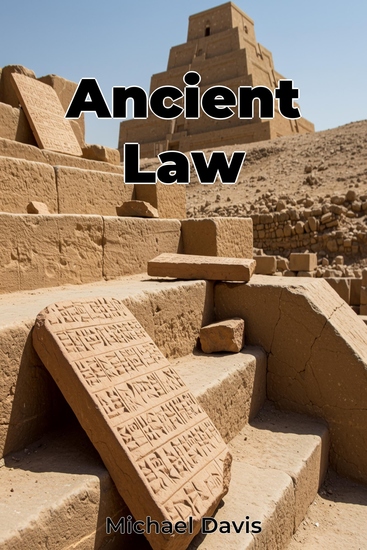
Ancient Law - cover

Ancient Law

Michael Davies

Translator A Ai

Publisher: Publifye

  • 0
  • 0
  • 0

Summary

"Ancient Law" explores the historical origins of modern legal systems by examining the legal codes, court systems, and concepts of justice in ancient civilizations like Mesopotamia, Egypt, Greece, and Rome. It argues that fundamental legal principles such as fairness and the rule of law, often taken for granted today, have roots in these early societies. The book uniquely compares different ancient legal systems, revealing common themes and divergent approaches, and providing a broader understanding of legal evolution.

 
The book traces the evolution of legal principles from rudimentary retribution to more sophisticated justice notions and examines the development of legal institutions from informal dispute resolutions to formalized court systems. For instance, the Code of Hammurabi, one of the earliest known legal codes, reveals much about ancient societal values and punishments.

 
Understanding the social, political, and economic contexts of these ancient laws is crucial, as it sheds light on the assumptions embedded within our current legal structures. The approach taken in "Ancient Law" is academic, utilizing both primary and secondary sources to ensure a comprehensive analysis.

 
The book is structured in three parts, beginning with an introduction to basic concepts such as offenses and punishments, moving to the evolution of court systems, and concluding with an analysis of the lasting influence of ancient law on modern legal systems. This historical and political exploration is intended for those interested in legal history or political science.
Available since: 03/21/2025.
Print length: 64 pages.


Other books that might interest you

  • Euthphyro - Plato - cover

    Euthphyro - Plato

    Plato

    • 0
    • 0
    • 0
    "Euthyphro" is a philosophical dialogue written by Plato, set in the Athens of the 5th century BC. The dialogue takes place outside the courthouse, where Socrates meets Euthyphro, a young man who claims to have a deep knowledge of piety and holiness. Euthyphro has come to prosecute his own father for the murder of a slave, whom he believed was guilty of impiety. 
    Socrates questions Euthyphro about his understanding of piety and holiness, and the dialogue becomes a profound exploration of the nature of these concepts. Socrates challenges Euthyphro's definition of piety and holiness, and ultimately concludes that he does not have a clear understanding of what these concepts mean. 
    Throughout the dialogue, Plato raises important questions about the nature of ethics, the relationship between religion and morality, and the limits of human knowledge. "Euthyphro" remains a classic work of philosophy, renowned for its clear and rigorous approach to philosophical inquiry.
    Show book
  • Stanford White and Madison Square Garden: The Shocking History of New York City’s Most Notorious Architect and Most Famous Arena - cover

    Stanford White and Madison...

    Editors Charles River

    • 0
    • 0
    • 0
    Of all the great cities in the world, few personify their country like New York City. As America’s largest city and best known immigration gateway into the country, the Big Apple represents the beauty, diversity and sheer strength of the United States, a global financial center that has enticed people chasing the “American Dream” for centuries.  
    	As such, it’s only fitting that Madison Square Garden, the stadium that bills itself as the world’s most famous arena, resides in the heart of Manhattan. Just blocks away from the Empire State Building and situated atop Penn Station, the Garden is always bustling, whether it’s for special events or as the home of the NBA’s New York Knicks and NHL’s New York Rangers, and all the while, performing in the Garden has been a career benchmark for artists as varied as Elvis Presley, The Doors, Led Zeppelin, and Michael Jackson. As Billie Joel put it, “Madison Square Garden is the center of the universe as far as I'm concerned. It has the best acoustics, the best audiences, the best reputation, and the best history of great artists who have played there. It is the iconic, holy temple of Rock and Roll for most touring acts and, being a New Yorker, it holds a special significance to me.” 
    	The Garden is now nearly 50 years old, making it one of the oldest sporting venues used in professional sports, but the current arena was not the first Madison Square Garden, and the area has a history as an entertainment center dating back to the 19th century. Ironically, its location on the less crowded fringes of Manhattan in the 19th century helped establish it as a place for hucksters like P.T. Barnum to hold events. In fact, a previous Garden was one of New York City’s tallest buildings in the early 20th century, and it was bankrolled by business titans like J.P. Morgan and Andrew Carnegie. 
    Show book
  • Spanish Fluency Unleashed: Boost Confidence Impress Amigos - A Swift Guide to Master Vocabulary Common Phrases and Pronunciation for Adult Beginners - cover

    Spanish Fluency Unleashed: Boost...

    Gabriel Moreno

    • 0
    • 0
    • 0
    Discover a transformative approach to mastering Spanish that transcends traditional methods, seamlessly integrating into your everyday life. Say goodbye to language barriers and hello to a world of boundless opportunities with "Spanish Fluency Unleashed" 
    Within this audiobook, you'll uncover:Seven structured lessons designed for steady progress and enhanced confidence in Spanish proficiency.A groundbreaking technique ensuring flawless pronunciation from day one, regardless of your starting point.Insights into common pronunciation pitfalls, accompanied by strategies for authentic native-like speech.Practical communication skills for immediate use in various scenarios, from dining out to professional engagements.Clear grammatical explanations, focusing on practical mastery over convoluted theory.A captivating exploration of Spanish culture and history, fueling your passion and motivation.Comprehensive vocabulary coverage and expert tips for sharing contact information effortlessly.Strategies for overcoming challenging grammatical structures and verb conjugations.Abundant quizzes and exercises to reinforce learning seamlessly into your daily routine. 
    Bid farewell to the outdated notion of language learning confined to the classroom.  
    Embrace the freedom of integrating Spanish seamlessly into your daily life and unlock a world of endless possibilities.Ready to embark on your Spanish journey? Seize this audiobook now and take the first step toward fluency!
    Show book
  • Epicurus - Pleasure Atoms and the Good Life - cover

    Epicurus - Pleasure Atoms and...

    Hector Davidson

    • 0
    • 0
    • 0
    Epicurus, a Greek philosopher born in 341 BCE on the island of Samos, founded the school of philosophy known as Epicureanism, which emphasized the pursuit of happiness through the cultivation of pleasure and the avoidance of pain. His teachings were revolutionary for their focus on the individual’s inner peace and well-being, rather than devotion to the gods or the pursuit of wealth and power. Epicurus advocated for a life of simple pleasures, good friendships, and intellectual contemplation, arguing that these were the true sources of happiness. 
      
    His philosophy was grounded in atomism, the belief that everything in the universe is made up of small, indivisible particles, or atoms, moving through the void. For Epicurus, the natural world was not governed by divine intervention, but by laws that could be understood through reason and observation. He believed that by understanding the workings of nature, individuals could free themselves from irrational fears, especially the fear of death and the gods. 
      
    Epicurus placed great importance on pleasure, defining it not as indulgence in material excess, but as the absence of pain (ataraxia) and the pursuit of a serene and balanced life. He argued that physical and mental pleasures, when experienced in moderation, contributed to a life of tranquility. Furthermore, he saw pain not as an inherent part of life, but as something to be minimized or avoided through thoughtful living and wise choices.
    Show book
  • The Time of My Life - Dirty Dancing - cover

    The Time of My Life - Dirty Dancing

    Andrea Warner

    • 0
    • 0
    • 0
    An engaging exploration into the enduring popularity of Dirty Dancing and its lasting themes of feminism, activism, and reproductive rights
    		 
    When Dirty Dancing was released in 1987, it had already been rejected by producers and distributors several times over, and expectations for the summer romance were low. But then the film, written by former dancer Eleanor Bergstein and starring Jennifer Grey and Patrick Swayze as a couple from two different worlds, exploded. Since then, Dirty Dancing’s popularity has never waned. The truth has always been that Dirty Dancing was never just a teen romance or a dance movie — it also explored abortion rights, class, and political activism, with a smattering of light crime-solving.
    		 
    In The Time of My Life, celebrated music journalist Andrea Warner excavates the layers of Dirty Dancing, from its anachronistic, chart-topping soundtrack, to Baby and Johnny’s chemistry, to Bergstein’s political intentions, to the abortion subplot that is more relevant today than ever. The film’s remarkable longevity would never have been possible if it was just a throwaway summer fling story. It is precisely because of its themes — deeply feminist, sensitively written — that we, over 30 years later, are still holding our breath during that last, exhilarating lift.
    		 
    About the Pop Classics Series
    		 
    Short books that pack a big punch, Pop Classics offer intelligent, fun, and accessible arguments about why a particular pop phenomenon matters.
    Show book
  • Florida at Sea - A Maritime History - cover

    Florida at Sea - A Maritime History

    Joe Knetsch

    • 0
    • 0
    • 0
    From small ports to large ports, from rivers to creeks, from lakes to lagoons, water routes have been essential to Florida's development as a commercial, recreational, agricultural, and cultural entity. With more than 30,000 lakes and ponds and some 1,700 rivers, creeks, and streams, Florida ranks second in the list of wettest states in the USA. Native Americans used the rivers, creeks, and lakes as routes to various locales within the peninsula while harvesting fish and other aquatic edibles to sustain their daily lives. Early European settlers followed suit and supplemented their diets with the bounty from the oceans and fresh water sources. Into statehood, settlers relied on the same sources for food while using fresh water to make the land productive for food and cash crops. By the early decades of the 20th Century, water became a marketable attraction to lure millions of tourists to Florida for recreation and sports. The trend continues today. Join a trio of authors on this look at the immense impact water and maritime activities have played in the development of Florida.
    Show book