Begleiten Sie uns auf eine literarische Weltreise!
Buch zum Bücherregal hinzufügen
Grey
Einen neuen Kommentar schreiben Default profile 50px
Grey
Jetzt das ganze Buch im Abo oder die ersten Seiten gratis lesen!
All characters reduced
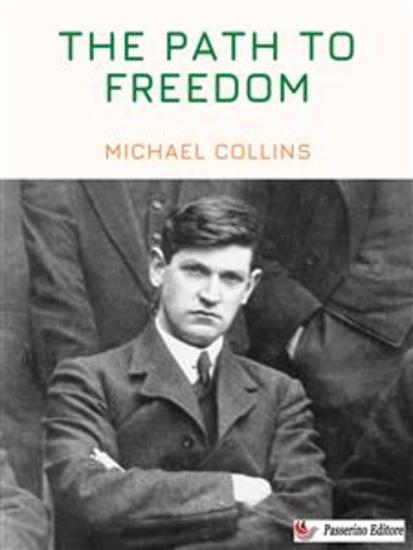
The Path to Freedom - cover

The Path to Freedom

Michael Collins

Verlag: Passerino

  • 0
  • 0
  • 0

Beschreibung

Michael Collins (16 October 1890 – 22 August 1922) was an Irish revolutionary, soldier and politician who was a leading figure in the early-20th century struggle for Irish independence. During the War of Independence he was Director of Intelligence of the Irish Republican Army (IRA) and a government minister of the self-declared Irish Republic. He was then Chairman of the Provisional Government of the Irish Free State from January 1922 and commander-in-chief of the National Army from July until his death in an ambush in August 1922, during the Civil War.

Collins bequeathed to posterity a considerable body of writing: essays, speeches and tracts, articles and official documents in which he outlined plans for Ireland's economic and cultural revival, as well as a voluminous correspondence, both official and personal. Selections have been published in The Path to Freedom and Michael Collins in His Own Words.
Verfügbar seit: 07.02.2023.

Weitere Bücher, die Sie mögen werden

  • Wage Labour and Capital - cover

    Wage Labour and Capital

    Karl Marx

    • 0
    • 0
    • 0
    *Wage-Labour and Capital* by Karl Marx is a foundational text in Marxist economic theory that explores the exploitative dynamics of capitalist societies. Originally delivered as a series of lectures, the work delves into the relationship between wage laborers and capitalists, emphasizing how workers sell their labor power for wages that merely sustain their existence, while the capitalists appropriate the surplus value created by the workers. Marx unpacks the mechanisms of capital accumulation, the commodification of labor, and the inherent inequalities that sustain the capitalist system. Serving as a precursor to his seminal work *Das Kapital*, this concise and accessible text provides a critical framework for understanding the economic forces underpinning modern industrial society and the cyclical crises that arise from its contradictions.
    Zum Buch
  • Italy's Paradise - A History of Tuscany - cover

    Italy's Paradise - A History of...

    Alistair Moffat

    • 0
    • 0
    • 0
    'A delicious trip through the geography, history and culture of the region' – Sunday Telegraph
    Ever since the days of the Grand Tour, Tuscany has cast its magic spell on foreign vistiors. Attracted by the perfect combination of history, art, architecture, superb natural beauty and weather – not to mention magnificent traditions of food and drink – British visitors and residents have been at times so numerous that the local word for foreigners was simply 'gli inglesi' – 'the English'.
    What is it that makes this exquisite part of Italy so seductive? Alistair Moffat embarks on a journey into Tuscany's past. From the flowering of the Etruscan civilization in the seventh century bc through the rise of the powerful medieval communes of Arezzo, Luca, Pisa and Florence, and the role the area played as the birthplace of the Renaissance, he underlines both the area's regional uniqueness as well as the vital role it has played in the history of the whole of Italy. Insightful, readable and imbued with the author's own enthusiasm for Tuscany, this book includes a wealth of information not found in tourist guides.
    'A sun-drenched meditation on the character of the place and its people' – The Scotsman
    Zum Buch
  • Forgotten Landscapes - How Native Americans Created Pre-Columbian North America and What We Can Learn From It - cover

    Forgotten Landscapes - How...

    Stanley A. Rice

    • 0
    • 0
    • 0
    North America was not empty nor were its inhabitants savages when Europeans arrived in 1492. Quite the opposite, North America was thickly populated by indigenous people who lived in clean cities, had a thriving economy, and transformed the landscape into bountiful productivity. Forgotten Landscapes reveals the incredible extent to which Native Americans manipulated and shaped their surrounding environs through agricultural practices and urban engineering, resulting in one of the most prosperous civilizations of their time.Well before European contact, North American cities and villages were bound together by an intricate trade network. Today, Spiro Mound in rural Oklahoma is a few piles of dirt, not on the road to anywhere. But at the time of the Mississippian civilization, about a thousand years ago, it was one of the largest cities in the world. With the controlled use of fire, Native Americans had transformed thick forests into open woodlands and expanded the ranges of prairies. Through organized hunting, Natives controlled the populations of prey animals such as passenger pigeons, and when Native populations grew large enough, they developed agriculture including irrigated crops, and even orchards. In this fascinating and overdue book, author Stanley A. Rice shows his audience the Pre-Columbian landscape of America that has been largely forgotten.
    Zum Buch
  • The Messianic Character of American Education - cover

    The Messianic Character of...

    R. J. Rushdoony

    • 0
    • 0
    • 0
    Rushdoony's study tells us an important part of American history: exactly what has public education been trying to accomplish? Before the 1830s and Horace Mann, no schools in the U.S. were state supported or state controlled. They were local, parent-teacher enterprises, supported without taxes, and taking care of all children. They were remarkably high in standard and were Christian. From Mann to the present, the state has used education to socialize the child. The school's basic purpose, according to its own philosophers, is not education in the traditional sense of the 3 R's. Instead, it is to promote "democracy" and "equality," not in their legal or civic sense, but in terms of the engineering of a socialized citizenry. Public education became the means of creating a social order of the educators design. Such men saw themselves and the school in messianic terms. This book was instrumental in launching the Christian school and homeschool movements.
    Zum Buch
  • Wild West’s Most Influential Black Men The: The Lives and Legacies of the Forgotten Mountain Men Cowboys Sheriffs and Rodeo Performers - cover

    Wild West’s Most Influential...

    Editors Charles River

    • 0
    • 0
    • 0
    Space may be the final frontier, but no frontier has ever captured the American imagination like the “Wild West”, which still evokes images of dusty cowboys, outlaws, gunfights, gamblers, and barroom brawls over 100 years after the West was settled. A constant fixture in American pop culture, the 19th century American West continues to be vividly and colorful portrayed not just as a place but as a state of mind. 
    	Almost absent in the perceptions of modern America is the comprehension of African Americans participating so prolifically in the building of the nation. Print fiction idealizing the cowboy life to Eastern readers would not depict what had ignited the war for which so many had an utter revulsion. The black man of the post-war years did not inspire the white spirit so essential for reveling in the old system. The 20th century’s television and cinematic offerings operated on the same drive, and the existence of black cattle workers was all but blotted out. Indeed, many of the modern age are barely aware that an African-American ever “stepped foot on the West bank of the Mississippi River.” No one saw the black cowboy on screen or in print, the two information industries that shaped our perception of America’s westward expansion. Therefore, a collective assumption that they must never have existed at all was nationally internalized. 
    	However, as UCLA professors Philip Durham and Everett L. Jones, authors of The Negro Cowboys, reminded readers, about 25% of cowboys working in the West were African-American. They further noted that former slaves emigrating from the South entered virtually every viable profession in the plains, mountain ranges, and on to the Pacific. Their contribution ranged from the military to mining, exploration, farming, and in the construction of the West’s first towns.
    Zum Buch
  • A Theologico-Political Treatise - cover

    A Theologico-Political Treatise

    Benedict Spinosa

    • 0
    • 0
    • 0
    Benedict Spinoza's 'A Theologico-Political Treatise' challenges prevailing religious and political dogmas of his time. With bold reasoning, Spinoza advocates for intellectual freedom, questioning the role of theology in governance. This seminal work lays the groundwork for secularism, advocating for a state where reason prevails over religious authority. A visionary treatise, it remains a cornerstone in discussions on freedom, politics, and the separation of church and state. Read in English, unabridged.
    Zum Buch