Join us on a literary world trip!
Add this book to bookshelf
Grey
Write a new comment Default profile 50px
Grey
Subscribe to read the full book or read the first pages for free!
All characters reduced
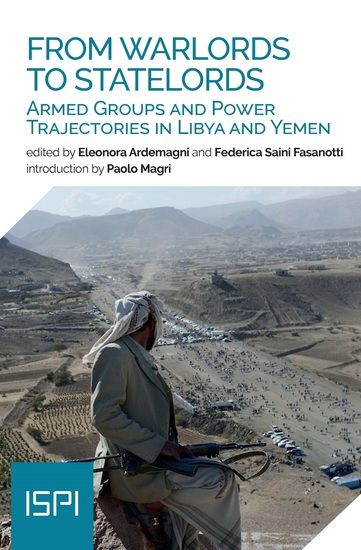
From Warlords to Statelords - Armed Groups and Power Trajectories in Libya and Yemen - cover

From Warlords to Statelords - Armed Groups and Power Trajectories in Libya and Yemen

Federica Saini Fasanotti, Eleonora Ardemagni

Publisher: Ledizioni

  • 0
  • 0
  • 0

Summary

In Libya and Yemen armed groups play a central role. Pervading weak and contested institutions, they have gradually brought their webs of survival, profit and governance under the state umbrella: warlords have become the new lords of the state. Armed groups control most of the energy revenues, critical infrastructure, smuggling and illicit trafficking. Their leaders are multifaceted: they are simultaneously military commanders, tribal chiefs, politicians and businessmen.
Combining comparative analysis and case studies, this Report sheds light on the "economic face" of the armed groups and their power trajectories. How do armed groups build networks of profit and loyalty in the territories they hold? How does clientelism mark a continuity trend with former authoritarian regimes?
Available since: 11/29/2022.
Print length: 156 pages.

Other books that might interest you

  • Simone Weil - Philosophy of Gravity and Grace - cover

    Simone Weil - Philosophy of...

    Hector Davidson

    • 0
    • 0
    • 0
    Simone Weil (1909–1943) stands as one of the most profound and unique thinkers of the 20th century, whose philosophy blends the intellectual rigor of traditional philosophy with the depth of mysticism, spirituality, and social activism. Despite her relatively short life, Weil’s work has had a lasting impact on diverse fields, including philosophy, theology, politics, and social theory. Her exploration of the concepts of gravity and grace forms the core of her intellectual legacy, offering a powerful lens through which to understand human suffering, freedom, and the potential for spiritual transformation. 
    At the heart of Weil’s philosophy is the concept of gravity, a metaphor she uses to describe the pull of the material world, which she believes leads to the oppression and suffering of individuals. Gravity represents the forces of self-centeredness, alienation, and the weight of human desires, which trap individuals in their own limitations and separation from the divine. It is the force that binds human beings to their own egos, making them blind to the higher truths of existence. 
    In stark contrast, grace in Weil’s thought is the force that can liberate individuals from the constraints of gravity. Unlike gravity, grace is not something humans can control or earn through effort. It is a divine gift that transcends human will and brings about a spiritual awakening. Grace enables individuals to experience a higher level of freedom—freedom from the self and from the oppression of the material world. For Weil, grace is central to human existence, as it offers the possibility of redemption and spiritual transformation.
    Show book
  • The Serpent’s Empire - Unmasking the Demonic Power Behind Racial Hatred - cover

    The Serpent’s Empire - Unmasking...

    Anonymous

    • 0
    • 0
    • 0
    What if the greatest threat to justice isn't just political corruption or social ignorance, but a spiritual force masquerading as righteousness? 
    In The Serpent's Empire: Unmasking the Demonic Power Behind Racial Hatred, Dr. Michael J. Henderson delivers a fearless and prophetic exposé on the spiritual and systemic roots of racism in America. This is not just a book—it is a spiritual weapon, cutting through centuries of lies upheld by whiteness, weaponized Christianity, and silent complicity. 
    From the slave ships to the sanctuary, from lynching trees to legislative halls, Henderson unveils how racial hatred has been sustained by principalities of darkness-and how many churches have baptized that hatred in the name of God. But this book does not stop at exposing evil. It speaks the truth. It honors the testimony of the oppressed. And it calls forth the lions those who will no longer bow to empire, but rise in holy resistance. 
    This is a book for the truth-tellers, the justice seekers, the wounded warriors, and the unashamed prophets. If you've ever felt like your faith didn't fit inside the walls of injustice, this book will affirm your fire. If you've ever been told to stay silent, this book will give you back your roar. The serpent is real. The empire is now exposed, and the Lion in you is about to roar.
    Show book
  • The Invented State - Policy Misperceptions in the American Public - cover

    The Invented State - Policy...

    Emily Thorson

    • 0
    • 0
    • 0
    In The Invented State, Emily Thorson argues that a problematic and understudied aspect of political misinformation reflects widespread public misperception about what the government does. Because much of public policy is invisible to the public, there is fertile ground for false beliefs to flourish, leading to what Thorson terms the "invented state": systematic misperceptions about public policy. However, people get the facts wrong not because they are stupid or blinded by partisan loyalty. Misperceptions are created when three conditions are met: when citizens have incomplete information about an issue, when their own biases color their understanding of it, and when they feel that the issue is important. The invented state is created by exposure to misinformation and by individuals' cognitive errors. 


    Correcting these policy misperceptions is highly effective at reducing false beliefs. Providing people with corrective information has downstream effects on attitudes. When they learn how policies really work, their approval increases and they also shift their policy priorities. Contrary to pundits' assumptions of a public who is largely indifferent to policy, there is a deep public desire to learn basic facts about how the government works. Thorson meets that desire with analysis on how the media can identify and correct substantive policy misperceptions.
    Show book
  • Social and Political Change in Revolutionary China - cover

    Social and Political Change in...

    David S. G Goodman

    • 0
    • 0
    • 0
    This in-depth study examines the influence of the Chinese Communist Party’s effective organizing in Shanxi Province during the War of Resistance. Shanxi Province was on the frontlines of the 1937–1945 War of Resistance against Japan—the war that launched the Chinese Communist Party. During that time, the Taihang Base Area of Southwest Shanxi was one of the Party’s most important strongholds. David Goodman provides the first county-level analysis of social and political change in the Taihang Base Area during those crucial years.   Goodman explores revolution as process, arguing that the Party was successful because of its management of revolutionary incrementalism. He examines the roles of various groups, highlighting the activities of urban intellectuals, teachers, and peasant small-holders as agents of change.   Based on newly available sources, including recently republished materials from the Taihang Base Area, restricted documentation from the Taiyuan Archive, and interviews with veterans of the Taihang Base Area this meticulously researched work deepens our understanding of the social and political origins of the Chinese revolution.
    Show book
  • Creating the KGB and CIA: The Establishment of the World’s Most Famous Intelligence Agencies - cover

    Creating the KGB and CIA: The...

    Editors Charles River

    • 0
    • 0
    • 0
    The KGB is one of the most famous abbreviations of the 20th century, and it has become synonymous with the shadowy and often violent actions of the Soviet Union’s secret police and internal security agencies. In fact, it is often used to refer to the Soviet state security agencies throughout its history, from the inception of the inception of the Cheka (Extraordinary Commission) in 1917 to the official elimination of the KGB in 1992. Whether it’s associated with the Russian Civil War’s excesses, Stalin’s purges, and even Vladimir Putin, the KGB has long been viewed as the West’s biggest bogeyman during the second half of the 20th century. However, the KGB did not appear out of thin air. Naturally, the earliest Soviet leaders utilized intelligence agencies that collected information both abroad and within the Soviet Union, targeting foreign opponents and domestic opponents alike. Lenin did not imagine the scale of the opposition he would have to face after the revolution, and he quickly came to the conclusion that "a special system of organized violence" must be created to implement the dictatorship of the proletariat. 
    Though it might be hard to believe, the Americans did not have a covert operations organization when they joined World War II, and like the British, it took them some time to realize it could be a powerful tool. As a result, the Office of Strategic Services (OSS) was not established until June 13, 1942, six months after the attack on Pearl Harbor. This would all chart a path for the early days of America’s most famous intelligence agency, the CIA. Although plagued by its own share of problems in its early existence during World War II and the early Cold War years, the agency’s early problems, smoothed over by a string of tenured presidents, paled in comparison to those it would face in the coming decades.
    Show book
  • The Last Best Hope - A History of American Realism - cover

    The Last Best Hope - A History...

    John Hulsman

    • 0
    • 0
    • 0
    In this brilliant exploration of American history and contemporary conservative politics, foreign policy expert John Hulsman draws on his years at the heart of Washington to present a compelling new vision of conservative realism. 
    In our current Age of Insecurity, Hulsman suggests, there has never been a bigger need for the re-ascendance of realist principles in conservative circles. By drawing on U.S. history to illustrate realist precepts at the heart of the American story, The Last Best Hope provides a practical, realist foreign policy for a new age of American politics. 
    There has never been a greater time to re-claim the primacy of conservative thought. By fusing the populist Jacksonian base of the GOP with the more libertarian Jeffersonian school of thought, this cogently argued manifesto hopes to grasp that opportunity, and to act as a clarion call for a new dominant realist foreign policy.
    Show book