Join us on a literary world trip!
Add this book to bookshelf
Grey
Write a new comment Default profile 50px
Grey
Subscribe to read the full book or read the first pages for free!
All characters reduced
Rise of Photojournalism - cover

Rise of Photojournalism

Mia Collins

Translator A AI

Publisher: Publifye

  • 0
  • 0
  • 0

Summary

Rise of Photojournalism explores the compelling history of photography's influence on journalism and its profound effects on society. The book examines how photojournalism has evolved from early photographic experiments to the digital age, highlighting the symbiotic relationship between visual communication and historical events. Readers will gain insights into how a single image can shape public perception and even ignite social change.

 
The book navigates ethical considerations surrounding objectivity and manipulation, fundamental to photojournalism, and discusses how iconic photographs have shaped opinions on global events. It progresses through thematic chapters, each concentrating on a specific era or pivotal moment in photojournalism's development, using case studies of impactful photographs and their stories.

 
What sets this book apart is its balanced view, acknowledging both the power and limitations of photojournalism. It offers a nuanced perspective on ethical dilemmas and encourages critical thinking about the images that shape our world, and is valuable for anyone seeking a deeper understanding of the ethical and social implications of visual communication.
Available since: 02/26/2025.
Print length: 73 pages.

Other books that might interest you

  • A Sense of Balance - cover

    A Sense of Balance

    John Howard

    • 0
    • 0
    • 0
    On how our feeling of equilibrium has characterized us as a country and will protect our future. 
    In the years that the creator served in the public parliament he came to figure out the extraordinary person of Australia; to see the value in its assets and shortcomings; and in particular to regard the feeling of equilibrium in the plan of public strategy that has long characterized us as a country and made Australia an appealing objective for individuals from across the world. 
    In this book he investigates this equilibrium, its establishments and its future. Composed against the background of the Coronavirus pandemic, as well as a portion of the more challenged political occasions of late years - the appointment of Donald Trump, the Brexit vote, the ascent of China, and, inside our own country, a merry go round of six heads of the state in eleven years - these reflections address how Australia has answered strain over the course of the past ten years or somewhere in the vicinity. Editorial regarding these matters from lawmakers, assessment scholars and web-based entertainment can at times appear to be deafening and disruptive. Australia's 25th and second longest serving head of the state has confidence that regardless of what difficulties and limits take steps to agitate our feeling of equilibrium, the nation's foundations and individuals will stay hearty for a significant length of time.
    Show book
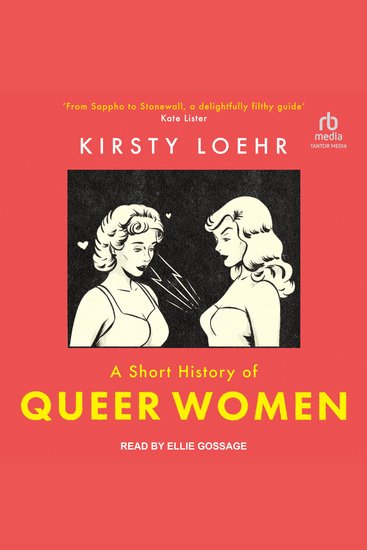
  • A Short History of Queer Women - cover

    A Short History of Queer Women

    Kirsty Loehr

    • 0
    • 0
    • 0
    Queer women have always existed—let's put them back in the history books 


    No, they weren't "just friends!" 


    Queer women have been written out of history since, well, forever. "But historians famously care about women!," said no one. From Anne Bonny and Mary Read who sailed the seas together disguised as pirates, to US football captain Megan Rapinoe declaring "You can't win a championship without gays on your team," via countless literary salons and tuxedos, A Short History of Queer Women sets the record straight on women who have loved other women through the ages. 


    Who says lesbians can't be funny?
    Show book
  • The Last Landlady - An English Memoir - cover

    The Last Landlady - An English...

    Laura Thompson

    • 0
    • 0
    • 0
    Laura Thompson's grandmother Violet was one of the great landladies. Born in a London pub, she became the first woman to be given a publican's licence in her own name. Just as pubs defined her life, she seemed in many ways to embody their essence.
    
    
    Laura spent part of her childhood in Violet's Home Counties establishment, mesmerised by her gift for cultivating the mix of cosiness and glamour that defined the pub's atmosphere, making it a unique reflection of the national character. Her memories of this time are just as intoxicating: beer and ash on the carpets in the morning, the deepening rhythms of mirth at night, the magical brightness of glass behind the bar…
    
    
    Through them Laura traces the story of the English pub, asking why it has occupied such a treasured position in our culture. But even Violet, as she grew older, recognised that places like hers were a dying breed, and Laura also considers the precarious future they face. 
    Part memoir, part social history, part elegy,  The Last Landlady  pays tribute to an extraordinary woman and the world she epitomised. It was selected as a Spectator book of the year in 2018.
    Show book
  • I Have a Dream - cover

    I Have a Dream

    Martin Luther King

    • 0
    • 0
    • 0
    Introducing the Martin Luther King Jr Library 
    With a New Foreword written and read by Amanda Gorman. 
    A beautiful audio edition of Dr. Martin Luther King Jr’s legendary speech at the March on Washington, part of Dr. King’s archives published exclusively by HarperCollins, hear both the original recording of the speech and a new reading by Blair Underwood. 
    On August 28, 1963, Dr. Martin Luther King Jr. stood before thousands of Americans who had gathered at the Lincoln Memorial in Washington, D.C. in the name of civil rights. Including the immortal words, “I have a dream,” Dr. King’s keynote speech would energize a movement and change the course of history. 
    With references to the Gettysburg Address, the Emancipation Proclamation, the Declaration of Independence, the U.S. Constitution, Shakespeare, and the Bible, Dr. King’s March on Washington address has long been hailed as one of the greatest pieces of writing and oration in history. Profound and deeply moving, it is as relevant today as it was nearly sixty years earlier. 
    This beautiful edition presents Dr. King’s speech in its entirety, paying tribute to this extraordinary leader and his immeasurable contribution, and inspiring a new generation of activists dedicated to carrying on the fight for justice and equality. 
    Show book
  • END OF HISTORY AND THE LAST MAN 10-Minute Summary THE - Has history come to an end? The boldest and most brilliant interpretation of humanity’s present and future history - cover

    END OF HISTORY AND THE LAST MAN...

    Francis Fukuyama

    • 0
    • 0
    • 0
    In The End of History and the Last Man, political scientist Francis Fukuyama presents one of the most provocative theses of the contemporary era: after the fall of the Berlin Wall and the collapse of the Soviet Union, liberal democracy not only emerged as the dominant political model, but also represents the culmination of humanity’s ideological evolution. 
    With clear prose and rigorous argumentation, Fukuyama draws on thinkers such as Hegel, Marx, and Nietzsche to develop an ambitious vision: if history is a struggle of ideas, then liberalism has triumphed over its rivals—fascism and communism—on political, economic, and moral grounds. From this perspective, humanity has reached its ultimate form of organization, at least structurally. 
    However, this claim is neither triumphalist nor naive. Fukuyama acknowledges the challenges that liberal democracies face: nationalism, religion, economic inequality, and especially the threat of the “last man,” a passive, conformist figure concerned solely with personal well-being. The author warns that although liberal ideology has prevailed, the human yearning for recognition, identity, and purpose remains alive. History may have ended, but human dilemmas persist. 
    This book offers not only a deep historical and philosophical reading but also challenges the reader with fundamental questions: What does it mean to be free? Can a society live without transcendent ideals? Are we condemned to comfort, or are we capable of reinventing our purpose? 
    Ideal for readers interested in politics, philosophy, contemporary history, and social theory, this work has become a classic of modern political thought. A brilliant, controversial, and deeply relevant text that invites reflection on humanity’s destiny in an age of uncertainty. 
       
     
    Show book
  • Mesoamerican Capitals - Cities of Stone and Gold (4 in 1) - cover

    Mesoamerican Capitals - Cities...

    Rolf Hedger

    • 0
    • 0
    • 0
    From the mist-shrouded valleys of central Mexico to the glimmering highlands of Colombia, the ancient Americas witnessed the rise of extraordinary urban centers that would shape the destiny of countless generations. In "Mesoamerican Capitals: Cities of Stone and Gold," we embark on a journey through time to explore four of the most influential civilizations that rose to prominence long before European contact transformed the Western Hemisphere. 
    These weren't merely settlements but complex metropolitan hubs—centers of innovation, artistry, and power that rivaled their Old World contemporparts in sophistication and grandeur. Teotihuacan, with its monumental Avenue of the Dead and towering pyramids, once housed over 125,000 inhabitants in a masterfully planned cityscape that influenced cultures throughout Mesoamerica. The Toltec capital of Tula stood as a beacon of military might and cultural refinement, establishing patterns of rulership and religious practice that would echo for centuries. Monte Albán, crown jewel of the Zapotec civilization, commanded the valleys of Oaxaca from its mountain perch, while the Muisca Confederation created a network of urban centers across the Colombian highlands, their wealth in gold becoming the stuff of legend. 
    These weren't simply places where people gathered—they were the physical manifestations of worldviews, cosmologies encoded in stone and adobe. Each represented distinct approaches to urban planning, governance, and the relationship between the sacred and the profane. Their rulers wielded power through combinations of divine authority, military prowess, and control of vital trade routes that connected distant regions through complex networks of exchange. 
    As you turn listen to this book, you'll discover how these remarkable urban centers functioned as crucibles of innovation, where art, architecture, mathematics, astronomy, and religious thought flourished in distinctive ways.
    Show book