Join us on a literary world trip!
Add this book to bookshelf
Grey
Write a new comment Default profile 50px
Grey
Subscribe to read the full book or read the first pages for free!
All characters reduced
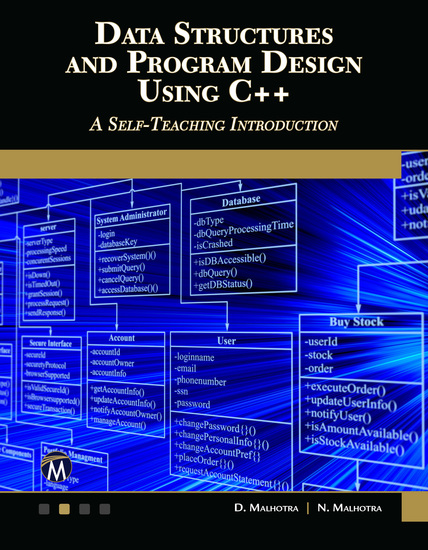
Data Structures and Program Design Using C++ - A Self-Teaching Introduction to Data Structures and C++ - cover

Data Structures and Program Design Using C++ - A Self-Teaching Introduction to Data Structures and C++

Mercury Learning and Information, D. Malhotra, N. Malhotra

Publisher: Packt Publishing

  • 0
  • 0
  • 0

Summary

This book introduces the fundamentals of data structures using C++ in a self-teaching format. It covers managing large amounts of information, SEO, and creating Internet/Web indexing services. Practical analogies with real-world applications help explain technical concepts. The book includes end-of-chapter exercises such as programming tasks, theoretical questions, and multiple-choice quizzes.The course starts with an introduction to data structures and the C++ language, progressing through arrays, linked lists, queues, searching and sorting, stacks, trees, multi-way search trees, hashing, files, and graphs. Each chapter builds on the previous one, ensuring a comprehensive understanding of data structures.Understanding these concepts is crucial for managing large databases and optimizing web services. This book guides readers from basic to advanced data structure techniques, blending theoretical knowledge with practical skills. Companion files with source code and data sets enhance the learning experience, making this book an essential resource for mastering data structures with C++.
Available since: 08/01/2024.
Print length: 568 pages.

Other books that might interest you

  • Ultimate Web Authentication Handbook - Strengthen Web Security by Leveraging Cryptography and Authentication Protocols such as OAuth SAML and FIDO - cover

    Ultimate Web Authentication...

    Sambit Dash

    • 0
    • 1
    • 0
    Practical gateway to securing web applications with OIDC, OAuth, SAML, FIDO, and Digital Identity to. 


    KEY FEATURES 
    ? Dive into real-world practical hands-on experience with authentication protocols through sample code. 
    ? Gain a programmer's perspective on cryptography, certificates, and their role in securing authentication processes. 
    ? Explore a wide array of authentication protocols, including TLS, SAML, OAuth, OIDC, WebAuthn, and Digital Identity. 
    ? Graded step-by-step guidance that simplifies complex concepts, making them accessible to programmers of all levels of expertise. 


    DESCRIPTIONIn today's digital landscape, web apps evolve rapidly, demanding enhanced security. This Ultimate Web Authentication Handbook offers a comprehensive journey into this realm. Beginning with web authentication basics, it builds a strong foundation. You'll explore cryptography fundamentals, essential for secure authentication. The book delves into the connection between authentication and network security, mastering federated authentication via OAuth and OIDC protocols. 


    You'll also harness multi factor authentication's power and stay updated on advanced trends. The book expands on deepening your understanding of Java Web Token (JWT), FIDO 2, WebAuthn, and biometric authentication to fortify web apps against multifaceted threats. Moreover, you'll learn to use Identity and Access Management (IAM) solutions for constructing highly secure systems. Whether you're a developer, security enthusiast, or simply curious about web security, this book unlocks the secrets of secure online interactions. 


    WHAT WILL YOU LEARN 
    ? Comprehend Web Application Architectures and Enhance Security Measures. 
    ? Implement Robust Web Security with Public Key Cryptography. 
    ? Harness SAML, OAuth, and OIDC for Advanced User Authentication and Authorization. 
    ? Strengthen Web App Security with Multi Factor Authentication. Transition to Passwordless Authentication with FIDO and Biometric Security. 
    ? Stay Ahead with Insights into Digital Identity, Biometric Authentication, Post-Quantum Cryptography, and Zero Trust Architecture Trends. 


    WHO IS THIS BOOK FOR?This book is for computer programmers, web application designers, and architects. Most Identity Management Products focus on the server components, while this book intends to serve numerous developers of client integrations who need a conceptual understanding of the standards. The sample applications are developed using Golang and Flutter Web. 


    TABLE OF CONTENTS 
    1. Introduction to Web Authentication. 
    2. Fundamentals of Cryptography. 
    3. Authentication with Network Security. 
    4. Federated Authentication-I
    5. Federated Authentication-II
    6. Multifactor Authentication. 
    7. Advanced Trends in Authentication.   
    Appendix A: The Go Programming Language Reference.   
    Appendix B: The Flutter Application Framework.   
    Appendix C: TLS Certificate Creation. 	 
    Index.
    Show book
  • A Field Guide to Climate Anxiety - How to Keep Your Cool on a Warming Planet - cover

    A Field Guide to Climate Anxiety...

    Sarah Jaquette Ray

    • 0
    • 0
    • 0
    Gen Z's first "existential toolkit" for combating eco-guilt and burnout while advocating for climate justice. 


    A youth movement is reenergizing global environmental activism. The "climate generation"—late millennials and iGen, or Generation Z—is demanding that policy makers and government leaders take immediate action to address the dire outcomes predicted by climate science. Those inheriting our planet's environmental problems expect to encounter challenges, but they may not have the skills to grapple with the feelings of powerlessness and despair that may arise when they confront this seemingly intractable situation. 


    Drawing on a decade of experience leading and teaching in college environmental studies programs, Sarah Jaquette Ray has created an "existential tool kit" for the climate generation. Combining insights from psychology, sociology, social movements, mindfulness, and the environmental humanities, Ray explains why and how we need to let go of eco-guilt, resist burnout, and cultivate resilience while advocating for climate justice. A Field Guide to Climate Anxiety is the essential guidebook for the climate generation—and perhaps the rest of us—as we confront the greatest environmental threat of our time.
    Show book
  • Right Down + Circle: Tony Hawk's Pro Skater - cover

    Right Down + Circle: Tony Hawk's...

    Cole Nowicki

    • 0
    • 0
    • 0
    An exuberant, incisive look at how Tony Hawk’s Pro Skater transformed a culture 
     
    Going from a hobby toy for surfers to an Olympic sport, skateboarding has had a tumultuous history. Today, professional skateboarders land endorsement deals with Nike and Adidas, while popular television series like HBO’s Betty tell the stories of diverse crews of skaters living in New York City. So how did a fledgling subculture rise from its near-death knell in the ’90s to become ubiquitous today? It was simply a matter of finding the right messenger. 
     
    In 1999, the bestselling video game Tony Hawk’sPro Skater was released, and a new generation was exposed to skateboarding culture right in their very own homes. Kids and adults alike could now spend hours playing as actual skateboarders, learning the vernacular, listening to the music skateboarders loved, and having fun onscreen before trying to skate IRL in the driveway. 
     
    Right, Down + Circle explores how a video game starring the most famous pro skater in the world brought skateboarding culture ― and its ever-shifting markers of music, subversion, and coolness ― to the masses and ultimately transformed the culture it borrowed from in the process.
    Show book
  • Python in Depth - A Multipurpose Coder and Programmer's Guide - cover

    Python in Depth - A Multipurpose...

    D Nathan Venture

    • 0
    • 0
    • 0
    This audiobook is narrated by an AI Voice.  
    Step Into the Future of Coding with Python: Your Comprehensive Guide Awaits 
    Dive into the vibrant universe of Python and emerge as a skilled coder and programmer equipped with the knowledge to tackle any challenge the digital world throws your way. Python in Depth: A Multipurpose Coder and Programmer's Guide is not just another programming book; it's a beacon guiding you through the ever-evolving landscape of Python, from basic concepts to the most advanced applications. 
    Begin your journey with an insightful introduction that not only welcomes you to the Python community but also prepares you for the exciting path ahead. Explore the world of Python in our first chapter, understanding why Python’s simplicity and versatility make it the go-to language for professionals worldwide. Whether you're setting up your environment, selecting an IDE, or diving into Python's syntax and structure, this guide ensures a smooth initiation into coding practices that matter. 
    But that's just the start. 
    As you progress, immerse yourself in intermediate and advanced topics that are crucial for modern development. From object-oriented programming, exception handling, to exploring Python’s extensive library ecosystem, every chapter serves as a stepping stone towards mastery. Delve into databases, web frameworks like Django and Flask, and unlock the potential of Python in data science, machine learning, and beyond. 
    What truly sets this guide apart is its dedication to not just teaching Python, but doing so in a manner that promotes readability, efficiency, and best practices. Learn how to optimize your code, adhere to the Python style guide, and navigate the nuances of collaborative development with ease.
    Show book
  • Elevate Your Projects : Infusing Spiritual Principles in Project Management - Spiritual Wisdom for Effective Project Delivery - cover

    Elevate Your Projects : Infusing...

    Rohit Dumane

    • 0
    • 0
    • 0
    This book "Elevate Your Projects: Infusing Spiritual Principles in Project Management" reveals how integrating spiritual principles can elevate your projects, teams, and outcomes. Drawing from the author's three decades of experience in Project Management of versatile Construction Projects, this guide shows how to infuse your projects with purpose, compassion, and resilience. Discover how to cultivate a culture of collaboration, innovation, and sustainability, and learn how to measure success through spiritual metrics. Embark on this journey to elevate your projects and transform your approach to Project Management.
    Show book
  • Creative Evolution - cover

    Creative Evolution

    Henri Bergson

    • 0
    • 0
    • 0
    Henri Bergson’s highly influential book, ‘Creative Evolution’ (‘Evolution Creatrice’, 1907) established a theory of evolution - called ‘Creative Evolution Theory’ - which gained a considerable following in the first half of the 20th Century. It also helped the author to win the Nobel Prize in 1927 for his work investigating the origins of biological information and divergence in the evolutionary process.  
     
    In this work, Bergson seeks an alternative explanation as to how new forms of life emerge compared to those prevailing at the time. This included both the ‘mechanistic’ or deterministic explanations of biological science on the one hand, and on the other the ‘finalist’ or strictly teleological explanation of those who believed in the hand of a ‘Creator’ or God, coordinating life in a divine plan. 
     
    Creative Evolution proposes a third explanation in what Bergson calls élan vital’ or ‘vital impetus’, a force that infuses all matter and drives it forward into an ever-changing and infinite variety of living forms. This appears as a vital impetus that can also be related to humanity’s own creative life force. Bergson’s book builds on his ‘Theory of Time’ as set forth in works such as ‘Matter and Memory’ and ‘Time and Free Will’.  In these works, and in the present volume, Bergson sees continuous ‘duration’ as real time, as opposed to the way in which time is divided up into measured units by the ‘organising’ mind of science. 
     
    Life, as we really experience it, is subject to constant change and our tendency to explain evolutionary change by looking only at ‘ends’ achieved rather than the processes by which they emerge, divorces us from the life force itself.  
     
    Instead, Bergson feels we need to reengage with our instincts as well as with our intelligence in order to understand the evolutionary process, as both co-exist to some extent within us, all forms of life having a common origin in that instinctual, innate knowledge of simpler life forms. Though these may be unconscious or semi-conscious, they are, in Bergson’s view, much more in touch with the ever-changing nature of real time than the analytical and rational knowledge of our species 
     
    As he writes:  “Our thought, in its purely logical form, is incapable of presenting the true nature of life, the full meaning of the evolutionary movement. Created by life, in definite circumstances, to act on definite things, how can it embrace life, of which it is only an emanation or an aspect?”  
     
    It is to attempt an answer to this question that ‘Creative Evolution’ directs its attention.
    Show book