Join us on a literary world trip!
Add this book to bookshelf
Grey
Write a new comment Default profile 50px
Grey
Subscribe to read the full book or read the first pages for free!
All characters reduced
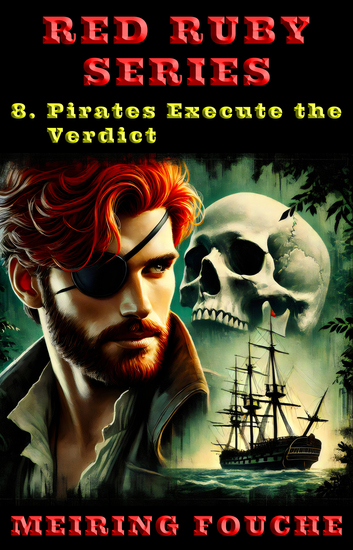
Pirates Execute the Verdict - A romantic pirate adventure Book 8 - cover

Pirates Execute the Verdict - A romantic pirate adventure Book 8

Meiring Fouche

Translator Pieter Haasbroek, A AI

Publisher: Pieter Haasbroek

  • 0
  • 0
  • 0

Summary

A ghost ship adrift on the African coast.
 
A deck awash in blood and corpses.
 
For Captain Simon Verbeeck, this is no ordinary prize, it is the beginning of a nightmare.
 
Gold Coast of Africa (1726). The famed pirate hunter Simon Verbeeck discovers a ship of the dead, its crew slaughtered in a mystery drenched with blood. But before he can uncover the truth, he is ambushed. His legendary vessel, the Red Ruby, is stolen en his crew scattered. Simon himself is left for dead by a charismatic traitor on a twisted crusade.
 
Stripped of power and hunted across hostile shores, Simon becomes a pawn in a madman’s game. Helpless, he watches as the Red Ruby is reborn as a pirate ship, its new captain willing to spill oceans of blood for his cause.
 
Beset by the traitor’s fleet and a hostile native tribe, Simon must claw his way back from ruin. To reclaim his ship and his honor, he may have to become more ruthless than the very monsters he hunts.
 
Packed with betrayal, mystery, and relentless high-seas action, Pirates Execute the Verdict is perfect for fans of Master and Commander and the pulse-pounding drama of Black Sails.
 
Set sail on the eighth book of Meiring Fouche’s unforgettable pirate saga today.
Available since: 02/03/2025.
Print length: 114 pages.
Other books that might interest you

  • The House of the Dead - Or Prison Life in Siberia - cover

    The House of the Dead - Or...

    Fyodor Dostoyevsky

    • 0
    • 0
    • 0
    The semiautobiographical prison account of convict Aleksandr Petrovich Goryanchikov, from the author of Crime and Punishment.   Originally published in 1862, The House of the Dead is based on Fyodor Dostoyevsky’s own four-year imprisonment in Siberia for his involvement in the Petrashevsky Circle. This masterpiece of Russian literature begins with a nameless narrator coming upon former convict Aleksandr Petrovich Goryanchikov in a remote Siberian town. Previously a nobleman and landowner, Goryanchikov had been given a ten-year sentence of hard labor for the murder of his wife, a crime of passion sparked by jealousy. After Goryanchikov’s death, the narrator finds a handwritten record of his decade of penal servitude. From his first days in the barracks, friendless and broken in spirit, to the removal of his shackles and freedom, Goryanchikov portrays the experiences of a “lost tribe of men,” and the horrors and degradation they experienced.  “Episodic, rambling, full of keen and deliberately stretched-out character sketches, the book is the drama of a person working out how to reproduce prison life in prose: its longueurs, its diversions, its pleasures, traumas, and inurements  . . . If Dostoyevsky’s captors had found the ribald, cacophonous commonplace book he assembled out of overheard insults and tossed-off sayings during his time in prison, they would have recognized that they were dealing with a spirit not easily suppressed.” —The Paris Review  “I know no better book in all modern literature.” —Leo Tolstoy
    Show book
  • Innocents Of Fr Brown - Produced by John Pridmore - cover

    Innocents Of Fr Brown - Produced...

    G K Chesterton

    • 0
    • 0
    • 0
    The Innocence of Father Brown is the first of five collections of mystery stories featuring Chesterton's canny priest. It's probably the best collection and it introduces the holy detective—as well as his sometime opponent, sometime collaborator, Flambeau. But each collection offers some great stories. 
    I'm very fond of Father Brown—despite several potential obstacles. 
    For one thing, the plots of these stories are implausible. They are part of the tradition of British murder mysteries that the later American hardboiled school revolted against. Murders are carried out in ridiculously complicated fashions, as no crimes are committed in the real world. 
    Father Brown is the prototype of the intuitive amateur sleuth (like Agatha Christie's Miss Marple and TV's Jessica Fletcher on Murder, She Wrote), who runs into murders everywhere he goes and manages to solve the crimes with only one or two clues where thorough, professional investigators are stumped. 
    The mysteries are extremely clever on the most superficial level, with several innovations on the classic locked-door mystery and other more novel situations. But on top of that, they involve an understanding of human nature—or at least of how human nature operates in society. 
    Typically, Father Brown solves crimes by sharing the perpetrators' own insights into human perception, which allow them to commit the deeds and him to uncover them. He sees what others, including the readers, do not, even when it is right before our eyes. 
    Not always though. In about a third of the stories I did see the solution coming from a long way off. I suspect though this is because these stories, like the mysteries of Arthur Conan Doyle and Edgar Allen Poe, have become embedded in our culture. The surprise has worn off because the tricks have been replayed so many times in stories, movies and television shows since they were invented by these masters.
    Show book
  • Labour Unrest The (Unabridged) - cover

    Labour Unrest The (Unabridged)

    H. G. Wells

    • 0
    • 0
    • 0
    Herbert George Wells (21 September 1866 - 13 August 1946) was an English writer. Prolific in many genres, he wrote dozens of novels, short stories, and works of social commentary, history, satire, biography and autobiography. His work also included two books on recreational war games. Wells is now best remembered for his science fiction novels and is often called the "father of science fiction", along with Jules Verne and the publisher Hugo Gernsback.
    THE LABOUR UNREST: Our country is, I think, in a dangerous state of social disturbance. The discontent of the labouring mass of the community is deep and increasing. It may be that we are in the opening phase of a real and irreparable class war.
    Show book
  • Les Misérables - Volume 2: Cosette (Unabridged) - cover

    Les Misérables - Volume 2:...

    Victor Hugo

    • 0
    • 0
    • 0
    Victor-Marie Hugo (26 February 1802 - 22 May 1885) was a French poet, novelist, essayist, playwright, and dramatist of the Romantic movement. During a literary career that spanned more than sixty years, he wrote abundantly in an exceptional variety of genres: lyrics, satires, epics, philosophical poems, epigrams, novels, history, critical essays, political speeches, funeral orations, diaries, and letters public and private, as well as dramas in verse and prose.
    VOLUME 2: COSETTE: Last year (1861), on a beautiful May morning, a traveller, the person who is telling this story, was coming from Nivelles, and directing his course towards La Hulpe. He was on foot. He was pursuing a broad paved road, which undulated between two rows of trees, over the hills which succeed each other, raise the road and let it fall again, and produce something in the nature of enormous waves.
    Show book
  • Man With a Nose The (Unabridged) - cover

    Man With a Nose The (Unabridged)

    H. G. Wells

    • 0
    • 0
    • 0
    Herbert George "H. G." Wells (1866 - 1946) was an English writer.
    He was prolific in many genres, including the novel, history, politics, social commentary, and textbooks and rules for war games. Wells is now best remembered for his science fiction novels and is called a "father of science fiction"
    THE MAN WITH A NOSE: "I never see thy face but I think upon hell-fire, and Dives that lived
    in purple, for there he is in his robes, burning, burning." "My nose has been the curse of my life."
    Show book
  • Marquis de Sade's Midsummer Night's Dream Conceivable - cover

    Marquis de Sade's Midsummer...

    Ophelia T'Wat, Robert Dwight...

    • 0
    • 0
    • 0
    Full-Cast Audiobook! 
    Go Beyond Your Wettest Dreams... as If You Are Penniless and Yet Listening From Outside the Globe Theater! 
    In the last decade of the 16th century, William Shakespeare could not dare write A Midsummer Night's (Wet) Dream unabridged. By the happenchance of his birth-century, The Bard wrote in a poetic 'Shakespearean Code', hinting at sexualities and paraphilias he fully intended to compose and expose his Elizabethan audience to. His intended 'erotica for every fetish' morphed instead into a 'humane and wise drama' by happenchance.  
    But What If? there was a multiversal reality where the Marquis de Sade deciphered the Shakespearean Code during his long stay at the lunatic asylum at Charenton. But now Ophelia T'Wat, living in a much more sexually accepting century, can reach across realities to snatch these pages from the bloody quill of the Marquis and finally, fatefully publish the Wettest Midsummer Night'sDream conceivable! 
    Show book