Join us on a literary world trip!
Add this book to bookshelf
Grey
Write a new comment Default profile 50px
Grey
Subscribe to read the full book or read the first pages for free!
All characters reduced
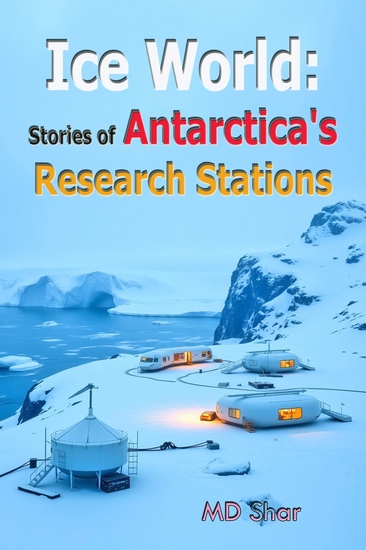
Ice World - Stories of Antarctica's Research Stations - cover

Ice World - Stories of Antarctica's Research Stations

MD Shar

Publisher: Publishdrive

  • 0
  • 0
  • 0

Summary

"Ice World: Stories of Antarctica's Research Stations" explores the vast, frozen landscape of Antarctica—a continent of extremes, scientific breakthroughs, and human resilience. It chronicles the evolution of global research efforts through the stories of iconic research stations like McMurdo (USA), Rothera (UK), Concordia (France-Italy), Vostok (Russia), Showa (Japan), and others. The book highlights the vital contributions of Indian stations—Dakshin Gangotri, Maitri, and Bharati—emphasizing India’s growing scientific role. With temperatures below -80°C and months of darkness, researchers work in isolation to uncover insights about climate change, the ozone layer, geology, space analogues, and subglacial microbial life. The narrative celebrates international cooperation under the Antarctic Treaty and delves into the daily lives, challenges, and triumphs of the scientists who live at the edge of the world. More than a scientific chronicle, it is a tribute to the human spirit and our collective drive to explore and protect the planet.
Available since: 04/30/2025.
Print length: 280 pages.
Other books that might interest you

  • Monsters of West Virginia - Mysterious Creatures in the Mountain State - cover

    Monsters of West Virginia -...

    Rosemary Ellen Guiley

    • 0
    • 0
    • 0
    Wild and wonderful West Virginia takes a turn for the weird with these accounts of Mothman, the Grafton Monster, Sheepsquatch, and more.   Every state and region has its own stellar cast of supernatural creatures, and West Virginia is no exception. Rosemary Ellen Guiley, the pioneering paranormal investigator, has spent a great deal of time in the Mountain State on the trail of entities, creatures, and all sorts of phenomena. These are her findings, featuring accounts of Mothman, the Grafton Monster, the Wampus Cat, the White Things, and other bizarre creatures, including Bigfoot, lizard people, and out-of-place panthers.  “Featuring tales of Mothman, the Sheepsquatch, and a host of lesser known West Virginia weirdness, Monsters of West Virginia is the perfect book for anyone with even a passing interest in West Virginia cryptozoology . . . a quick read by one of the most knowledgeable researchers of the paranormal in the country.” —Theresa’s Haunted History of the Tri-State
    Show book
  • Citizen of the World: Soon-Young and the UN - cover

    Citizen of the World: Soon-Young...

    Soon-Young Yoon

    • 0
    • 0
    • 0
    From North Korean Refugee to the United Nations: A Courageous and Compassionate Memoir 
    Soon-Young Yoon understood from an early age that people's destinies are connected to international events. This book is a collection of her reflections as a women's human rights advocate speaking up to end violence against women and change the world to ensure gender equality, sustainable development, and peace. 
    Yoon has seen the struggle for human rights in all corners of the world, meeting with people in urban slums and the offices of the United Nations. She urges us to look at the world through women's eyes to understand why gender equality and women's empowerment, particularly for the poorest and most vulnerable populations, is essential to our collective good. 
    In Citizen of the World, you'll be inspired by Yoon's stories on 
    Ending violence against women and girls 
    Finding the Earth's balance 
    Claiming the right to social and economic development 
    Portraits of great women leaders 
    Collective voices that are changing the world 
    Challenges working as a feminist anthropologist inside and outside the United Nations 
    Written through the lens of an anthropologist, these essays reflect her belief that one needs to understand a wide range of issues to shape our common future. 
    Students, academics, and activists in the fields of women's studies, international relations, anthropology, and social justice will find Citizen of the World both unique and eye-opening—and filled with hope for a better future for us all.
    Show book
  • Daily Life in Ancient Egypt - Society Culture and Customs - cover

    Daily Life in Ancient Egypt -...

    Omar Khalil

    • 0
    • 0
    • 0
    Ancient Egyptian society was highly structured, with a rigid hierarchy that defined people’s roles and responsibilities. At the top of this social order was the pharaoh, considered both a political ruler and a divine figure. Below the pharaoh were the nobility and officials who managed the kingdom’s affairs. The middle class consisted of scribes, artisans, and merchants, while the majority of the population comprised farmers, laborers, and slaves. Each social group played a crucial role in maintaining Egypt’s stability and prosperity. 
    The pharaoh was the central authority in Egypt, believed to be the living embodiment of a god. His rule was absolute, and his primary duty was to maintain ma’at, the divine balance of order and justice. He oversaw military campaigns, religious ceremonies, and massive building projects, including temples and pyramids. The royal court and government officials assisted the pharaoh in administration. These officials, often chosen from the nobility, held positions such as viziers, tax collectors, and governors, ensuring the kingdom functioned efficiently. 
    Scribes, artisans, and merchants formed the middle class, contributing to Egypt’s economy and culture. Scribes were essential for maintaining records, writing official documents, and preserving religious texts. Their education was rigorous, requiring years of training in hieroglyphic writing. Artisans, including sculptors, painters, and metalworkers, created the intricate decorations found in tombs and temples. Merchants facilitated trade both within Egypt and with foreign lands, bringing valuable goods such as gold, spices, and precious stones. Although they did not hold political power, the middle class enjoyed a stable livelihood and social respect.
    Show book
  • Egyptian Science - Innovations and Discoveries of the Ancient World (3 in 1) - cover

    Egyptian Science - Innovations...

    Omar Khalil

    • 0
    • 0
    • 0
    Egyptian Science – Innovations and Discoveries of the Ancient World (3 in 1) offers a captivating dive into the scientific brilliance of ancient Egypt, revealing how a civilization often known for its mysticism was also a beacon of practical knowledge and invention. This collection highlights the remarkable advancements made by Egyptian scholars, physicians, engineers, and astronomers—centuries before many of these concepts reached the rest of the world. 
    The first section explores medicine and anatomy, showcasing how ancient Egyptian doctors performed surgeries, treated wounds, and understood diseases with a surprisingly systematic approach. Medical texts, herbal remedies, and anatomical observations formed the foundation of a health system deeply intertwined with both empirical knowledge and spiritual beliefs. 
    In the second section, readers uncover the mathematical and engineering feats that made the construction of monumental structures like pyramids and temples possible. Discover how Egyptians used geometry, surveying tools, and complex planning techniques to design precise buildings and manage the Nile’s life-giving floods. Their grasp of weights, measurements, and balance was essential to everything from agriculture to architecture. 
    The final section reveals the Egyptians' advanced understanding of astronomy and timekeeping. They charted celestial movements, created solar calendars, and aligned structures with astronomical events. Whether for agricultural cycles, religious ceremonies, or royal rituals, their scientific innovations were closely tied to their spiritual worldview. This volume shows how ancient Egypt’s legacy is not only in stone but also in knowledge that shaped civilizations to come.
    Show book
  • Imperial Chinese Foundations - Uniting the Land (3 in 1) - cover

    Imperial Chinese Foundations -...

    Rolf Hedger

    • 0
    • 0
    • 0
    The story of China's imperial unification represents one of history's most consequential political transformations. "Imperial Chinese Foundations: Uniting the Land" explores the three dynasties that forged China's imperial system—a political structure that would endure for over two millennia. 
    The brief but revolutionary Qin Dynasty (221-206 BCE) ended centuries of warring states by conquering all rivals under the leadership of the First Emperor, Qin Shi Huang. Through military might, standardized writing, currency, measurements, and a unified legal code, the Qin created China's first centralized bureaucratic empire—though their harsh Legalist policies triggered rebellion after the emperor's death. 
    The Western Han Dynasty (206 BCE-9 CE) consolidated imperial rule through a more pragmatic blend of Confucian ideology and centralized governance. Under Emperor Wu's dynamic leadership, the Han expanded Chinese territory, opened the Silk Road, established the civil service examination system, and created cultural and political institutions that would define Chinese civilization for millennia. 
    As power shifted to the Eastern Han (25-220 CE), the dynasty initially flourished before facing mounting challenges from natural disasters, court intrigues, and the Yellow Turban Rebellion. Yet even as political cohesion weakened, this period saw remarkable innovations—including paper, the seismograph, and advances in mathematics and medicine—while Buddhism began its profound influence on Chinese civilization. 
    Through examining these three foundational dynasties, we witness the birth and evolution of the imperial Chinese state that would serve as a template for governance across East Asia and continue to influence Chinese identity into the modern era.
    Show book
  • Born Naked - cover

    Born Naked

    Farley Mowat

    • 0
    • 0
    • 0
    Farley Mowat's youth was charmed and hilarious, and unbelievably free in its access to unspoiled nature through bird-banding expeditions and overnight outings in the dead of winter. The author writes of sleeping in haystacks for survival, and other adventures, with equal shares of Booth Tarkington and Jack London. He also brings back Mutt, the famous hero-dog of his classic The Dog Who Wouldn't Be, and his pet owl Wol, hero of Owls in the Family. The tale of an outrageous and clever boy, Born Naked takes its place as the foundation of the Farley Mowat canon.
    Show book