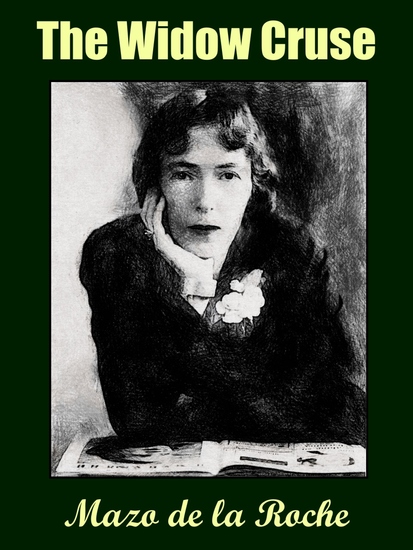
The Widow Cruse
Mazo de la Roche
Publisher: Alien Ebooks
Summary
Shy retiree Unsworth strikes up a tentative friendship with a widow, Mrs. Cruse. This classic short story first appeared in MacLean’s, December 1, 1932.
Publisher: Alien Ebooks
Shy retiree Unsworth strikes up a tentative friendship with a widow, Mrs. Cruse. This classic short story first appeared in MacLean’s, December 1, 1932.
Bruno Bicek, “Lefty,” is a prizefighter and small-time hood in Chicago. Boxing is his ticket to escape hard times and gang life, but when Bruno doesn’t prevent the brutal gang rape of his girlfriend, Steffi, it tears them apart, their worlds changed forever. Bruno is sent to jail and Steffi to a brothel governed by the brutality of a local crime boss, the Barber. Sinister and dark, the Barber controls Steffi and has no intention of letting her go. Why should he, when he holds all the cards? Bruno and Steffi, who dream of breaking free, learn this in the end and find that for them there will be no bright morning.Show book
Embark on a timeless journey with Jules Verne’s Twenty Thousand Leagues Under the Sea, an epic where science and adventure intertwine beneath the waves. Join Professor Pierre Aronnax and the enigmatic Captain Nemo aboard the Nautilus, exploring a world of hidden undersea marvels and exotic creatures, while grappling with themes of freedom and the thirst for knowledge. Verne’s visionary tale not only pioneered science fiction but continues to ignite curiosity and inspire technological innovation. Experience the classic that dives deep into the human spirit’s exploratory drive and reflects on our endless quest for discovery. Ready for an underwater odyssey that transcends time? Let Twenty Thousand Leagues Under the Sea sweep you into its depths. This audiobook was narrated and produced by RAM Studios, where humans and artificial intelligence collaborate to create an excellent listening experience. (The reading is done primarily by AI)Show book
There is something about the number 3. The Ancient Greeks believed 3 was the perfect number, and in China 3 has always been a lucky number, and they know a thing or two. Most religions also have 3 this and 3 that and, of course, in these more modern times, three’s a crowd may be too many, except when it’s a ménage à trois. It seems good things usually come in threes. Whatever history and culture says WE think 3, a hat-trick of stories, is a great number to explore themes and literary avenues that classic authors were so adept at creating. From their pens to your your ears. 01 - 3 Stories - Parents Losing A Child 02 - Silence by Leonid Nikolaevich Andreyev 03 - The Vendetta by Guy de Maupassant 04 - Misery by Anton ChekhovShow book
Talbot Mundy was born William Lancaster Gribbon on April 23rd 1879 in London. After a particularly undistinguished record at Rugby School, he ran off to Germany and joined a circus. After his return, from Germany, he left Britain to work as a relief worker in Baroda in India. This was followed by further adventures in Africa, the Near East and the Far East. His initial inclination was to be a con artist, a confidence trickster and exploit other areas of petty criminality. However with a change of location to the United States and a near fatal mugging he decided that life as an upright citizen was now more to his liking. By the age of 29 he had decided on Talbot Mundy as a name and three years later in 1911 he began his writing career. Obviously late but it was still to be prodigious none the less. Talbot’s first story, "A Transaction in Diamonds," was published in The Scrap Book in February 1911. Two months later in April he published his first non-fiction article, "Pig-sticking in India" – based on a sport much practised by British forces in the Empire – in the pulp magazine Adventure. Many of his novels including his first ‘Rung Ho!’ and his most famous ‘King - Of the Khyber Rifles are set during the British Raj in India. His time in India was short though he spent many years in Africa and, as seen in the attached bibliography, Talbot had no fear or qualms about writing about any location. Talbot became an American citizen on 9th December 1916. On 5th February 1920, Talbot Mundy, now President of the Anglo-American Society of America, arrived in Jerusalem. He also met and fell in love with a widow named Sally Ames, who would eventually become Mrs Mundy, number 4. During this period Talbot worked mainly as editor for the Jerusalem News, which entailed doing everything from proof reading to reporting. One of his biggest coups was that he was invited to go to Damascus to interview King Feisal. In early 1922, Mundy moved to San Diego, California. It was here that he met Katherine Tingley, the head of a splinter branch of the Theosophical Society which had a community at Point Loma, near San Diego. It was there in late 1923 that Talbot began writing perhaps his finest novel, Om, the Secret of Ahbor Valley. By 1928 with relationships between himself and his then current wife and also with his publisher failing he re-located to New York to rebuild his life, career and finances. Whilst much of Talbot’s early life was used in his work it seems he was not particularly proud to return to these places or indeed say to much more about his earlier escapades in these places. Although his writing was to prove very popular over the years and has been revived on many occasions since his death it is fair to say that both his writing and his life were colourful. He married a number of times and still believed that his business dealings would make him very rich. However much of his life would not go as planned and it took several marriages in the hope of finding true happiness. His sixth wife, Dawn, gave birth to a girl on 26 February 1933 shortly after their return to England. Unfortunately the child died shortly after birth. Thereafter he wrote little but much of his work was republished and his name kept in print. On 5 August 1940 Talbot Mundy died from complications associated with diabetes.Show book
A classic Sci-Fi tale by the master Murray Leinster of the last catastrophic stages of our planet and its inhabitants. The true villain of this fascinating piece is excess carbon dioxide!..The results on the earth, plant life, animals and humans are vividly imagined and described: giant insects, weird fungi, poisonous air and gases, fighting and conflict amongst humanity...How, or rather, how badly will all of this end? (Published in 1920)Show book
Gulliver's Travels by Jonathan Swift is a brilliantly layered satirical novel that follows the extraordinary voyages of Lemuel Gulliver, a ship's surgeon who encounters astonishing civilizations across uncharted parts of the world. From the tiny inhabitants of Lilliput to the towering giants of Brobdingnag, from the abstract philosophers of Laputa to the noble horses known as Houyhnhnms, each journey offers a sharp and often humorous reflection on human nature and society.Though often mistaken for a children's adventure, the novel is a profound critique of politics, science, war, and the flaws of civilization. Swift's biting wit and inventive imagination turn Gulliver's fantastical experiences into a timeless exploration of power, pride, and reason. Gulliver's Travels remains one of the most enduring works of English literature — both entertaining and unsettling.Show book