Join us on a literary world trip!
Add this book to bookshelf
Grey
Write a new comment Default profile 50px
Grey
Subscribe to read the full book or read the first pages for free!
All characters reduced
Mother - A Revolutionary Russian Classic - cover

Mother - A Revolutionary Russian Classic

Maxim Gorky

Publisher: DigiCat

  • 0
  • 0
  • 0

Summary

In "Mother," Maxim Gorky crafts a poignant narrative that delves into the struggles of the working class in early 20th-century Russia. The novel centers on Pelageya Nilovna, a simple mother whose ardent support of her revolutionary son catalyzes her awakening to social consciousness. Gorky employs a realist style interwoven with lyrical language, effectively portraying the harsh realities of poverty and oppression while also illuminating the transformative power of collective action. Set against the backdrop of revolutionary fervor, the novel is situated within the literary movement that sought to inspire social change through provocative storytelling. Gorky's own tumultuous upbringing in an impoverished family, coupled with his experiences in a politically charged Russia, informs the emotional depth and authenticity in "Mother." As a prominent figure in the Russian literary canon and a champion of the proletarian cause, Gorky's work embodies the ideological struggle of his time, blending personal narrative with broader sociopolitical themes. His intimate understanding of the plight of the oppressed is reflected in the characters he so vividly brings to life. This seminal work is highly recommended for readers interested in social realism, revolutionary literature, and the human capacity for resilience. Gorky's exploration of motherly love and revolutionary zeal creates a compelling narrative that resonates powerfully with contemporary audiences, underscoring the timeless nature of the struggle for justice.
Available since: 11/08/2023.
Print length: 311 pages.
Other books that might interest you

  • The Man Who Would Be King - cover

    The Man Who Would Be King

    Rudyard Kipling

    • 0
    • 0
    • 0
    In this gripping tale of ambition, hubris, and imperial adventure, Rudyard Kipling takes us deep into the heart of 19th-century British India — and beyond, to the remote and mysterious land of Kafiristan. When two bold and cunning ex-soldiers, Daniel Dravot and Peachey Carnehan, hatch a plan to become kings of an isolated region untouched by Western influence, they embark on a journey as daring as it is reckless. 
    What begins as a quest for power and riches quickly becomes something far more dangerous, as legend, belief, and identity collide. Told through the eyes of a journalist who hears their story firsthand, The Man Who Would Be King is a darkly compelling exploration of colonial arrogance, human ambition, and the fine line between myth and madness. 
    This classic novella, brought vividly to life in a new audio performance, remains as powerful and thought-provoking today as when it was first published in 1888. 
    Cover photo by Jose Manuel Gonzalez  Lupiañez Photography: https://www.pexels.com/photo/lightning-bolt-over-a-dark-sky-with-trees-in-the-background-28103646/
    Show book
  • The Decameron - cover

    The Decameron

    Giovanni Boccaccio

    • 0
    • 0
    • 0
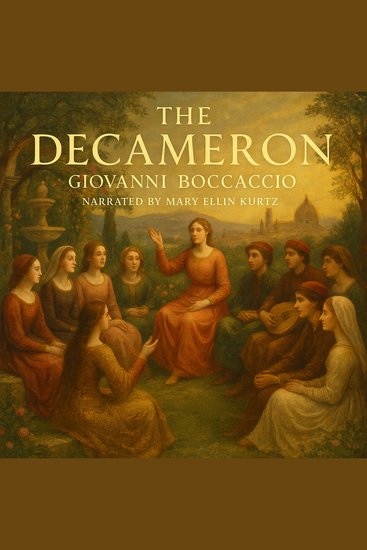
    Set against the shadow of the Black Plague, The Decameron by Giovanni Boccaccio is a radiant tapestry of love, wit, tragedy, and the triumph of the human spirit. When Florence is ravaged by pestilence, ten young nobles — seven women and three men — flee to a countryside villa to escape the horrors of the city. Over ten days, they pass the time by telling one hundred stories: tales of romance and folly, devotion and deception, virtue and vice. 
    From the poetic tragedy of “Griselda” to the romantic daring of “Cymon and Iphigenia” and the moral allegory of “The Three Rings,” Boccaccio captures the full spectrum of human experience — earthy, wise, and profoundly moving. 
    Narrated with grace and warmth by Mary Ellin Kurtz, this timeless masterpiece invites listeners into a world where storytelling itself becomes an act of survival — and of joy.
    Show book
  • Behind the Wall - From their pens to your ears genius in every story - cover

    Behind the Wall - From their...

    Violet Jacob

    • 0
    • 0
    • 0
    The bookshelves of British literature are incredible collections that have gathered together centuries of very talented authors.  From these Isles their fame spread and whilst among their number many are now forgotten or neglected their talents endure.  Among them is Violet Jacob.
    Show book
  • War and Peace - Book 12: 1812 (Unabridged) - cover

    War and Peace - Book 12: 1812...

    Leo Tolstoy

    • 0
    • 0
    • 0
    War and Peace is a literary work mixed with chapters on history and philosophy by the Russian author Leo Tolstoy. It was first published serially, then published in its entirety in 1869. It is regarded as one of Tolstoy's finest literary achievements and remains an internationally praised classic of world literature.
    Book 12: 1812: In Petersburg at that time a complicated struggle was being carried on with greater heat than ever in the highest circles, between the parties of Rumyántsev, the French, Márya Fëdorovna, the Tsarévich, and others, drowned as usual by the buzzing of the court drones.
    Show book
  • The Scarlet Letter - cover

    The Scarlet Letter

    Nathaniel Hawthorne

    • 0
    • 0
    • 0
    Journey into the heart of 17th-century Puritan society with The Scarlet Letter, a timeless tale of love, betrayal, and redemption. This audiobook masterfully brings to life the struggles of Hester Prynne, a woman branded with the infamous scarlet letter 'A' for committing adultery. As she endures public shaming and inner turmoil, her resilience and grace shine through, challenging the rigid moral codes of her time.
     
    Rich with symbolism and profound moral questions, The Scarlet Letter explores themes of sin, judgment, and the complexities of human nature. It delves into the intersections of love and punishment, revealing how individuals confront societal expectations and personal guilt.
     
    Perfect for those who appreciate emotionally resonant storytelling, this audiobook offers a deeply reflective experience. Let this classic inspire you to consider the strength of the human spirit and the power of forgiveness in the face of adversity.
    Show book
  • A Profitable Weakness - From their pens to your ears genius in every story - cover

    A Profitable Weakness - From...

    George Gissing

    • 0
    • 0
    • 0
    George Robert Gissing was born on November 22nd, 1857 in Wakefield, Yorkshire.  
    He was educated at Back Lane School in Wakefield. Gissing loved school. He was enthusiastic with a thirst for learning and always diligent.  By the age of ten he was reading Dickens, a lifelong hero. 
    In 1872 Gissing won a scholarship to Owens College. Whilst there Gissing worked hard but remained solitary. Unfortunately, he had run short of funds and stole from his fellow students. He was arrested, prosecuted, found guilty, expelled and sentenced to a month's hard labour in 1876. 
    On release he decided to start over.  In September 1876 he travelled to the United States. Here he wrote short stories for the Chicago Tribune and other newspapers. On his return home he was ready for novels. 
    Gissing self-published his first novel but it failed to sell.  His second was acquired but never published. His writing career was static.  Something had to change.  And it did. 
    By 1884 The Unclassed was published.  Now everything he wrote was published. Both Isabel Clarendon and Demos appeared in 1886. He mined the lives of the working class as diligently as any capitalist. 
    In 1889 Gissing used the proceeds from the sale of The Nether World to go to Italy. This trip formed the basis for his 1890 work The Emancipated. 
    Gissing's works began to command higher payments. New Grub Street (1891) brought a fee of £250.  
    Short stories followed and in 1895, three novellas were published; Eve's Ransom, The Paying Guest and Sleeping Fires. Gissing was careful to keep up with the changing attitudes of his audience.  
    Unfortunately, he was also diagnosed as suffering from emphysema. The last years of his life were spent as a semi-invalid in France but he continued to write. 1899; The Crown of Life. Our Friend the Charlatan appeared in 1901, followed two years later by The Private Papers of Henry Ryecroft. 
    George Robert Gissing died aged 46 on December 28th, 1903 after catching a chill on a winter walk.
    Show book