Rejoignez-nous pour un voyage dans le monde des livres!
Ajouter ce livre à l'électronique
Grey
Ecrivez un nouveau commentaire Default profile 50px
Grey
Abonnez-vous pour lire le livre complet ou lisez les premières pages gratuitement!
All characters reduced
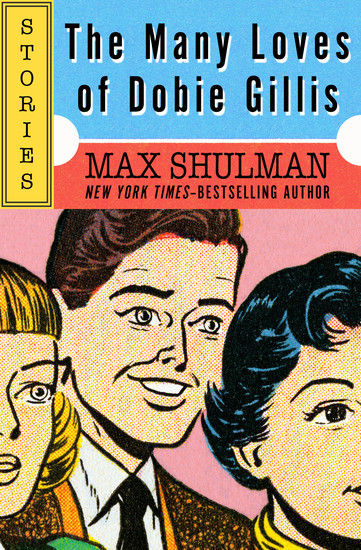
The Many Loves of Dobie Gillis - Stories - cover

The Many Loves of Dobie Gillis - Stories

Max Shulman

Maison d'édition: Open Road Media

  • 0
  • 2
  • 0

Synopsis

Riotous tales of the college playboy-next-door—the basis for the iconic television show. “Shulman’s creation was born a sitcom hero” (The A.V. Club). Including stories first published in Cosmopolitan and the Saturday Evening Post, this bestselling collection follows the romantic escapades of Max Shulman’s famed collegiate Don Juan. Like most undergraduates, Dobie Gillis is a bit scattered—sometimes he’s as quick as a whip, other times dull as a doorstop, and his major keeps changing from chemistry to law to journalism. But no matter what subject he should be studying, Dobie always has a girl on his mind.   In “Love Is a Fallacy,” Shulman’s best-known short story that to this day is taught in writing classes and English survey courses as an archetypal example of the genre, Dobie finds the perfect bride-to-be. She’s beautiful and gracious, but not too smart—a flaw that he sets out to fix, with the most hilarious and ironic of consequences. In “The Unlucky Winner,” Dobie and Clothilde Ellingboe cut corners in class to make more time for their dates. But after an impossible English assignment sends the couple deep into the stacks to plagiarize an obscure essay, Dobie finds himself in a ridiculous bind. And in “She Shall Have Music,” Dobie can’t focus on his duties as circulation manager for the college humor magazine because his girlfriend, Pansy, has been shipped off to New York by her purple-faced father. The desperate Romeo hatches a plan to save the magazine and visit his girl, but a series of bad decisions and a Lithuanian wedding band threaten to ruin everything.
Disponible depuis: 19/01/2016.
Longueur d'impression: 211 pages.

D'autres livres qui pourraient vous intéresser

  • Glad Ghosts - cover

    Glad Ghosts

    D H Lawrence

    • 0
    • 0
    • 0
    ‘Glad Ghosts’ is another of Lawrence's supernatural stories, set in the archetypical country house. He doesn't attempt to explain the supernatural happenings which occur but uses them to extol his own ideas of the power of the sex drive and the triumph of life over death.
    Voir livre
  • The Red Room - cover

    The Red Room

    H. G. Wells

    • 0
    • 0
    • 0
    A lone man holding a candelabrum stands in the center of a cold, stone-walled chamber known as the Red Room. Flickering candlelight casts ominous shadows along the walls, and antique furniture looms in the corners. His eyes are wide with tension, and he looks over his shoulder at something unseen. The atmosphere is eerie, dark, and steeped in gothic suspense. 
    The Red Room by H.G. Wells is a masterfully written tale of psychological horror, suspense, and atmosphere. First published in 1896, this gothic short story explores the fine line between fear and imagination through the experience of a skeptic who agrees to spend the night alone in a room said to be haunted. 
    The protagonist enters the notorious Red Room with confidence, determined to debunk the legends surrounding it. But as the night wears on, flickering shadows, silence, and mounting dread take a toll on his mind. Is the room truly haunted, or is the most terrifying specter the fear that lives within us all? 
    This full audiobook brings Wells' vivid descriptions and rising tension to life, drawing listeners deep into a chilling exploration of the psychology of fear, where darkness is both literal and symbolic. 
    If you love classic horror, atmospheric fiction, and tales that challenge the boundary between reality and perception, The Red Room is a must-listen.
    Voir livre
  • The Witch Hunt - a short historical Magicians story - cover

    The Witch Hunt - a short...

    Rachel Lawson

    • 0
    • 0
    • 0
    The Plague Doctor 
    A short historical Magicians story. Warlock Blake is captured and tortured by witch hunters and he's not hiding it or escaping when he can easily, but why?
    Voir livre
  • The Necromancer - cover

    The Necromancer

    Rachel Lawson

    • 0
    • 0
    • 0
    Stories from The Magicians Series starring Lancelot Alexander the NecromancerGood Quotes From The Haunting of the Necromancer a story in audio book 
    "We are not fake anythings!" said Lance. 
    "I could debate that with you," said Blake. 
    "Where is the ghost?" Blake said changing the subject. 
    "Now I have a ghost and a grim reaper in my lounge room!" said Lance infuriated. 
    "Grand Reaper? What's that?" the ghost asked. 
    "Another name for a couch potato!" Lance hissed, 
    "Dork why you shouting," said Junior walking in the room. 
    "Oh, he's no bother, he has good taste! Anyone who likes Neighbours is alright with me" Blake said. 
    "You sure this isn't The Munsters!" Blake asked. 
    "I want to watch this!" said the ghost standing up. 
    "Quit it stop using the voice let him watch this!" Blake said. 
    "He is a ghost he shouldn't be watching soapies!" said Lance. 
    "Dork!” snapped Junior in protest. 
    Narrated by:Rachel Lawson- main narrator 
    Addison Fell- Alexa in Bad Omens
    Voir livre
  • The Pit and the Pendulum - cover

    The Pit and the Pendulum

    Edgar Allan Poe

    • 0
    • 0
    • 0
    A prisoner of the Spanish Inquisition faces a horrifying ordeal. Trapped in a dark dungeon, he's subjected to a series of terrifying tortures. His battle for survival against these gruesome elements is a tale of suspense and psychological terror.
    Voir livre
  • Dracula's Guest - From their pens to your ears genius in every story - cover

    Dracula's Guest - From their...

    Bram Stoker

    • 0
    • 0
    • 0
    Abraham Stoker was born in Dublin, Ireland on the 8th of November 1847, the third of seven children.  
    His early years were plagued with such ill-health that he was unable to start school until the age of seven.  He turned the long periods of recovery into an opportunity for thinking and said “I was naturally thoughtful, and the leisure of long illness gave opportunity for many thoughts which were fruitful according to their kind in later years”.  
    Strikingly at Trinity College, Dublin his health had returned with such vigour that he was named their University Athlete whilst also achieving a BA in Mathematics with honours.  
    At this time his interest in theatre became a job offer to be the Dublin Evening Mail’s theatre critic, co-owned by Sheridan Le Fanu.  He now began to also write short stories and in 1872 ‘The Crystal Cup’ was published.  An interest in art developed and he co-founded the Dublin Sketching Club.  
    In 1878 came marriage to Florence Balcombe.  She had formerly been courted by Stoker’s acquaintance, Oscar Wilde.  The marriage produced one child.   
    Stoker had some years before reviewed Henry Irving’s Hamlet and had dined with him.  That friendship now resulted in a proposal from Irving to move to London and to manage his Lyceum Theatre.  His numerous commercial innovations ensured both he and the theatre thrived.  Irving would also often take Stoker with him when he toured abroad. 
    Despite this busy life Stoker continued to write and these works paved the way for his most famous creation, published in 1897, ‘Dracula’.  It is rightly recognised as one of the greatest horror novels of all time and although not the first with a theme of Vampires, it is undoubtedly the most well-known. 
    Stoker also wrote poetry and many excellent short stories and continued to write novels and other works throughout his career. 
    Politically Stoker supported Home Rule, though only by peaceful means.  He was also keen on following scientific trends particularly in medicine. 
    In 1902 his tenure at the Lyceum Theatre ended and although he continued to write his health was deteriorating, mainly due to a series of debilitating strokes. 
    Bram Stoker died on the 20th April 1912, in Pimlico, London.  He was 64.
    Voir livre