Unisciti a noi in un viaggio nel mondo dei libri!
Aggiungi questo libro allo scaffale
Grey
Scrivi un nuovo commento Default profile 50px
Grey
Iscriviti per leggere l'intero libro o leggi le prime pagine gratuitamente!
All characters reduced
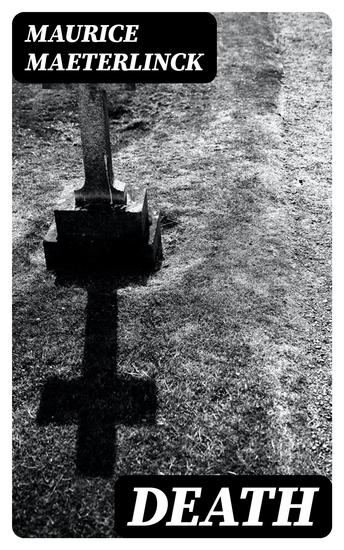
Death - Enriched edition - cover

Death - Enriched edition

Maurice Maeterlinck

Traduttore Alexander Teixeira de Mattos

Casa editrice: DigiCat

  • 0
  • 0
  • 0

Sinossi

In "Death," Maurice Maeterlinck delves into the profound contemplation of mortality, masterfully blending philosophical inquiry with poetic prose. The text examines the inevitability of death, exploring its emotional and existential dimensions within the human experience. Written in the context of fin-de-siècle European thought, Maeterlinck's literary style is characterized by sparse, evocative language and vivid imagery, which invites readers to engage deeply with the themes of transience and the unknowable afterlife. His musings transcend mere despair, presenting a contemplative meditation that urges readers to confront death as an integral aspect of existence. Maurice Maeterlinck, a pivotal figure in the Symbolist movement, was influenced by his background in both philosophy and the natural sciences. His earlier works emphasized challenges to perception, bridging aesthetics with the darker facets of human nature. Such intellectual pursuits naturally led him to engage with fundamental questions of existence, mortality, and the human condition, crafting a unique lens through which "Death" emerges as a profound exploration of life's transient nature and the quiet dignity with which one might approach its end. I highly recommend "Death" to readers seeking not just a literary work but a philosophical companion. Maeterlinck's poignant reflections will resonate with anyone grappling with their understanding of mortality, offering solace and insight in a world often consumed by fear of the inevitable. This book is essential for those who wish to explore profound questions of life, making it a timeless meditation that remains relevant across generations.

In this enriched edition, we have carefully created added value for your reading experience:
- A succinct Introduction situates the work's timeless appeal and themes.
- The Synopsis outlines the central plot, highlighting key developments without spoiling critical twists.
- A detailed Historical Context immerses you in the era's events and influences that shaped the writing.
- An Author Biography reveals milestones in the author's life, illuminating the personal insights behind the text.
- A thorough Analysis dissects symbols, motifs, and character arcs to unearth underlying meanings.
- Reflection questions prompt you to engage personally with the work's messages, connecting them to modern life.
- Hand‐picked Memorable Quotes shine a spotlight on moments of literary brilliance.
- Interactive footnotes clarify unusual references, historical allusions, and archaic phrases for an effortless, more informed read.
Disponibile da: 10/08/2022.
Lunghezza di stampa: 34 pagine.

Altri libri che potrebbero interessarti

  • Art Monsters - Unruly Bodies in Feminist Art - cover

    Art Monsters - Unruly Bodies in...

    Lauren Elkin

    • 0
    • 0
    • 0
    Coming across the term "art monster" in Jenny Offill's 2014 novel Dept. of Speculation, Lauren Elkin was intrigued. What kinds of connections might there be between art and monstrosity, and how was it different when the artist in question was a woman? 


    Art Monsters is a landmark feminist intervention in the way we think about women's stories and bodies, calling attention to a radical genealogy of feminist art that not only reacts against patriarchy but redefines its own aesthetic aims. Exploring a rich lineage of visual artists, thinkers, and writers, Elkin examines the ways feminists have confronted the problem of how to tell the truth of their experiences as bodies. Queer bodies, sick bodies, raced bodies, female bodies: What are the languages of the body, and what are the materials we need to transcribe them? Above all, how can we use the notion of the feminist "art monster" to shape how we live our lives? 


    Writing in the tradition of Susan Sontag and Maggie Nelson, Elkin demonstrates her power as a cultural critic in this erudite and engaging book. From Kara Walker's silhouettes to Theresa Hak Kyung Cha's trilingual masterpiece Dictee, Art Monsters daringly weaves links between disparate artists and writers, and shows that their work offers a potent defense of beauty and excess, sentiment and touch, ambiguity and opacity.
    Mostra libro
  • Embrace Your Bold Self in Life's Toughest Moments - Discover your inner strength! Engage with audio lessons to shine in life's challenges and unleash your fearless spirit - cover

    Embrace Your Bold Self in Life's...

    Orson Hemsley

    • 0
    • 0
    • 0
    Embrace Your Bold Self in Life's Toughest Moments 
    ⭐⭐ Your Go-To Guide for Transformation ⭐⭐ 
    Are you ready to advance your career and solidify your knowledge by embracing boldness in life's toughest moments? 
    Given the need for a holistic resource that contains all the necessary elements to transform challenges into strengths, your search ends here! 
    This guide is your ultimate companion for deepening your understanding, enhancing your skills, and engaging in practical exercises. With this, you're on track for success. 
    Updated for Challenges and Opportunities. 
    Key features of this enriched guide: 
    - In-depth insights on embracing bold transformations 
    - Detailed explanation of transforming challenges into strengths 
    - Effective strategies for preparing and tackling life's toughest moments 
    Our guide stands out with its comprehensive coverage, crucial for triumphing over personal challenges. Concepts are thoroughly explored with utmost clarity. 
    Please note that this guide is purely an independent resource designed for your growth and is not affiliated with any official entity. 
    Structured clearly and written in simple language, our guide ensures smooth progression through topics. Bid farewell to confusion and embrace clear, precise, and accurate content. 
    So, why wait? Click the BUY NOW button, secure your guide, and begin your journey toward embracing your bold self!
    Mostra libro
  • The Dung Beetles of Liberia - cover

    The Dung Beetles of Liberia

    Daniel V. Meier Jr.

    • 0
    • 0
    • 0
    Liberia’s oligarchy: The beginning of the end.2019 Grand Prize Winner - Red City ReviewBased on the remarkable true account of a young American who landed in Liberia in 1961.The story weaves drama, dark comedy, and romance throughout a rich tapestry of narration - The San Francisco Book ReviewKEN VERRIER IS NOT HAPPY, NOR AT PEACE. He is experiencing the turbulence of Ishmael and the guilt of his brother's death. His sudden decision to drop out of college and deal with his demons shocks his family, his friends, and especially his girlfriend, soon to have been his fiancee. His destination: Liberia - The richest country in Africa both in monetary wealth and in natural resources.NOTHING COULD HAVE PREPARED HIM FOR THE EXPERIENCES HE WAS ABOUT TO LIVE THROUGH. Ken quickly realizes that he has arrived in a place where he understands very little of what is considered normal, where the dignity of life has little meaning, and where he can trust no one.Flying into the interior bush as a transport pilot, Ken learns quickly. He witnesses, first-hand, the disparate lives of the Liberian "Country People? and the "Congo People" also known as Americo-Liberians. These descendants of President Monroe's American Colonization Policy that sent freed slaves back to Africa in the 1800's have set up a strict hierarchical society not unlike the antebellum South.Author Dan Meier describes Ken's many escapades, spanning from horrifying to whimsical, with engaging and fast-moving narrative that ultimately describes a society upon which the wealthy are feeding and in which the poor are being buried.It's a novel that will stay with you long after the last word has been read.
    Mostra libro
  • Creative Evolution - cover

    Creative Evolution

    Henri Bergson

    • 0
    • 0
    • 0
    Henri Bergson’s highly influential book, ‘Creative Evolution’ (‘Evolution Creatrice’, 1907) established a theory of evolution - called ‘Creative Evolution Theory’ - which gained a considerable following in the first half of the 20th Century. It also helped the author to win the Nobel Prize in 1927 for his work investigating the origins of biological information and divergence in the evolutionary process.  
     
    In this work, Bergson seeks an alternative explanation as to how new forms of life emerge compared to those prevailing at the time. This included both the ‘mechanistic’ or deterministic explanations of biological science on the one hand, and on the other the ‘finalist’ or strictly teleological explanation of those who believed in the hand of a ‘Creator’ or God, coordinating life in a divine plan. 
     
    Creative Evolution proposes a third explanation in what Bergson calls élan vital’ or ‘vital impetus’, a force that infuses all matter and drives it forward into an ever-changing and infinite variety of living forms. This appears as a vital impetus that can also be related to humanity’s own creative life force. Bergson’s book builds on his ‘Theory of Time’ as set forth in works such as ‘Matter and Memory’ and ‘Time and Free Will’.  In these works, and in the present volume, Bergson sees continuous ‘duration’ as real time, as opposed to the way in which time is divided up into measured units by the ‘organising’ mind of science. 
     
    Life, as we really experience it, is subject to constant change and our tendency to explain evolutionary change by looking only at ‘ends’ achieved rather than the processes by which they emerge, divorces us from the life force itself.  
     
    Instead, Bergson feels we need to reengage with our instincts as well as with our intelligence in order to understand the evolutionary process, as both co-exist to some extent within us, all forms of life having a common origin in that instinctual, innate knowledge of simpler life forms. Though these may be unconscious or semi-conscious, they are, in Bergson’s view, much more in touch with the ever-changing nature of real time than the analytical and rational knowledge of our species 
     
    As he writes:  “Our thought, in its purely logical form, is incapable of presenting the true nature of life, the full meaning of the evolutionary movement. Created by life, in definite circumstances, to act on definite things, how can it embrace life, of which it is only an emanation or an aspect?”  
     
    It is to attempt an answer to this question that ‘Creative Evolution’ directs its attention.
    Mostra libro
  • The Art of the Delusion - cover

    The Art of the Delusion

    Marcus Reed

    • 0
    • 0
    • 0
    The Art of the Delusion is a meditation on power, image, and the quiet disappearance of truth beneath the glow of persuasion. In a world where confidence outweighs competence and charisma becomes currency, reality is no longer discovered — it’s negotiated. This book dissects the psychology of performance: how ambition turned into identity, how sincerity became spectacle, and how modern life taught us to sell versions of ourselves instead of understanding who we are. Written in lyrical, critical prose, it examines the new economy of illusion — where authenticity is curated, morality is optional, and the art of influence has replaced the pursuit of integrity.
    Mostra libro
  • Essays of Michel de Montaigne #1 - cover

    Essays of Michel de Montaigne #1

    Michel de Montaigne

    • 0
    • 0
    • 0
    Michel de Montaigne's Essays represent a groundbreaking contribution to literature and philosophy, establishing the essay as a distinct literary form. First published in 1580, with subsequent editions expanding the content, Montaigne published over 100 essays, exploring a diverse range of topics from the mundane to the profound. 
    At its core, Essays is a collection of Montaigne's personal reflections, characterized by a conversational style that invites readers into his intellectual journey. Montaigne's skepticism is a prominent theme; he questions accepted truths and highlights the fallibility of human knowledge. His famous motto, "What do I know?" encapsulates his belief in the limits of reason and understanding, urging readers to adopt a mindset of inquiry rather than certainty.Humanism and Individual Experience. Montaigne's humanism shines through his respect for individual dignity and experience. He emphasizes the importance of self-knowledge as a pathway to understanding the world. By advocating for learning from both classical texts and personal insights, he encourages readers to explore their own lives deeply.
    Mostra libro