Join us on a literary world trip!
Add this book to bookshelf
Grey
Write a new comment Default profile 50px
Grey
Subscribe to read the full book or read the first pages for free!
All characters reduced
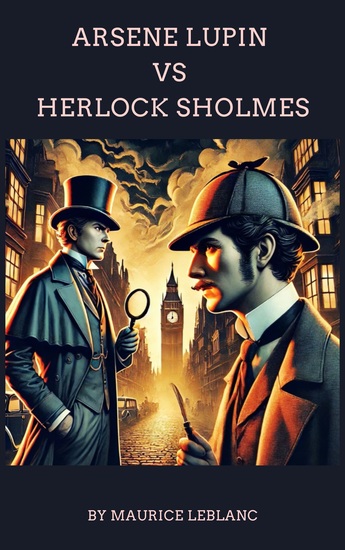
Arsène Lupin versus Herlock Sholmes - Maurice Leblanc's Iconic Clash of Wit and Mystery - cover

Arsène Lupin versus Herlock Sholmes - Maurice Leblanc's Iconic Clash of Wit and Mystery

Maurice Leblanc, Zenith Crescent Moon Press

Publisher: Zenith Crescent Moon Press

  • 0
  • 0
  • 0

Summary

Witness the ultimate battle of intellects as Arsène Lupin, the charming gentleman thief, faces off against the brilliant detective, Herlock Sholmes! 🌟 Arsène Lupin Versus Herlock Sholmes by Maurice Leblanc is a thrilling masterpiece that combines sharp wit, clever puzzles, and intense rivalry into an unforgettable story. 🕵️‍♂️✨
This gripping novel presents two larger-than-life characters engaged in a thrilling game of cat and mouse, where every move is packed with suspense and ingenuity. Lupin's unmatched cunning and charisma are pitted against Sholmes' relentless pursuit of justice, creating a dynamic and electrifying narrative that keeps readers on the edge of their seats. 📖⚡
🌟 Maurice Leblanc masterfully crafts a tale filled with unexpected twists, laugh-out-loud moments, and high-stakes drama, making this novel a standout in the mystery genre. 🏆 As two great minds collide, readers are treated to a story brimming with tension, humor, and a touch of elegance. It's a must-read for fans of classic detective fiction and literary duels! 💫✨
Explore the themes of loyalty, deception, and wit as Lupin and Sholmes engage in a battle that challenges not only their skills but their very principles. Whether you root for the quick-thinking thief or the determined detective, this book will leave you thoroughly entertained. 📚☕
👉 Click "Buy Now" to join the iconic rivalry and experience the brilliance of Maurice Leblanc's storytelling! 🚀✨
Available since: 03/20/2025.
Print length: 240 pages.

Other books that might interest you

  • A Middle-Sized Artist - From their pens to your ears genius in every story - cover

    A Middle-Sized Artist - From...

    Charlotte Perkins Gilman

    • 0
    • 0
    • 0
    Charlotte Perkins Gilman was born on 3rd July 1860 in Hartford, Connecticut, to an unaffectionate mother and a father who abandoned her and her older brother to a life of poverty. 
    Inevitably her schooling was limited and by 15 she had attended seven different schools but received only four years education.  However Charlotte was resourceful and did spend time with her father’s aunts – the suffragist Isabella Beecher Hooker and the ‘Uncle Tom Cabin’s’ author, Harriet Beecher Stowe as well as many hours at the public library studying ancient civilisations. 
    In 1878, she enrolled in classes at the Rhode Island School of Design where she met Martha Luther and they developed a close relationship until Luther married in 1881. Charlotte was devastated and detested romance and love until she met and married the artist Charles Walter Stetson.  
    Their only child, Katharine Beecher Stetson, was born in 1885 but left Charlotte with post-natal depression, then often dismissed as a case of hysteria or nerves.  Unsuited to domestic life she ruptured her life and moved to California with Katherine.  She divorced in 1894 and then sent Katharine east to live with her father and his second wife confirming that his paternal rights be acknowledged and that Katherine establish a relationship with her father. 
    After her mother died in 1893, Charlotte moved back east and became involved with her first cousin, Wall Street attorney, Houghton Gilman who she married in 1900. After his death she moved back to California, where Katherine now lived.   
    Her most popular story is ‘The Yellow Wallpaper’ which touched on her own post-partum depression and underlined the need for women to be responsible for their mental and physical well-being, as the narrator is ordered by her husband/doctor to take compete rest in her room where she is isolated and becomes obsessed with the revolting yellow wallpaper.   
    She wrote other notable short stories the best of which we also include.   
    Charlotte lectured widely for social reform, wrote important non-fiction works that questioned our patriarchal system and left a legacy as a leading and positive spokesperson for feminism.  
    She was diagnosed with incurable breast cancer in 1932 and, as she wrote in her suicide note and autobiography, she ‘chose chloroform over cancer’    
    Charlotte Perkins Gilman took her own life on 17th August 1935, aged 75, in Pasadena, California.
    Show book
  • Picture of Dorian Gray The - Audiobook - cover

    Picture of Dorian Gray The -...

    Oscar Wilde, Classic Audiobooks,...

    • 0
    • 0
    • 0
    The Picture of Dorian Gray is a haunting exploration of beauty, morality, and the corrupting influence of unchecked desire. Oscar Wilde's only novel tells the story of Dorian Gray, a strikingly handsome young man who becomes the subject of a portrait by the artist Basil Hallward. Under the influence of the hedonistic Lord Henry Wotton, Dorian wishes for eternal youth, allowing the portrait to age and bear the marks of his sins instead of him.As Dorian descends deeper into a life of debauchery and moral corruption, his outward appearance remains flawless, but the portrait reflects the growing darkness of his soul. Wilde's masterful prose delves into themes of vanity, the duality of human nature, and the consequences of living without conscience.The Picture of Dorian Gray is both a captivating story and a profound meditation on art, morality, and the human condition. It remains one of the most celebrated works of English literature, resonating with readers across generations.
    Show book
  • The Moving Finger - An detective story that brings mystery and revelation by occult means - cover

    The Moving Finger - An detective...

    Rose Champion de Crespigny

    • 0
    • 0
    • 0
    Annie Rose Charlotte Key was born on 9th November 1859 in Kensington, London. 
     
    With a privileged background—her father was an admiral, her mother a Lady, Rose began her creative life as a painter before a stab at writing local history settled her into popular fiction. 
     
    Her works were solidly written and often described as having a ‘certain graceful facility’. 
     
    Her marriage to Philip Augustus Champion de Crespigny in 1878 resulted in a family of 4 children and a name of status. 
     
    Rose was a leading member of the Ridley Art Club, the Lyceum Club in Piccadilly, and of the British College of Psychic Science.  Victorian society had a particular fascination with spiritualism and in ‘The Moving Finger’ Rose uses the theme as a background to introduce her popular occult detective Norton Vyse into her series of short stories.  
     
    Rose Champion de Crespigny died on 10th February 1935.  She was 75.
    Show book
  • Who's There? - cover

    Who's There?

    Arthur C. Clarke

    • 0
    • 0
    • 0
    "Who's There?" was first published in the November 1958 issue of New Worlds.In Arthur C. Clarke's "Who's There?" explores themes of the human connection to animals, especially in unusual environments, and the unexpected quirks of space travel.
    Show book
  • The Further Adventures of Robinson Crusoe - cover

    The Further Adventures of...

    Daniel Defoe

    • 0
    • 0
    • 0
    Embark on an exhilarating continuation with "The Further Adventures of Robinson Crusoe" by Daniel Defoe, where adventure and perseverance know no bounds. Having left his solitary island life, Crusoe's thirst for exploration leads him back to sea. From treacherous encounters with pirates to thrilling escapades in exotic lands, Crusoe navigates danger and discovery once more. This rich sequel delves deeper into themes of resilience and the unending quest for adventure, capturing the spirit of exploration.
    Show book
  • The Voyage Out - The Lost Manuscript - cover

    The Voyage Out - The Lost...

    Virginia Woolf

    • 0
    • 0
    • 0
      
    "The Voyage Out" is the debut novel written by Virginia Woolf, a prominent English modernist writer. Published in 1915, the novel follows the journey of Rachel Vinrace, a young woman who embarks on a voyage to South America with her aunt and uncle. The novel explores themes of self-discovery, social conventions, and the constraints placed upon women in early 20th-century society. 
     
    As Rachel sets sail on her voyage, she encounters a diverse group of passengers, each representing different social classes, backgrounds, and personalities. Through her interactions with them, Rachel undergoes a transformative journey of personal growth and awakening. Woolf skillfully captures Rachel's internal thoughts and emotions, delving into her inner world as she navigates her way through the complexities of life and relationships. 
     
    "The Voyage Out" also provides a critical examination of societal norms and gender roles during the Edwardian era. Woolf challenges the traditional expectations placed upon women and explores the limitations and frustrations they face. Rachel's journey serves as a metaphor for breaking free from societal constraints and seeking personal fulfillment and independence. 
     
    Virginia Woolf's writing style in "The Voyage Out" is characterized by its lyrical prose, stream-of-consciousness narrative technique, and keen observations of human psychology. Through vivid descriptions and introspective passages, Woolf explores themes of identity, love, and the search for meaning in a rapidly changing world 
    . 
    "The Voyage Out" is a significant novel in Woolf's body of work and serves as a precursor to her later, more experimental novels. It provides an early glimpse into Woolf's mastery of character development, psychological insight, and her unique literary style that would go on to shape the landscape of modernist literature.
    Show book