Join us on a literary world trip!
Add this book to bookshelf
Grey
Write a new comment Default profile 50px
Grey
Subscribe to read the full book or read the first pages for free!
All characters reduced
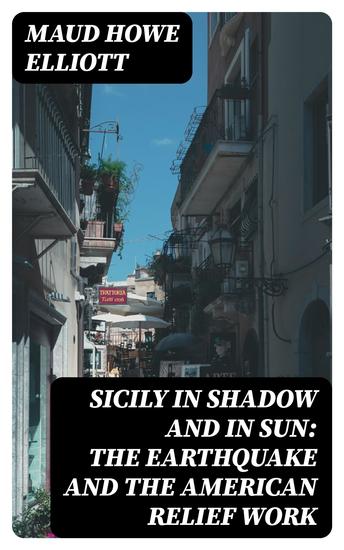
Sicily in Shadow and in Sun: The Earthquake and the American Relief Work - cover

Sicily in Shadow and in Sun: The Earthquake and the American Relief Work

Maud Howe Elliott

Publisher: DigiCat

  • 0
  • 0
  • 0

Summary

In "Sicily in Shadow and in Sun: The Earthquake and the American Relief Work," Maud Howe Elliott presents a poignant narrative detailing the devastating 1908 Messina earthquake and the subsequent American response to the catastrophe. Through her rich and descriptive literary style, Elliott vividly captures the duality of Sicily's beauty and tragedy, exploring themes of resilience, humanitarianism, and cultural identity. Her firsthand observations and thoughtful reflections are interwoven with historical context, offering readers a compelling account that highlights both the local suffering and the international solidarity that emerged in the wake of disaster. Maud Howe Elliott, an esteemed American writer and social activist, was profoundly influenced by her experiences as a member of a prominent New England family. Her activism, particularly in women's suffrage and relief efforts, imbued her with a sense of duty to illuminate the plight of marginalized communities. Elliott's deep empathy and commitment to social justice are palpably reflected in her detailed documentation of relief efforts, showcasing her capacity to bridge personal narrative with broader social themes. This book is a must-read for those interested in disaster response, social change, and the intricate interplay between culture and adversity. Elliott's nuanced perspective not only enriches our understanding of Sicilian history but also serves as a timeless reminder of our shared humanity in times of crisis.
Available since: 09/16/2022.
Print length: 292 pages.

Other books that might interest you

  • Death in Old Mexico - The 1789 Dongo Murders and How They Shaped the History of a Nation - cover

    Death in Old Mexico - The 1789...

    Nicole von Germeten

    • 0
    • 0
    • 0
    In a Mexico City mansion on October 23, 1789, Don Joaquín Dongo and ten of his employees were brutally murdered by three killers armed with machetes. Investigators worked tirelessly to find the perpetrators, who were publicly executed two weeks later. Labelled the "crime of the century," these events and their aftermath have intrigued writers of fiction and nonfiction for over two centuries. Using a vast range of sources, Nicole von Germeten recreates a paper trail of Enlightenment-era greed and savagery, and highlights how the violence of the Mexican judiciary echoed the acts of the murderers. The Spanish government conducted dozens of executions in Mexico City's central square in this era, revealing how European imperialism in the Americas influenced perceptions of violence and how it was tolerated, encouraged, or suppressed. An evocative history, Death in Old Mexico provides a compelling new perspective on late colonial Mexico City.
    Show book
  • Yours Truly - An Obituary Writer's Guide to Telling Your Story - cover

    Yours Truly - An Obituary...

    James R. Hagerty

    • 0
    • 0
    • 0
    Someday, your life story is likely to be boiled down to a few lines. If you leave things to chance, your obituary is almost sure to be solemn, formulaic, and full of errors—an obligatory final chapter written in haste by others. James R. Hagerty, longtime obit writer for The Wall Street Journal, knows how to get the job done right: Do it yourself, starting now, while you still can. 


    In this heartfelt and reassuring guide, Hagerty explains how to preserve your personal history—from crafting a brief obituary for newspapers and websites, to a more thoughtful and detailed mini-memoir for those close to you. Through his personal stories, on-the-job anecdotes, and insights, you will learn what to include, what to leave out, and how to provide historical context, record oral histories, and make the most of details, all with candor and wit. Best of all, you'll find that reviewing your life story helps you think about what you're doing with your time on Earth and whether you're on the right path. It isn't too late to improve the narrative with a stronger ending. 


    Telling your story your way can be the best gift you ever give to friends and loved ones—and yourself.
    Show book
  • Summary: Change Your Thoughts Change Your Life - Living the Wisdom of Tao by Dr Wayne W Dyer: Key Takeaways Summary & Analysis Included - cover

    Summary: Change Your Thoughts...

    Brooks Bryant

    • 0
    • 0
    • 0
    Disclaimer: This is not the official book, but a summary & it does not accompany the official. 
    Embark on a transformative journey where ancient wisdom meets modern insights. Dr. Wayne W. Dyer delves into the timeless teachings of the Tao Te Ching to present a groundbreaking interpretation relevant for today's seekers. In 'Change Your Thoughts, Change Your Life', Dyer unveils the profound secrets held within this ancient text, guiding readers towards a life of peace, harmony, and abundance. 
    With our distilled summary, dive deep into the essence of each verse, capturing the core principles that have inspired sages for centuries. Discover how shifting your thoughts can lead to a profound change in your perspective, actions, and overall well-being. Experience the power of positive thinking, and witness the ripple effects it has on every facet of your life. 
    Step into a world where the old and the new harmoniously converge, revealing pathways to personal growth, spiritual enlightenment, and boundless potential. Let Dyer's insights paired with our concise summary be your compass in navigating the landscape of your soul, leading you to a life of purpose, passion, and peace.
    Show book
  • A Quick Introduction To Spanish Grammar - A Beginner's Guide To Key Grammar Topics - cover

    A Quick Introduction To Spanish...

    Alessio Ruiz

    • 0
    • 0
    • 0
    This comprehensive Spanish grammar guide is designed to help English speakers gain a deeper understanding of the language’s structure and usage. Whether you're a beginner learning Spanish for the first time or an advanced student looking to refine your grammar skills, this resource provides clear explanations and practical examples to support your progress. 
    The guide covers key grammar topics essential for effective communication, including noun gender, verb conjugation, subject and object pronouns, and sentence structure. Learners will also find in-depth discussions on frequently confused concepts, such as the difference between ser and estar, the use of por vs. para, and when to apply the subjunctive mood. These detailed explanations help demystify Spanish grammar and make it easier to form accurate and natural sentences. 
    For those looking to expand their vocabulary, the guide highlights common false cognates—words that appear similar in Spanish and English but have different meanings—as well as true cognates that can accelerate vocabulary acquisition. Additionally, it explores essential verb tenses, from the present and past tenses to the conditional and future, ensuring that learners can confidently discuss different timeframes. 
    Designed to be practical and user-friendly, this guide also addresses regional variations in Spanish grammar and usage, helping learners navigate differences in how the language is spoken across Spain and Latin America. Whether you're studying for an exam, preparing for travel, or simply aiming to improve your fluency, this Spanish grammar reference provides the tools you need to communicate effectively and confidently. 
    With its clear structure, real-world examples, and focus on practical application, this guide serves as an invaluable resource for anyone looking to master Spanish grammar.
    Show book
  • World War II in 1941: The History of the War’s Most Pivotal Year - cover

    World War II in 1941: The...

    Editors Charles River

    • 0
    • 0
    • 0
    At the beginning of 1941, it was unclear whether the Allies would be able to remain in the war for much longer. British Prime Minister Winston Churchill had already immortalized the men of the Royal Air Force with one of the West’s most famous war-time quotes, but the potential of a German invasion of Britain still loomed. With the comfort of hindsight, historians now suggest that the picture was actually more complex than that, but the Battle of Britain, fought throughout the summer and early autumn of 1940, was unquestionably epic in scope.  
    In the warm predawn darkness of June 22, 1941, 3 million men waited along a front hundreds of miles long, stretching from the Baltic coast of Poland to the Balkans. Ahead of them in the darkness lay the Soviet Union, its border guarded by millions of Red Army troops echeloned deep throughout the huge spaces of Russia. This massive gathering of Wehrmacht soldiers from Adolf Hitler's Third Reich and his allied states – notably Hungary and Romania – stood poised to carry out Operation Barbarossa, Hitler's surprise attack against the country of his putative ally, Soviet dictator Joseph Stalin. 
    All Americans are familiar with the “day that will live in infamy.” At 9:30 a.m. on Sunday, December 7, 1941, Pearl Harbor, the advanced base of the United States Navy’s Pacific Fleet, was ablaze. It had been smashed by aircraft launched by the carriers of the Imperial Japanese Navy. All eight battleships had been sunk or badly damaged, 350 aircraft had been knocked out, and over 2,000 Americans lay dead. Indelible images of the USS Arizona exploding and the USS Oklahoma capsizing and floating upside down have been ingrained in the American conscience ever since. In less than an hour and a half the Japanese had almost wiped out America’s entire naval presence in the Pacific.
    Show book
  • Grunwald and Orsha: The History and Legacy of the Polish–Lithuanian Commonwealth’s Most Decisive Battles - cover

    Grunwald and Orsha: The History...

    Editors Charles River

    • 0
    • 0
    • 0
    Like other secretive groups, the mystery surrounding the Teutonic Knights has helped their legacy endure. While some conspiracy theorists attempt to tie the group to other alleged secret societies like the Illuminati, other groups have tried to assert connections with the Teutonic Knights to bolster their own credentials. Who they were and what they had in their possession continue to be a source of great intrigue even among non-historical circles.  
    While the military orders are now often tied to religion or conspiracy theories, they did once wield great power and influence in Europe, and their actions had consequences centuries after they had reached their peak. This was made clear in the wake of a major battle fought between German and Russian forces from August 26-30, 1914 during the First World War. It occurred in Masuria, a region of marshes, woodland, and numerous lakes in northern Poland, almost 400,000 men were involved, and it was a decisive victory for the Germans, who annihilated the Russian army. The Germans named the battle after Tannenberg (Polish Stebark), and the battle, though widely fought over 100 miles, did indeed encompass the village, but there was a historical reason for assigning the name to the battle. On July 15, 1410, Tannenberg was the site of another decisive battle between the army of the Germanic Teutonic Order and that of Poland-Lithuania, a battle now commonly referred to as the Battle of Grunwald (after another nearby village).  
    	In 1514, Orsha was a much smaller town, home to a population of no more than 5,000 as part of the Grand Duchy of Lithuania, but on September 8 of that year, the normally quiet and unpretentious town was thrust into the world’s gaze when over 100,000 troops engaged in one of the 16th century’s biggest battles outside the town walls. The battle pitted the forces of the King of Poland and the Grand Duchy of Lithuania against the Grand Duchy of Moscow.
    Show book