Join us on a literary world trip!
Add this book to bookshelf
Grey
Write a new comment Default profile 50px
Grey
Subscribe to read the full book or read the first pages for free!
All characters reduced
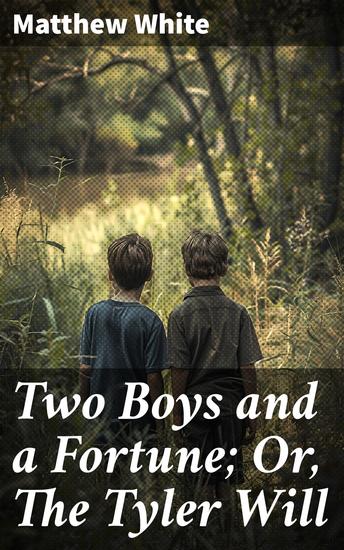
Two Boys and a Fortune; Or The Tyler Will - A Tale of Hidden Wealth and Betrayal - cover

Two Boys and a Fortune; Or The Tyler Will - A Tale of Hidden Wealth and Betrayal

Matthew White

Publisher: Good Press

  • 0
  • 0
  • 0

Summary

In "Two Boys and a Fortune; Or, The Tyler Will," Matthew White crafts a compelling narrative that intertwines themes of ambition, morality, and the intricacies of familial relationships. Set against a backdrop of societal transitions, the novel employs a vivid, accessible literary style replete with sharp dialogue and rich descriptive passages. White's storytelling deftly navigates the complexities of inheritance and the moral dilemmas it evokes, as two boys grapple with an unexpected fortune and its implications on their lives and ethics. The book artfully aligns with the literary traditions of American realism, exploring how wealth can shape character and destiny. Matthew White, a keen observer of human nature and a writer influenced by the socio-economic nuances of his time, imbues this tale with authentic emotional resonance. His experiences and insights into the concept of wealth, particularly its transformative power and potential pitfalls, enrich the narrative. White's background in literature and his understanding of early American societal norms inform his character development and plot structure, allowing for a profound exploration of personal integrity amid temptation. Readers seeking a thought-provoking and engaging tale will find "Two Boys and a Fortune" an enlightening journey. This novel is a rich exploration of youth, greed, and the quest for identity, making it essential reading for those interested in moral complexities and the human condition.
Available since: 10/12/2023.
Print length: 131 pages.

Other books that might interest you

  • Wapping Workhouse (Unabridged) - cover

    Wapping Workhouse (Unabridged)

    Charles Dickens

    • 0
    • 0
    • 0
    Charles Dickens was a writer and social critic who created some of the world's best-known fictional characters and is regarded as the greatest novelist of the Victorian era. His works enjoyed unprecedented popularity during his lifetime, and by the twentieth century critics and scholars had recognised him as a literary genius. His novels and short stories enjoy lasting popularity.
    WAPPING WORKHOUSE: My day's no-business beckoning me to the East-end of London, I had turned my face to that point of the metropolitan compass on leaving Covent-garden, and had got past the India House, thinking in my idle manner of Tippoo-Sahib and Charles Lamb, and had got past my little wooden midshipman.
    Show book
  • Notes From The Underground - The Classic Tale - cover

    Notes From The Underground - The...

    Fyodor Dostoevsky

    • 0
    • 0
    • 0
    Notes from Underground is an 1864 novella by Fyodor Dostoyevsky. Notes is considered by many to be the first existentialist novel. It presents itself as an excerpt from the rambling memoirs of a bitter, isolated, unnamed narrator (generally referred to by critics as the Underground Man) who is a retired civil servant living in St. Petersburg. The first part of the story is told in monologue form or the underground man's diary, and attacks emerging Western philosophy, especially Nikolay Chernyshevsky's What Is to Be Done?. The second part of the book is called "Àpropos of the Wet Snow," and describes certain events that, it seems, are destroying and sometimes renewing the underground man, who acts as a first person, unreliable narrator. 
     
    Fyodor Mikhailovich Dostoevsky was a Russian novelist, short story writer, essayist, and journalist. His literary works explore human psychology in the troubled political, social, and spiritual atmospheres of 19th-century Russia, and engage with a variety of philosophical and religious themes. His most acclaimed novels include Crime and Punishment (1866), The Idiot (1869), Demons (1872), and The Brothers Karamazov (1880). 
     
    Many literary critics rate him as one of the greatest novelists in all of world literature, as multiple of his works are considered highly influential masterpieces.
    Show book
  • Freckles - From their pens to your ears genius in every story - cover

    Freckles - From their pens to...

    William Pett Ridge

    • 0
    • 0
    • 0
    William Pett Ridge was born at Chartham, near Canterbury, Kent, on 22nd April 1859. 
    His family’s resources were certainly limited. His father was a railway porter, and the young Pett Ridge, after schooling in Marden, Kent became a clerk in a railway clearing-house. The hours were long and arduous, but self-improvement was Pett Ridge’s goal.  After working from nine until seven o’clock he would attend evening classes at Birkbeck Literary and Scientific Institute and then to follow his passion; the ambition to write.  He was heavily influenced by Dickens and several critics thought he had the capability to be his successor. 
    From 1891 many of his humourous sketches were published in the St James's Gazette, the Idler, Windsor Magazine and other literary periodicals of the day. 
    Pett Ridge published his first novel in 1895, A Clever Wife. By the advent of his fifth novel, Mord Em'ly, a mere three years later in 1898, his success was obvious.  His writing was written from the perspective of those born with no privilege and relied on his great talent to find humour and sympathy in his portrayal of working class life. 
    Today Pett Ridge and other East End novelists including Arthur Nevinson, Arthur Morrison and Edwin Pugh are being grouped together as the Cockney Novelists.   
    In 1924, Pugh set out his recollections of Pett Ridge from the 1890s: “I see him most clearly, as he was in those days, through a blue haze of tobacco smoke. We used sometimes to travel together from Waterloo to Worcester Park on our way to spend a Saturday afternoon and evening with H. G. Wells. Pett Ridge does not know it, but it was through watching him fill his pipe, as he sat opposite me in a stuffy little railway compartment, that I completed my own education as a smoker... Pett Ridge had a small, dark, rather spiky moustache in those days, and thick, dark, sleek hair which is perhaps not quite so thick or dark, though hardly less sleek nowadays than it was then”. 
    With his success, on the back of his prolific output and commercial success, Pett Ridge gave generously of both time and money to charity. In 1907 he founded the Babies Home at Hoxton.  This was one of several organisations that he supported that had the welfare of children as their mission.  
    His circle considered Pett Ridge to be one of life's natural bachelors. In 1909 they were rather surprised therefore when he married Olga Hentschel.  
    As the 1920’s arrived Pett Ridge added to his popularity with the movies. Four of his books were adapted into films.  
    Pett Ridge now found the peak of his fame had passed. Although he still managed to produce a book a year he was falling out of fashion and favour with the reading public and his popularity declined rapidly.  His canon runs to over sixty novels and short-story collections as well as many pieces for magazines and periodicals. 
    William Pett Ridge died, on 29th September 1930, at his home, Ampthill, Willow Grove, Chislehurst, at the age of 71. 
    He was cremated at West Norwood on 2nd October 1930.
    Show book
  • A Pen-and-Ink Effect - From their pens to your ears genius in every story - cover

    A Pen-and-Ink Effect - From...

    Frances E Huntley the writing...

    • 0
    • 0
    • 0
    The bookshelves of British literature are incredible collections that have gathered together centuries of very talented authors.  From these Isles their fame spread and whilst among their number many are now forgotten or neglected their talents endure.  Among them is Ethel Colburn Mayne.
    Show book
  • The Stranger - cover

    The Stranger

    Katherine Mansfield

    • 0
    • 0
    • 0
    "The Stranger" is a 1921 short story by Katherine Mansfield. It was first published in the London Mercury in January 1921, and later reprinted in The Garden Party and Other Stories.
    In Auckland, Mr. Hammond is waiting for his wife, back from Europe. After talking to some other people waiting at the harbour, she lands in but takes her time, leading him to wonder if she was sick during the voyage - she was not.
    Show book
  • Tom Jones - cover

    Tom Jones

    Henry Fielding

    • 0
    • 0
    • 0
    "Tom Jones" is a classic novel by Henry Fielding, published in 1749. Officially titled "The History of Tom Jones, a Foundling," it is a comic novel that follows the life and adventures of the title character, Tom Jones, from his birth to his eventual marriage. The story unfolds in the context of Fielding's satire of 18th-century British society, manners, and morality. It is known for its vibrant characters, intricate plot, and the author's direct engagement with the reader, which was innovative for its time.
    Show book