Join us on a literary world trip!
Add this book to bookshelf
Grey
Write a new comment Default profile 50px
Grey
Subscribe to read the full book or read the first pages for free!
All characters reduced
Among the Firsts: Lieutenant Colonel Gerhard L Bolland's Unconventional War - D-Day 82nd Airborne Paratrooper OSS Special Forces Commander of Operation Rype - cover

Among the Firsts: Lieutenant Colonel Gerhard L Bolland's Unconventional War - D-Day 82nd Airborne Paratrooper OSS Special Forces Commander of Operation Rype

Matthew T. Bolland

Publisher: Casemate

  • 0
  • 0
  • 0

Summary

In his own words, the war of the doubly pioneering Lt Col Gerhard L. Bolland—82nd Airborne paratrooper on D-Day and senior OSS field operative on Operation Rype.Unconventional warfare tactics can have a considerable effect on the outcome of any war. During World War II, the United States government developed and employed two new methods of fighting. The first was the development of "paratroop" units, as they were first called. The second was the formation of a covert and sabotage operations branch called the Office of Strategic Services (OSS). Lt. Colonel Bolland was involved in both of these "firsts." During the D-Day invasion he parachuted behind enemy lines, jumping out of the 82nd Airborne lead aircraft with General James Gavin. After fighting with the 507th Parachute Infantry Regiment for thirty-three days straight, he returned to England and became involved with the OSS Scandinavian Section. He served as Field Commander for their Operation, code named Rype. This was the only American military undertaking, albeit covert, in Norway during the entire course of the war.  As a young boy growing up in rural western Minnesota, Bolland got his military start with the Minnesota National Guard, before being accepted to West Point, solely on merit. His military career lasted seventeen years. Lt. Colonel Bolland ended up with numerous decorations including the Norwegian Liberation Medal and Citation, the Bronze Star for valor, the French Fouragerre of Croix de Guerre with Palms and posthumously the Congressional Gold medal awarded to the OSS Society on behalf of all former OSS members that served during the war.  His story reveals the struggles, successes, failures and ultimate victories, detailing what went right and what went wrong with these new unconventional methods of fighting.
Available since: 05/19/2022.
Print length: 384 pages.


Other books that might interest you

  • Utopia - cover

    Utopia

    Thomas More

    • 0
    • 0
    • 0
    What would a perfect society really look like?
    
    Written in 1516, Utopia by Thomas More is one of the most influential works of political philosophy ever published. Through a vivid fictional island society, More explores ideas of justice, equality, governance, education, and the relationship between individuals and the state.
    
    This timeless classic challenges readers to question accepted social norms and reflect on the strengths and flaws of their own societies. Blending satire with serious philosophical inquiry, Utopia remains remarkably relevant in discussions of politics, economics, and social reform.
    
    Inside this eBook, you'll explore:
    
    A detailed vision of an idealized society and its laws
    
    Early critiques of wealth inequality and corruption
    
    Thought-provoking ideas on property, work, religion, and government
    
    A foundational text that shaped modern political and social theory
    
    Studied in universities worldwide and debated for centuries, Utopia continues to inspire thinkers, reformers, and readers interested in the future of society.
    
    Whether you are a student of philosophy, a lover of classic literature, or a reader curious about political ideals, this essential work belongs in your collection.
    
    Discover the book that gave the world the word "utopia." Buy now and explore one of the most important classics in political thought.
    Show book
  • NATO After Russia's Invasion of Ukraine - Threat Perceptions and Their Consequences - cover

    NATO After Russia's Invasion of...

    Jason W. Davidson

    • 0
    • 0
    • 0
    A revealing look at differing threat perceptions in six key NATO countries 
     
    When Russia began its full-scale invasion of Ukraine in February 2022, analysts and policymakers highlighted the unifying shock that NATO members experienced. However even before the return of US president Donald Trump, beneath this seeming cohesion lay deep-seated differences in how member states perceive and prioritize security threats. 
     
    NATO after Russia's Invasion of Ukraine analyzes the six most influential members of the alliance: the United States, the United Kingdom, France, Germany, Poland, and Italy. Through extensive interviews with current and former policymakers and a detailed examination of public statements and policies, Jason W. Davidson delivers a unique assessment of how divergent threat perceptions influence the NATO allies' major defense decisions, such as defense spending, and whether the alliance addresses each ally's most important threat and its view of NATO's most important challenges. With the rise in tumultuous geopolitical challenges posed by Russia, China, terrorism, mass refugee flows, and nationalism, this book provides the crucial context needed to navigate NATO's evolving role in international security.
    Show book
  • A Journey Through America - Patriotic Observations and Commentary - cover

    A Journey Through America -...

    Lawrence Kadish

    • 0
    • 0
    • 0
    A Journey Through America introduces insightful commentary on our American democracy. Author Lawrence Kadish draws from over eighty-five years of lived experience, allowing him to celebrate our nation's strengths, reflect on our self-inflicted errors, and draw attention to the challenges of a nation that remains humanity's last hope. 


    An astute and insightful observer of our nation's political experience, Lawrence Kadish draws on his decades of advocacy on behalf of a nation he loves to advance its founding principles. A Journey Through America offers cautionary advice, inspiring words, and a reminder that a great nation needs to remain strong and united in the face of challenges from within and abroad.
    Show book
  • Wage Labor And Capital - cover

    Wage Labor And Capital

    Karl Marx

    • 0
    • 0
    • 0
    Originally written as a series of newspaper articles in 1847, Wage-Labor and Capital were intended to give an overview of Marx’s central theories regarding the economic relationships between workers and capitalists. These theories outlined include the Marxian form of the Labour Theory of Value, which distinguishes “labor” from “labor-power”, and the Theory of Concentration of Capital, which states that capitalism tends towards the creation of monopolies and the disenfranchisement of the middle and working classes. These theories were later elaborated in Volume 1 of Capital, published in 1867. Karl Heinrich Marx FRSA was a German philosopher, a critic of political economy, economist, historian, sociologist, political theorist, journalist, and socialist revolutionary. His best-known titles are the 1848 pamphlet The Communist Manifesto and the four-volume Das Kapital.
    Show book
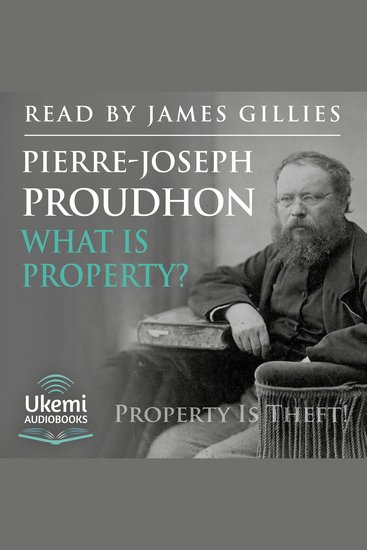
  • What Is Property? - An Inquiry into the Principle of Right and of Government - cover

    What Is Property? - An Inquiry...

    Pierre-Joseph Proudhon

    • 0
    • 0
    • 0
    ‘Property is Theft’, a phrase which has passed into common parlance, was the rallying call of Pierre-Joseph Proudhon’s political treatise What Is Property? Proudhon (1809-1865) was both admired and excoriated. A political theorist of the first order, he was vilified in his native France by the Communists and the Monarchists alike, though admired by Karl Marx as well as many in the nation’s academia and judiciary who valued the clarity of his thought and analytical method.  
     
    He criticised both Right and Left (the very definition of French political thinking), describing them as two sides of the same coin. Their solutions to society’s ills, he said, were like Thesis and Antithesis, based on a common error and both inadequate to the task of healing society. He offered, instead, a third way, which he called his Synthesis. Regarded as the founder of modern Anarchism, his aim was not to engender chaos, as the word anarchy often connotes, but to suggest a workable, political, and economic foundation for society which would promote order and equity for all under the most unfettered conditions of individual liberty.  
     
    Proudhon grew up in poverty, and was home schooled as a child, but received a bursary in his youth sufficient to allow him to attend the City College in his home town (though not sufficient, it seems, to buy him shoes). There, he discovered the library which introduced him to a world, classical and contemporary, previously denied him. Lacking wealth or contacts, he worked variously as a printer, a compositor and proof-reader by day and an essayist by night, learning Latin along the way to assist in his work. In 1830, a friend, a scholar, invited Proudhon to join him in Paris to pursue his philosophical writings full time. When a cholera outbreak forced his return home, Proudhon spent the next few years juggling his two careers. In 1839, he applied for a pension (bursary) at the Academy of Besançon which obliged him to write works on its behalf.  
     
    What Is Property?, published in France in 1840, was his first. It was so controversial that little else followed. However, it established his reputation, and he was eventually able to pursue his philosophical work full time. What Is Property? (First Memoir) attempts to uncover the roots of poverty and associated social ills and examines different attitudes to poverty and wealth from the Greeks to the present day. Proudhon quickly identifies a common thread, property, which he distinguishes from possession, and argues that only a fundamental, though gradual, abandonment of property (as an asset) and all that flows from it, can rescue society from its current conflicts. The memoir seeks to illuminate the underlying causes of war, poverty, slavery, and oppression and points the way to a solution. In effect, it is a practical manual for the survival of mankind. The Second Memoir (1841), included on this recording, is Proudhon’s response to the criticisms of the First Memoir, initially uncomprehending and then self-assured by turns. What Is Property? is Proudhon’s masterwork. It divides opinion, but no one who hears it can come away with their view of their own world unchanged.  
     
    Translation: Benjamin R. Tucker.
    Show book
  • Deliberative Policymaking - Redesigning How We Make Education Policy - cover

    Deliberative Policymaking -...

    Elizabeth Grant

    • 0
    • 0
    • 0
    A Choice Outstanding Academic Title of the Year 


    In Deliberative Policymaking, Elizabeth Grant advances a fresh framework for making collective decisions about US schools. Grant argues that education policy can be made better by improving education policymaking methods. Informed by accounts of policymaking actions as well as her own experience, she offers a keen assessment of which components of existing education policy and policymaking have been effective and which have not. 


    Grant presents new approaches to the craft of policymaking. She endorses policy design thinking, including user-centered design; greater attention to education statecraft, such as reinforcing federal-state relations; and partnering with intermediaries who can help policymakers determine where the public interest lies. She underscores how these practices support democratized policymaking and implementation, which can lead to more inclusive, equitable policy. 


    Grant notes that the success of policy work depends on civic capacity to initiate and sustain improvement efforts, and on policy's ability to meet the demands of the time. This book is essential for anyone who makes policy or is interested in education reform.
    Show book