Join us on a literary world trip!
Add this book to bookshelf
Grey
Write a new comment Default profile 50px
Grey
Subscribe to read the full book or read the first pages for free!
All characters reduced
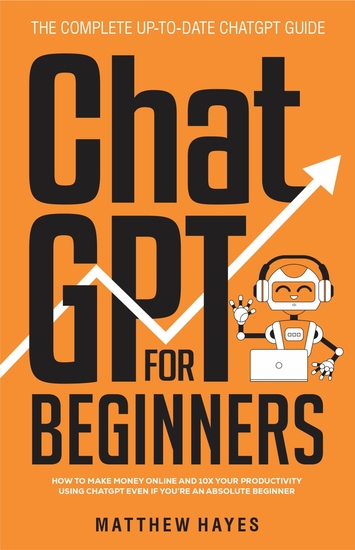
ChatGPT for Beginners - How to Make Money Online and 10x Your Productivity Using ChatGPT Even if You’re an Absolute Beginner (The Complete Up-to-Date ChatGPT Guide) - cover

ChatGPT for Beginners - How to Make Money Online and 10x Your Productivity Using ChatGPT Even if You’re an Absolute Beginner (The Complete Up-to-Date ChatGPT Guide)

Matthew Hayes

Publisher: Mark Atwood

  • 0
  • 0
  • 0

Summary

Discover how ChatGPT can help you make money online and dramatically increase your productivity, even if you're an absolute beginner. "ChatGPT for Beginners" is the ultimate guide to unlocking the power of ChatGPT in the digital world.
 
Learn about ChatGPT's applications, set it up, and customize it for your business. Monetize your skills using effective strategies and generate captivating content. Automate tasks, save time, and integrate ChatGPT to boost productivity. Overcome fears about AI, and troubleshoot issues with ChatGPT's IT advice.
 
Whether you're an entrepreneur, content creator, or professional, this book provides the knowledge, strategies, and techniques to propel you towards success.Highlights of ChatGPT for Beginners:
 
* Comprehensive understanding of ChatGPT and its applications
 
* Set up and customize ChatGPT for your business needs
 
* Effective strategies to monetize your skills and knowledge using ChatGPT
 
* Generate creative and engaging content
 
* Automate tasks and save time with ChatGPT
 
* Boost productivity and efficiency by integrating ChatGPT into your workflow
 
* Overcome fears and misconceptions about AI and ChatGPT
 
* Troubleshoot common issues with ChatGPT's IT advice
 
Ready to make money online and supercharge your productivity? Grab your copy of "ChatGPT for Beginners" now and unlock the incredible potential of ChatGPT!
Available since: 07/13/2023.
Print length: 162 pages.
Other books that might interest you

  • EXCEL 2019 - A Comprehensive Beginners Guide to Learn Excel 2019 Step by Step from A - Z - cover

    EXCEL 2019 - A Comprehensive...

    Alexander Cane

    • 0
    • 0
    • 0
    This Excel 2019 Guide gathers all the necessary how-to information on using the different functions of the latest version of Microsoft Excel. Designed in a simple, easy-to-understand language, this book aims to be of service to all users, no matter how much or how little your user experience is with the said program. 
    As the premier spreadsheet and data analysis application for all kinds of computing devices running under Windows 10, Excel 2019 gives endless capabilities that are often hidden under technical language and masked by explanations that only software engineers and data scientists could decipher. In addition, many of today’s how-to guides often present the software’s features, but fail to make you realize their specific purpose, or how these features can be of benefit to you. 
    Learning how to use the features offered by Excel 2019 is only the start of the real battle. This book is specially designed not only for you to make use of its functions, but more importantly, to make these features be of use and reap you benefits. 
    The discussions on this book strike a balance between the “how to” and the “so what” aspects of using Excel 2019. At the same time, it aims to be as clear and simple in its explanations, using a little jargon as possible. 
    Excel 2019 is worth the learning effort because it is one, if not the best data-processing and analysis applications ever developed. Features such as the Quick Analysis Tool, Flash Fill, Office Add-ins, and Recommended Charts and PivotTables, as well as the Live Preview feature and pre-made galleries allow this version to be the easiest to use. In essence, Excel 2019 is a gold mine to those who rely on the application in their everyday tasks.
    Show book
  • Summary and Interpretation of Reality Transurfing - cover

    Summary and Interpretation of...

    Bootsy Greenwood

    • 0
    • 0
    • 0
    This book was created to summarize the concepts and ideas of the full series of Reality Transurfing Books Steps I-V written by Vadim Zeland. This book was written by the original audiobook narrator to distill the concepts into their simplest form so that you can effectively apply the techniques immediately. 
    The principles in this book are meant to help guide you back to yourself and toward a better understanding of your own authenticity while helping you to understand what it is you really want and equipping you with the tools to accomplish your most cherished goals.
    Show book
  • The Shortest History of the Dinosaurs - The 230-Million-Year Story of Their Time on Earth - cover

    The Shortest History of the...

    Riley Black

    • 0
    • 0
    • 0
    Despite their cultural influence, the grand narrative of the dinosaur story is rarely told. Most of us have heard of Stegosaurus and Tyrannosaurus, but these two dinosaurs lived more than eighty million years apart—a greater span of time than the entire post-T. rex history of the planet. Furthermore, we often know even less about the environments these animals lived in. 


    The Shortest History of the Dinosaurs tells the full story, a 230-million-year epic of small beginnings, spectacular golden periods, and eventual global domination—before an unthinkable asteroid event brought everything to a screeching halt. We learn that, for millions of years in the Triassic, dinosaurs were dog-sized—but slowly developing evolutionary traits like feathers and warm-bloodedness. In the Jurassic Period, these traits—and others like laying eggs and growing specialized air sacs—led to an era of rapid growth in dinosaur population and physical size. As Pangea continued to break apart, during the Cretaceous Period, dinosaurs traversed the globe, adapting to air and water—before a six-mile-wide asteroid hit Central America. 


    Using fossil discoveries and fresh understandings of genetics and evolution, author Riley Black reveals the startling relationships dinosaurs shared with each other, the land they lived on, other animal species, and the earth.
    Show book
  • Biotechnology - The Future of Science - cover

    Biotechnology - The Future of...

    Mike Crawford

    • 0
    • 0
    • 0
    Biotechnology is a field that has revolutionized many aspects of science, health, agriculture, and industry. Defined broadly, it is the use of living organisms or their components to develop or create new products. Biotechnology combines elements from various scientific disciplines, including biology, chemistry, physics, and engineering, to harness biological systems and organisms in ways that can benefit society. The origins of biotechnology can be traced back thousands of years, though its modern applications are far more advanced, opening up new possibilities that were once beyond imagination. 
    The history of biotechnology begins with early humans’ use of fermentation in food production. Ancient civilizations used microbial fermentation to produce alcoholic beverages, bread, and other food products. While these early practices were largely based on trial and error, they laid the groundwork for what would later become a scientifically rigorous and highly specialized field. Over time, as our understanding of biology and genetics advanced, biotechnology expanded beyond simple fermentation. The discovery of DNA, the identification of genes, and the subsequent development of genetic engineering techniques paved the way for biotechnology to play a central role in fields such as medicine, agriculture, and environmental conservation. 
    One of the key milestones in the development of biotechnology was the invention of recombinant DNA technology in the 1970s. This groundbreaking innovation enabled scientists to manipulate genetic material in organisms and create genetically modified organisms (GMOs). The ability to transfer genes between species brought new possibilities for improving crops, developing vaccines, and producing medicines. The first genetically engineered human insulin, for example, revolutionized the treatment of diabetes and marked a significant leap in biotechnological advancement.
    Show book
  • Machine Learning (ML) Guide - An Extensive Exploration of Key Concepts Data Handling Model Building and Application Scenarios - cover

    Machine Learning (ML) Guide - An...

    May Sherry

    • 0
    • 0
    • 0
    Unlock the full potential of machine learning with this comprehensive guide that takes you on a deep dive into the essential concepts, methodologies, and applications of ML. Whether you're a novice eager to grasp the basics or an experienced practitioner looking to refine your skills, this book provides a thorough and accessible exploration of machine learning's core principles and advanced techniques. 
    Machine Learning (ML) Guide is more than just a textbook—it's a comprehensive resource designed to equip you with the knowledge and skills needed to harness the power of machine learning. With clear explanations, practical examples, and actionable insights, this guide will help you navigate the world of ML and apply its principles to real-world challenges. 
    Embark on your journey to mastering machine learning and unlock new possibilities for data-driven decision-making and innovation. 
     
    Show book
  • The Human Gene Editing Debate - cover

    The Human Gene Editing Debate

    John H. Evans

    • 0
    • 0
    • 0
    In 2018 the first genetically modified babies were reportedly born in China, made possible by the invention of CRISPR technology in 2012. This controversial advancement overturned the pre-existing moral consensus, which had held for over fifty years before: while gene editing an adult person was morally acceptable, modifying babies, and thus subsequent generations, crossed a significant moral line. If this line is passed over, scientists will be left without an agreed-upon ethical limit. What do we do now? 


    John H. Evans here provides a meta-level guide to how these debates move forward and their significance to society. He explains how the bioethical debate has long been characterized as a slippery slope, with consensually ethical use at the top, nightmarish dystopia at the bottom, and specific agreed-upon limits in between, which draw the lines between the ethical and the unethical. Evans frames his analysis around these limits, or barriers. He examines the history of how barriers were placed, then fell, then replaced by new ones, and discusses how these insights inform where the debate may head. He evaluates other proposed barriers relevant to where we are now, projects that most of the barriers suggested by scientists and bioethicists will not hold, and cautiously identifies a few that could serve as the moral boundary for the next generation.
    Show book