Join us on a literary world trip!
Add this book to bookshelf
Grey
Write a new comment Default profile 50px
Grey
Subscribe to read the full book or read the first pages for free!
All characters reduced
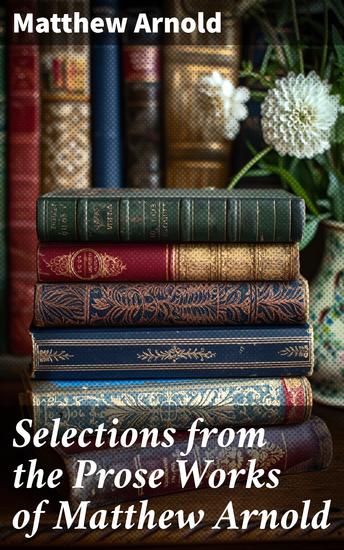
Selections from the Prose Works of Matthew Arnold - Insightful essays and cultural critique from a Victorian literary master - cover

Selections from the Prose Works of Matthew Arnold - Insightful essays and cultural critique from a Victorian literary master

Matthew Arnold

Publisher: Good Press

  • 0
  • 0
  • 0

Summary

In "Selections from the Prose Works of Matthew Arnold," the reader is invited into the intellectual landscape of the Victorian era through Arnold's incisive essays and critiques. This anthology showcases Arnold's literary prowess and his commitment to addressing the social, educational, and cultural challenges of his time. His prose combines a lyrical quality with rigorous analytical depth, creating a rich tapestry that examines the interplay between morality, aesthetics, and society. Renowned for his concept of 'touchstone' criticism, Arnold encourages a discerning engagement with literature and culture, ultimately advocating for a harmonization of art and life in a rapidly changing world. Matthew Arnold (1822-1888) was not only a prominent poet but also a significant cultural critic, deeply influenced by his background in education and his role as an inspector of schools. His experiences witnessing the shortcomings of the educational system propelled his ideas surrounding culture and its transformative power. Arnold's heritage'Äîas the son of a well-respected headmaster'Äîinstilled in him a profound belief in the moral and ethical responsibilities of literature, prompting him to challenge societal norms through his prose. For readers keen on understanding the intersection of literature, culture, and social issues, Arnold's
Available since: 08/12/2023.
Print length: 288 pages.

Other books that might interest you

  • Revenge - How Donald Trump Weaponized the US Department of Justice Against His Critics - cover

    Revenge - How Donald Trump...

    Michael Cohen

    • 0
    • 0
    • 0
    The man the New York State Attorney General credited with inspiring her prosecution of Donald Trump — New York Times number one bestselling author Michael Cohen — tells the behind-the-scenes story of what can happen to you — and what really happened to him — when a President who believes himself to be above the law decides to go after his critics . . . . 
     
    When Michael Cohen's secret payoff to porn star Stormy Daniels on behalf of Donald Trump made Cohen look like a liability to the by-then-President of the United States, the end to their decade-long relationship came swiftly — with a knock on the door from the FBI. Soon, Cohen would find himself imprisoned — even though he had plenty of evidence to show he was innocent of most of the charges. 
     
    Meanwhile, with the release of the Steele Dossier, Cohen also found himself battling endless news reports citing the Dossier's claims that he'd had clandestine dealings with Russia — reports that only mounted despite his exoneration by the Mueller Report. 
     
    In a story now being echoed in recent breaking news stories about IRS persecution of Trump foes such as former FBI head James Comey and others, Cohen details — in his inimitable blunt language, with absolutely no holds barred and naming names — his attempt to clear his name and tell the truth about Donald Trump. Chillingly, he also makes clear what happens when you try to speak truth to power, and the power knows no bounds.
    Show book
  • Tango 1-1 - 9th Infantry Division LRPs in the Vietnam Delta - cover

    Tango 1-1 - 9th Infantry...

    Jim Thayer

    • 0
    • 0
    • 0
    LRPs were all volunteers. They were in the spine-tingling, brain-twisting, nerve-wracking business of Long Range Patrolling. They varied in age from eighteen to thirty. These men operated in precision movements, like walking through a jungle quietly and being able to tell whether a man or an animal is moving through the brush without seeing the cause of movement. They could sit in an ambush for hours without moving a muscle except to ease the safety off the automatic weapon in their hand at the first sign of trouble. These men were good because they had to be to survive. 


    Called LRPs for short, they were despised, respected, admired, and sometimes thought to be a little short on brains by those who watched from the sidelines as a team started out on another mission to seek out the enemy. They were men who can take a baby or small child in their arms and make them stop crying. They shared their last smoke, last ration of food, last canteen of water. They were kind in some ways, deadly in others. They were men who believed in their country, freedom, and fellow men. They were a new kind of soldier in a new type of warfare. 


    LRPs stand out in a crowd of soldiers. It's not just their tiger fatigues but the way they walk, talk, and stand. They were proud warriors because they were members of the Long Range Patrol.
    Show book
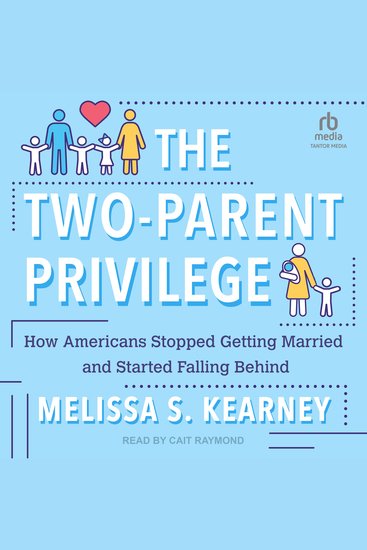
  • The Two-Parent Privilege - How Americans Stopped Getting Married and Started Falling Behind - cover

    The Two-Parent Privilege - How...

    Melissa S. Kearney

    • 0
    • 0
    • 0
    In The Two-Parent Privilege, Melissa S. Kearney makes a data-driven case for marriage by showing how the institution's decline has led to a host of economic woes—problems that have fractured American society and rendered vulnerable populations even more vulnerable. Eschewing the religious and values-based arguments that have long dominated this conversation, Kearney shows how the greatest impacts of marriage are, in fact, economic: when two adults marry, their economic and household lives improve, offering a host of benefits not only for the married adults but for their children. Studies show that these effects are today starker, and more unevenly distributed, than ever before. Kearney examines the underlying causes of the marriage decline in the US and draws lessons for how this trend can be reversed. 


    Kearney's research shows that a household that includes two married parents functions as an economic vehicle that advantages some children over others. For many, the two-parent home may be an old-fashioned symbol of the American dream. But this book makes it clear that marriage may be our best path to a more equitable future. By confronting the critical role that family makeup plays in shaping children's futures, Kearney offers a critical assessment of what a decline in marriage means for an economy and a society—and what we must do to change course.
    Show book
  • Jim Crow's Pink Slip - The Untold Story of Black Principal and Teacher Leadership - cover

    Jim Crow's Pink Slip - The...

    Leslie T. Fenwick

    • 0
    • 0
    • 0
    In 1954, the Supreme Court's Brown decision ended segregated schooling in the United States, but regrettably, as documented in congressional testimony and transcripts, it also ended the careers of a generation of highly qualified and credentialed Black teachers and principals. In the Deep South and northern border states over the decades following Brown, Black schools were illegally closed and Black educators were displaced en masse. As educational policy and leadership expert Leslie T. Fenwick deftly demonstrates, the effects of these changes stand contrary to the democratic ideals of an integrated society and equal educational opportunity for all students. 


    Jim Crow's Pink Slip provides a trenchant account of how tremendous the loss to the US educational system was and continues to be. The book draws the line from the past injustices to problems that the educational system grapples with today: not simply the underrepresentation of Black teachers and principals, but also salary reductions, teacher shortages, and systemic inequality. 


    By engaging with the complicated legacy of the Brown decision, Fenwick illuminates a crucial chapter in education history. She also offers policy prescriptions aimed at correcting the course of US education, supporting educators, and improving workforce quality and diversity.
    Show book
  • Then I Am Myself the World - What Consciousness Is and How to Expand It - cover

    Then I Am Myself the World -...

    Christof Koch

    • 0
    • 0
    • 0
    The world's leading investigator of consciousness argues that by understanding what consciousness does—cause change in the world—we can understand its origins and its future 


    In Then I Am Myself the World, Christof Koch explores the only thing we directly experience: consciousness. At the book's heart is integrated-information theory, the idea that the essence of consciousness is the ability to exert causal power over itself, to be an agent of change. Koch investigates the physical origins of consciousness in the brain and how this knowledge can be used to measure consciousness in natural and artificial systems. 


    Enabled by such tools, Koch reveals when and where consciousness exists, and uses that knowledge to confront major social and scientific questions: When does a fetus first become self-aware? Can psychedelic and mystical experiences transform lives? What happens to consciousness in near-death experiences? Why will generative AI ultimately be able to do the very thing we can do, yet never feel any of it? And do our experiences reveal a single, objective reality? 


    This is an essential book for anyone who seeks to understand ourselves and the future we are creating.
    Show book
  • Accordion Eulogies - A Memoir of Music Migration and Mexico - cover

    Accordion Eulogies - A Memoir of...

    Noé Álvarez

    • 0
    • 0
    • 0
    Searching, propulsive, and deeply spiritual, Accordion Eulogies is an odyssey to repair a severed family lineage, told through the surprising history of a musical instrument 


    Growing up in Yakima, Washington, Noé Álvarez never knew his grandfather. Stories swirled around this mythologized, larger-than-life figure: That he had abandoned his family, and had possibly done something awful that put a curse on his descendants. About his grandfather, young Noé was sure of only one thing: That he had played the accordion. Now an adult, reckoning with the legacy of silence surrounding his family's migration from Mexico, Álvarez resolves both to take up the instrument and to journey into Mexico to discover the grandfather he never knew. 


    Álvarez travels across the US with his accordion, meeting makers and players in cities that range from San Antonio to Boston. He uncovers the story of an instrument that's been central to classic American genres, but also played a critical role in indigenous Mexican history. Like the accordion itself, Álvarez feels trapped between his roots in Mexico and the US. As he tries to make sense of his place in the world—as a father, a son, a musician—he gets closer to uncovering the mystery of his origins.
    Show book