Join us on a literary world trip!
Add this book to bookshelf
Grey
Write a new comment Default profile 50px
Grey
Subscribe to read the full book or read the first pages for free!
All characters reduced
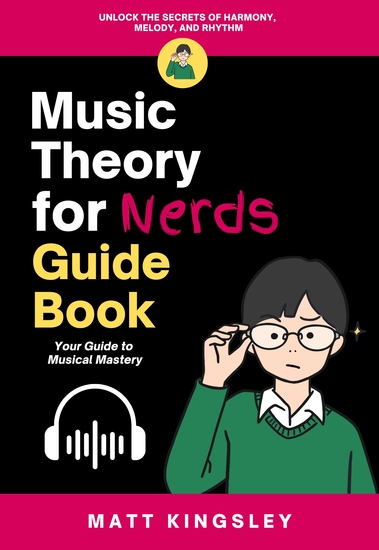
Music Theory For Nerds Guide Book - Music Theory Guidebook Beginner Music Theory Book Music Theory for Songwriters Learn Music Theory Easy - cover

Music Theory For Nerds Guide Book - Music Theory Guidebook Beginner Music Theory Book Music Theory for Songwriters Learn Music Theory Easy

Matt Kingsley

Publisher: Publishdrive

  • 0
  • 0
  • 0

Summary

Are you a musician who's always felt like music theory is some kind of secret code you can't crack? Do you get lost in a sea of sharps, flats, and Roman numerals?
 
You're not alone! Most music theory books are dry, academic, and frankly, intimidating. But Music Theory for Nerds is different. We break down complex concepts into simple, easy-to-understand language, with plenty of real-world examples and a healthy dose of humor. Learn to read music, understand harmony, write your own songs, and finally unlock the secrets behind the music you love. This isn't your professor's music theory – it's practical, engaging, and designed to make you a better musician, no matter your instrument or genre."
 
Ready to take your songwriting or composing to the next level? Tired of relying on the same old chord progressions? Music Theory for Nerds is your key to unlocking a universe of musical possibilities. Learn how to:
 
Craft memorable melodies: Understand the principles of melodic construction.Create rich and interesting harmonies: Explore extended chords, altered dominants, and modal interchange.
 
Structure your music effectively: Master musical form and create compelling arrangements.
 
Analyze the music of the masters: Learn from the best and apply their techniques to your own work.
 
Break the rules (creatively!): Go beyond diatonic harmony and explore the wilder side of music theory.
Available since: 09/04/2025.
Print length: 20 pages.

Other books that might interest you

  • Art History The Viennese Secession - cover

    Art History The Viennese Secession

    Victoria Charles, Klaus H. Carl

    • 0
    • 0
    • 0
    Influenced by Art Nouveau, this movement (created in 1897 by Gustav Klimt, Carl Moll, and Josef Hoffmann) was not an anonymous artistic revolution. Defining itself as a “total art”, without any political or commercial constraint, the Viennese Secession represented the ideological turmoil that affected craftsmen, architects, graphic artists, and designers from this period. Turning away from an established art and immersing themselves in organic, voluptuous, and decorative shapes, these artists opened themselves to an evocative, erotic aesthetic that blatantly offended the bourgeoisie of the time. Painting, sculpture, and architecture are addressed by the authors and highlight the diversity and richness of a movement whose motto proclaimed “for each time its art, for each art its liberty” – a declaration to the innovation and originality of this revolutionary art movement.
    Show book
  • Ultimate Guide to Music Monetization - A Complete Breakdown of the Strategies Platforms & Tools That Pay Artists - cover

    Ultimate Guide to Music...

    Shawn Folk

    • 0
    • 0
    • 0
    The Ultimate Guide to Music Monetization 
    A Practical Breakdown of How Artists Earn in the Modern Music Industry 
    In today’s music industry, making great music isn’t enough—understanding how money is made is just as essential. The Ultimate Guide to Music Monetization is a practical, research-driven resource created to help artists, managers, and independent creatives make sense of the evolving monetization landscape. 
    This guide breaks down the many different ways artists can earn income, not to promise riches, but to help you understand how each model actually works, where its limitations lie, and how artists are using them today. 
    Inside, you'll find:Clear explanations of streaming, licensing, NFTs, catalog advances, social tokens, direct sales, subscriptions, and moreAnalysis of the platforms and companies leading each monetization modelInsights into the incentives behind industry messaging—from distributors to marketers to creatorsReal-world pros and cons of each path, so you can make informed decisions based on your goals and circumstances 
    Written by Gif of Payusnomind, an artist, marketer, and founder of the first YouTube channel offering comparative analysis of music distribution platforms, this guide offers an unbiased look at the business side of music, free from hype, and focused on helping you understand the options available. 
    If you're trying to find the right path, build sustainable systems, or just want to know what’s behind the curtain, this book is a valuable starting point.
    Show book
  • War Is A Racket - cover

    War Is A Racket

    General Smedley Darlington Butler

    • 0
    • 0
    • 0
    War Is a Racket is Marine General Smedley Butler's classic treatise on why wars are conducted, who profits from them, and who pays the price. Few people are as qualified as General Butler to advance the argument encapsulated in his book's sensational title. When War Is a Racket was first published in 1935, Butler was the most decorated American soldier of his time. He had led several successful military operations in the Caribbean and in Central America, as well as in Europe during the First World War. Despite his success and his heroic status, however, Butler came away from these experiences with a deeply troubled view of both the purpose and the results of warfare.
    Show book
  • Yuan Dynasty - Mongol Rule and the Blending of Cultures - cover

    Yuan Dynasty - Mongol Rule and...

    Rolf Hedger

    • 0
    • 0
    • 0
    The Yuan Dynasty emerged from the ambitions of Kublai Khan, the grandson of Genghis Khan, who sought to consolidate Mongol rule over China. Before the establishment of the Yuan, the Mongols had waged a relentless military campaign against the Song Dynasty, the ruling power in southern China. After decades of conflict, Kublai Khan successfully defeated the Song in 1279, marking the first time in history that all of China was under foreign rule. His ascension to the throne not only signified the dominance of the Mongols but also introduced a new era of governance that blended Mongol traditions with Chinese administration. 
    Kublai Khan declared himself emperor in 1271 and named his dynasty "Yuan," meaning "Great Origin," a term rooted in Chinese philosophy and symbolic of the vast scope of Mongol rule. Unlike his predecessors, who maintained a nomadic lifestyle, Kublai recognized the necessity of adopting Chinese customs to effectively govern a vast and diverse population. He moved the capital from Karakorum to Dadu, present-day Beijing, reinforcing his commitment to ruling as a Chinese emperor while still maintaining Mongol authority. His reign sought to balance the military-driven expansion of his ancestors with the complexities of ruling a settled, bureaucratic society. 
    Despite his efforts to integrate into Chinese political traditions, Kublai faced challenges in legitimizing his rule. Many Han Chinese viewed the Mongols as outsiders and resisted their authority. To solidify his claim, Kublai adopted Confucian principles and retained elements of the Chinese imperial structure, appointing Chinese officials in lower government positions while keeping key positions reserved for Mongols and trusted foreign allies. This approach ensured Mongol dominance while utilizing the administrative expertise of the Chinese.
    Show book
  • Clubland: How the working men’s club shaped Britain - cover

    Clubland: How the working men’s...

    Pete Brown

    • 0
    • 0
    • 0
    The untold story of a British institution 
    ‘Brilliant.’ Alan Johnson 
    ‘Compelling.’ David Kynaston 
    ‘The beer drinkers’ Bill Bryson.’ Times Literary Supplement 
    Ferment Magazine’s Best Beer Book of the Year 
    Pete Brown is a convivial guide on this journey through the intoxicating history of the working men’s clubs. From the movement’s founding by teetotaller social reformer the Reverend Henry Solly to the booze-soaked mid-century heyday, when more than 7 million Brits were members, this warm-hearted and entertaining book reveals how and why the clubs became the cornerstone of Britain’s social life – offering much more than cheap Federation Bitter and chicken in a basket. 
    Often dismissed as relics of a bygone age – bastions of bigotry and racism – Brown reminds us that long before the days of Phoenix Nights, 3,000-seat venues routinely played host to stars like Shirley Bassey, Louis Armstrong, and the Bee Gees, offering entertainment for all the family, and close to home at that. Britain’s best-known comedians made reputations through a thick miasma of smoke, from Sunniside to Skegness. For a young man growing up in the pit town of Barnsley this was a radiant wonderland that transformed those who entered. 
    Brown explores the clubs’ role in defining masculinity, community and class identity for generations of men in Britain’s industrial towns. They were, at their best, a vehicle for social mobility and self-improvement, run as cooperatives for working people by working people: an informal, community-owned pre-cursor to the Welfare State. 
    As the movement approaches its 160th anniversary, this exuberant book brings to life the thrills and the spills of a cultural phenomenon that might still be rescued from irrelevance. 
    Pete Brown's Clubland is a cultural exploration of the British institution, weaving humour and criticism into the narrative. The book delves into the popular topic of beverages, specifically alcoholic ones, and their role in shaping regional and ethnic identities. 
    For fans of Adrian Tierney-Jones (London Local Pubs), Albert Jack (The Old Dog and Duck), David Kynaston (A Northern Wind), Marc Morris (Castles), and Christopher Mcdougall (Born to Run). 
    HarperCollins 2022
    Show book
  • Living Landmarks of Chicago - Tantalizing Tales and Skyscraper Stories; Bringing Chicago's Landmarks to Life - cover

    Living Landmarks of Chicago -...

    Theresa L. Goodrich

    • 0
    • 0
    • 0
    From the man shipped home in a rum barrel to the most dangerous woman in America, Chicago history comes to life in these tantalizing tales. 
    "A wonderful bible of Chicago." WGN 
    Living Landmarks of Chicago goes beyond the what, when, and where to tell the how and why of fifty Chicago landmarks. More than a book about architecture, these are stories of the people who made Chicago and many of its most popular tourist attractions what they are today. Each chapter is a vignette that introduces the landmark and brings it to life, and the book is organized chronologically to illustrate the development of the city's distinct personality. These fifty landmarks weave an interconnected tale of Chicago between 1836 and 1932 (and beyond). 
    History lines Chicago’s sidewalks. Stroll down LaSalle or Dearborn or State and you’ll see skyscrapers that have been there for a century or more. It’s easy to scurry by, to dismiss the building itself, but a hunt for placards turns up landmarks every few feet, it seems. Here’s a Chicago landmark; there’s a National Historic landmark. They’re everywhere. 
    Ironically, these skyscrapers keep the city grounded; they illustrate a past where visionaries took fanciful, impossible ideas and made them reality. Buildings sinking? Raise them. River polluting the lake and its precious drinking water? Reverse it. Overpopulation and urban sprawl making it challenging to get to work? Build up. From the bare to the ornate, from exposed beams to ornamented facades, the city’s architecture is unrestrainedly various yet provides a cohesive, beautiful skyline that illustrates the creativity of necessity, and the necessity of creativity.
    Show book