Join us on a literary world trip!
Add this book to bookshelf
Grey
Write a new comment Default profile 50px
Grey
Subscribe to read the full book or read the first pages for free!
All characters reduced
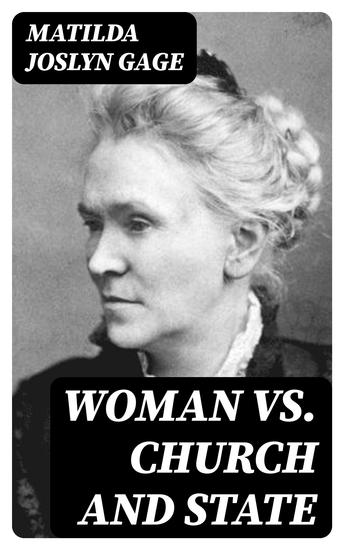
Woman VS Church and State - A Historical Account - cover

Woman VS Church and State - A Historical Account

Matilda Joslyn Gage

Publisher: DigiCat

  • 0
  • 0
  • 0

Summary

In "Woman VS. Church and State," Matilda Joslyn Gage compellingly navigates the intersecting realms of gender and religion within the socio-political landscape of the late 19th century. Employing a persuasive yet accessible literary style, Gage critically examines the oppressive structures upheld by church and state that have historically marginalized women. This text, situated within the feminist literary tradition, challenges the existing norms of her time, advocating for the emancipation and recognition of women's rights. Gage's meticulous research features an array of contemporary sources, making her arguments both robust and relevant. Matilda Joslyn Gage was a prominent suffragist, abolitionist, and a key figure in the women's rights movement. Her rich background in social activism, along with her personal experiences of discrimination, profoundly influenced her writing. Gage's collaboration with other notable figures, including Susan B. Anthony and Elizabeth Cady Stanton, underscores her commitment to the cause and situates her work within a broader context of civil rights activism that was gaining momentum during her lifetime. "Woman VS. Church and State" is not merely a historical account; it is a clarion call for justice and equality. Gage's eloquent argumentation and unwavering commitment to women's rights offer invaluable insights for contemporary readers. This essential read is not only crucial for those interested in feminist theory and history but also for anyone committed to challenging the status quo and understanding the enduring struggle for women's rights.
Available since: 11/13/2022.
Print length: 423 pages.
Other books that might interest you

  • The New Kingdom of Egypt - Empire and Expansion - cover

    The New Kingdom of Egypt -...

    Omar Khalil

    • 0
    • 0
    • 0
    The rise of the New Kingdom marks one of the most pivotal periods in Egyptian history, signaling the transformation of Egypt from a regional power to an expansive empire. This era began with the fall of the Middle Kingdom, a time of political instability and foreign invasions. As Egypt struggled with weak leadership and incursions from Asiatic and Nubian forces, the foundations were laid for the emergence of a new, more robust regime. 
    The decisive moment came with the reign of Ahmose I, who is credited with founding the 18th Dynasty and expelling the Hyksos invaders from the Delta region. Ahmose's victory over these foreign rulers was symbolic not only of military prowess but also of a reassertion of Egyptian identity and unity. This victory allowed the pharaohs of the New Kingdom to solidify their power and embark on territorial expansion that would characterize much of their rule. 
    Ahmose's successors built upon his military success. They began to push Egypt's borders further into Nubia to the south and the Levant to the north, extending Egypt’s reach and influence. The New Kingdom was thus defined by an ambitious policy of imperial expansion, which required a well-organized military and a stable central government. The initial successes of the 18th Dynasty laid the groundwork for the period's most famous rulers, such as Thutmose III, whose campaigns in Syria and Palestine created an empire that stretched far beyond Egypt’s traditional borders.
    Show book
  • The Moral Circle - Who Matters What Matters and Why - cover

    The Moral Circle - Who Matters...

    Jeff Sebo

    • 0
    • 0
    • 0
    Today, human exceptionalism is the norm. Despite occasional nods to animal welfare, we prioritize humanity, often neglecting the welfare of a vast number of beings. As a result, we use hundreds of billions of vertebrates and trillions of invertebrates every year for a variety of purposes, often unnecessarily. We also plan to use animals, AI systems, and other nonhumans at even higher levels in the future. Yet as the dominant species, humanity has a responsibility to ask: Which nonhumans matter, how much do they matter, and what do we owe them in a world reshaped by human activity and technology? 


    In The Moral Circle, philosopher Jeff Sebo challenges us to include all potentially significant beings in our moral community, with transformative implications for our lives and societies. 


    This book explores provocative case studies such as lawsuits over captive elephants and debates over factory-farmed insects, and compels us to consider future ethical quandaries, such as whether to send microbes to new planets, and whether to create virtual worlds filled with digital minds. Taking an expansive view of human responsibility, Sebo argues that building a positive future requires the shedding of human exceptionalism and radically rethinking our place in the world.
    Show book
  • Nazis on the Potomac - The Top-Secret Intelligence Operation that Helped Win World War II - cover

    Nazis on the Potomac - The...

    Robert K. Sutton

    • 0
    • 0
    • 0
    Now a green open space enjoyed by residents, Fort Hunt, Virginia, about fifteen miles south of Washington, DC, was the site of one of the highest-level, clandestine operations during World War II. 


    Shortly after the United States entered World War II, the US military realized that it had to work on exploiting any advantages it might gain on the Axis Powers. One part of these endeavors was to establish a secret facility not too close, but also not too far from the Pentagon which would interrogate and eavesdrop on the highest-level Nazi prisoners and also translate and analyze captured German war documents. 


    That complex was established at Fort Hunt, known by the code name: PO Box 1142. The American servicemen who interrogated German prisoners or translated captured German documents were young, bright, hardworking, and absolutely dedicated to their work. Many of them were Jews, who had escaped Nazi Germany as children—some had come to America with their parents, others had escaped alone, but their experiences and those they had been forced to leave behind meant they all had personal motivation to do whatever they could to defeat Nazi Germany. They were perfect for the difficult and complex job at hand.
    Show book
  • Ancient Greece: 500 Interesting Facts About Greek History - cover

    Ancient Greece: 500 Interesting...

    Ahoy Publications

    • 0
    • 0
    • 0
    Unlock the mysteries of ancient Greece with 500 interesting facts! 
    Explore the ancient world like never before in 500 Interesting Facts About Ancient Greece. Uncover the history and mysteries behind this great civilization, from prehistoric times to Alexander the Great. Learn about Greek mythology and religion and their culture and society. Dive into the military tactics and strategies that led them to victory. And discover how they established a common language through an alphabet system still used today! Trace the path of colonization they carried out using trade routes throughout Europe. Find out about the ancient Olympic Games and how ancient Greek tradition lives on today. There is so much to unpack about one of the greatest civilizations in history! 
    In this book, you will learn more about the following:Early ancient Greece (c. 8000 BCE–c. 1100 BCE)The Greek Dark Ages (c. 1100 BCE–c. 800 BCE)The rise of the polis (c. 800 BCE–c. 600 BCE)The Archaic period (c. 600 BCE–c. 500 BCE)The Greco-Persian Wars (c. 500 BCE–c. 479 BCE)The Golden Age of Athens (c. 479 BCE–c. 431 BCE)The rise of the Hellenistic kingdomsAnd much more! 
    Unlock this fascinating world and expand your knowledge with five hundred interesting facts about ancient Greece! 
    Scroll up and click the “add to cart” button to begin your journey today!
    Show book
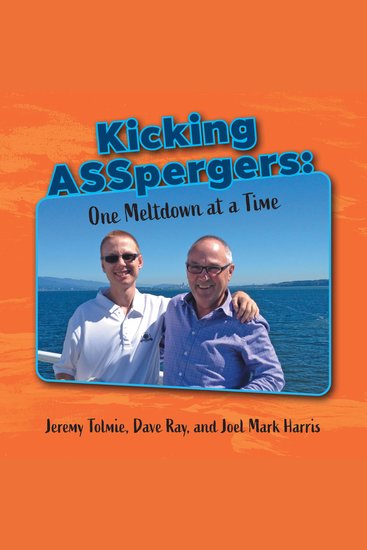
  • Kicking ASSpergers - One Meltdown at a Time - cover

    Kicking ASSpergers - One...

    Jeremy Tolmie

    • 0
    • 0
    • 0
    "I was tired of feeling this way. I was tired of everything, and I just wanted it to end . . . What would happen if I lit the entire place on fire? What if I just stayed perfectly still and did nothing?"Kicking ASSpergers is the triumphant memoir of one man's journey with autism and his quest for happiness and self empowerment despite the many challenges life throws at him. Detailing his struggles with acute anxiety, depression, OCD, psychosis, suicidal ideation, as well as social stigma and medical bias, Jeremy Tolmie moves through his childhood, from the moment he was adopted by loving parents, through brutal school years being bullied and teased, and into adulthood, where he attempts to hold down a job, attend college, and live semi independently. Over time, Jeremy starts to alienate the people in his life with his erratic and dangerous behaviour, and finds himself in and out of various living situations, including psych wards. When he meets Dave Ray, a home share provider, Jeremy starts to learn how to "trust the process" and how not to let autism rule his life.Written with humour, honesty, and compassion, Kicking ASSperger's breaks down stigma and dismantles myths and assumptions about autism. This unique voice tells an inspirational story of friendship, trust, and perseverance in the face of adversity.
    Show book
  • The Little Book of Restorative Justice for Campus Sexual Harms - A Holistic Approach for Colleges and Universities to Address Sexual Misconduct and Relationship Violence - cover

    The Little Book of Restorative...

    Rachel Roth Sawatzky, Mikayla...

    • 0
    • 0
    • 0
    A restorative justice approach to addressing sexual misconduct in colleges and universities. Written for college and university practitioners and administrators, The Little Book of Restorative Justice for Campus Sexual Harms: A Holistic Approach to Address Sexual Misconduct and Relationship Violence for Colleges and Universities combines explanation, justification, and contextualization for the application of restorative justice (RJ) for sexual misconduct, including for alleged Title IX violations. This book outlines considerations, action steps, and best practices for campuses that are interested in exploring the successful implementation of RJ for sexual misconduct. The authors' backgrounds as practitioners within the higher education context grounds this work with personal reflections, experiences, and stories. This book provides a primer for colleges and universities who seek to move campus culture in a more restorative direction generally, and specifically for practitioners interested in exploring the possibility of amending existing sexual misconduct policies, including investigative-adjudicatory Title IX policy and procedures, through a restorative justice informed lens. Readers will explore why it makes all the difference (for both students and administrators) to add RJ resolution options.
    Show book