Join us on a literary world trip!
Add this book to bookshelf
Grey
Write a new comment Default profile 50px
Grey
Subscribe to read the full book or read the first pages for free!
All characters reduced
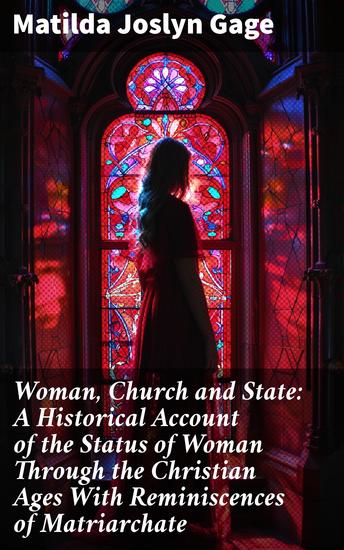
Woman Church and State: A Historical Account of the Status of Woman Through the Christian Ages With Reminiscences of Matriarchate - Unveiling Women's Struggles in Christian History - cover

Woman Church and State: A Historical Account of the Status of Woman Through the Christian Ages With Reminiscences of Matriarchate - Unveiling Women's Struggles in Christian History

Matilda Joslyn Gage

Publisher: Good Press

  • 0
  • 0
  • 0

Summary

In her seminal work, "Woman, Church and State: A Historical Account of the Status of Woman Through the Christian Ages With Reminiscences of Matriarchate," Matilda Joslyn Gage presents a comprehensive historical analysis of women's roles within the context of Christian ecclesiastical power. Gage employs a meticulous scholarly approach, intertwining rich historical narratives with a passionate argument for women's rights. The book, infused with a feminist lens, critiques the marginalization of female figures and voices throughout Christian history, while examining the resonance of matriarchal systems that preceded patriarchal dominance. Gage's literary style is both assertive and eloquent, effectively challenging prevailing narratives and urging a reevaluation of women's societal status from antiquity to modernity. Matilda Joslyn Gage, an influential suffragist and co-founder of the National Woman Suffrage Association, was deeply rooted in the 19th-century struggle for women's rights. Her extensive research into women'Äôs historical contributions and her advocacy against religious and societal patriarchy uniquely positioned her to write this groundbreaking work. Gage'Äôs intersectional approach not only highlights the oppression of women under religious institutions but also celebrates the matriarchal traditions that have historically empowered women. This book is essential for readers interested in feminist history, social justice, and the intersections between religion and gender. Gage's arguments resonate powerfully, offering historical insights that continue to challenge contemporary discourse on women's rights. "Woman, Church and State" is not merely a historical account; it is a clarion call for recognition and reformation, making it a crucial addition to any library committed to understanding the complexities of gender and power.
Available since: 11/16/2023.
Print length: 423 pages.


Other books that might interest you

  • The Frontier Below - cover

    The Frontier Below

    Jeff Maynard

    • 0
    • 0
    • 0
    Triumphs and disasters in the deep sea 
    This is a journey through time and water, to the bottom of the ocean and the future of our planet. 
    We do not see the ocean when we look at the water that blankets more than two thirds of our planet. We only see the entrance to it. Beyond that entrance is a world hostile to humans, yet critical to our survival. The first divers to enter that world held their breath and splashed beneath the surface, often clutching rocks to pull them down. Over centuries, they invented wooden diving bells, clumsy diving suits, and unwieldy contraptions in attempts to go deeper and stay longer. But each advance was fraught with danger, as the intruders had to survive the crushing weight of water, or the deadly physiological effects of breathing compressed air. The vertical odyssey continued when explorers squeezed into heavy steel balls dangling on cables, or slung beneath floats filled with flammable gasoline. Plunging into the narrow trenches between the tectonic plates of the Earth’s crust, they eventually reached the bottom of the ocean in the same decade that men first walked on the moon. 
    Today, as nations scramble to exploit the resources of the ocean floor, The Frontier Below recalls a story of human endeavour that took 2,000 years to travel seven miles, then investigates how we will explore the ocean in the future. 
    Meticulously researched and drawing extensively on unpublished sources and personal interviews, The Frontier Below is the untold story of the pioneers who had the right stuff, but were forgotten because they went in the wrong direction. 
    The Frontier Below by Jeff Maynard is a captivating journey through the history of maritime expeditions, the science of physiology, and the economics of resource extraction. It is a testament to human endeavour and the indomitable spirit of exploration, offering a glimpse into the future of our oceans. 
    For fans of Julian Sancton (Madhouse at the End of the Earth), Buddy Levy (Empire of Ice and Stone), Rachel Lance (In the Waves), James Bradley (Ghost Species), and Helen Czerski (Blue Machine). 
    HarperCollins 2023
    Show book
  • Prisoners of War - Survival and Resistance behind Enemy Lines - cover

    Prisoners of War - Survival and...

    Sage Winters

    • 0
    • 0
    • 0
    Throughout history, the experiences of prisoners of war (POWs) have captured the complexities of human endurance, resilience, and the moral challenges of conflict. In the midst of war, being taken captive often represents a turning point—one where survival becomes an individual’s primary focus, yet the determination to resist the enemy may persist despite overwhelming odds. This book explores the world of POWs, examining the strategies they employed to endure, resist, and sometimes escape the harsh conditions imposed by their captors.  
      
    Prisoners of war are not merely bystanders in conflicts; they are active participants in a different kind of battle. The battlefield shifts from the open fields of combat to the confines of prison camps, where physical deprivation, psychological manipulation, and moral dilemmas take center stage. Despite these hardships, many POWs found ways to preserve their dignity and humanity. They organized covert resistance movements, forged powerful bonds with their fellow captives, and made daring escape attempts, each story a testament to the indomitable human spirit.  
      
    International laws, such as the Geneva Conventions, were designed to protect the rights and well-being of POWs. However, history reveals that these laws were often ignored or inadequately enforced, leaving countless captives to endure severe mistreatment. The book delves into these legal frameworks while highlighting the real-life stories of those who lived through captivity, offering a vivid account of their experiences. 
    Show book
  • The Socratic Dialogues - Alcibiades and Other Attributed Dialogues - cover

    The Socratic Dialogues -...

    Plato

    • 0
    • 0
    • 0
    The influence of Plato, his Dialogues and his ‘Academy’, cast a long shadow. Around 35 Dialogues, almost all featuring Socrates as the principal figure, are generally ascribed to Plato and form one of the most important threads in Western philosophy  These four Dialogues may fall into the ‘Attributed Texts’ category, but they are of sufficient interest to warrant study in our time and when set against the principal canon.  
     
    The recording opens with Alcibiades I. Socrates’ interlocuter is well known as a young, charismatic figure of the time, and appears in the Symposium and Protagoras. The subject under discussion is justice and injustice. Socrates questions the over-confident Alcibiades about his understanding of these issues, which is crucial for someone about to play an active role in public life. It is the longest Dialogue of the four. 
     
    Hippias is another young man. A Sophist, brimming with the confidence of youth to the extent of being vain and boastful. He appears in two Dialogues on this recording, the Lesser Hippias and the Greater Hippias. The Lesser Hippias is a witty and lively conversation in which Hippias is keen to display his abilities only to be shaken by patient questioning by the astute Socrates. The Greater Hippias, a discussion about beauty, contains some interesting elements, while also showing how the form became diluted in the hands of lesser followers of Plato.  
     
    The final Dialogue, Menexenus is a special case. It was an important form in Athenian society and this is a rare surviving example. It has been included here in a new recording so it can be listened to in the context of ‘Attributed Dialogues’, rather than a fully accepted work by Plato. The background to each Dialogue is set by Benjamin Jowett. David Rintoul continues his persuasive characterisation of the masterful Socrates.
    Show book
  • The Shortest History of Migration - cover

    The Shortest History of Migration

    Ian Goldin

    • 0
    • 0
    • 0
    *Released early for the UK election.*
    
    From our earliest wanderings to the rise of the digital nomad, here is the story of human migration.
    
    For hundreds of thousands of years, the ability of Homo sapiens to travel across vast distances and adapt to new environments has been key to our survival as a species. Yet this deep migratory impulse is being tested as never before. By building ever stronger walls and raising barriers to progress, governments are harming the lives of migrants and threatening the future well-being of our societies.
    
    In The Shortest History of Migration, a visionary thinker tells a story of the movement of peoples that spans every age and continent and goes to the heart of what makes us human. Drawn from ancient records and the latest genetic research, it recounts strange, terrible and uplifting tales of migrants past and present, examining the legacies of empire, slavery and war.
    
    Finally, Goldin turns his attention to today's world, bringing together the evidence of history with the most recent data to suggest how we might create a more humane future -- one that allows us to reap the tremendous benefits that migration can offer.
    Show book
  • The Gods Were Astronauts - The Extraterrestrial Identity of the Old Gods Revealed - cover

    The Gods Were Astronauts - The...

    Erich von Däniken

    • 0
    • 0
    • 0
    Bestselling author Erich von Däniken explores the evidence of ancient visitors treated as gods in religious scripture and mythology. His findings shake the foundations of both science and faith. Why do nearly all the world’s major religions share similar myths and legends? Whether it’s the Old Testament, ancient legends, or the creation myths of New Zealand’s natives, you come across similar stories everywhere. Erich von Däniken, author of the international bestseller Chariots of the Gods, believes he knows the answer—and it is as wondrous and awe-inspiring as it is controversial: The winged angels populating the Bible, the Koran, and other religious texts from cultures the world over were, in reality, extraterrestrials who visited the Earth in ages long past. Who were the gods of ancient lore? How can the contradictions in the Bible be explained? Why are the pagodas of Myanmar (formerly Burma) so amazingly similar to space-capable rockets? Erich von Däniken provides convincing new and surprising interpretations and answers that fundamentally contradict both the teachings of religion and current science. His astonishing conclusion: The gods were not metaphysical beings that humans created in their imagination, but extraterrestrial intelligences that have left their traces all over the Earth. He offers persuasive evidence that actual living beings inspired the legends that became the basis for many of our religious traditions.
    Show book
  • FOOD FOR THOUGHT - Experiences - cover

    FOOD FOR THOUGHT - Experiences

    Constance Baxter

    • 0
    • 0
    • 0
    This book is for those who have the ability to feed off of the positivity of their thoughts.
    Show book