
Join us on a literary world trip!
Add this book to bookshelf
Grey
Write a new comment Default profile 50px
Grey
Subscribe to read the full book or read the first pages for free!
All characters reduced
Rise of Boarding - cover

Rise of Boarding

Mason Ross

Translator A AI

Publisher: Publifye

  • 0
  • 0
  • 0

Summary

Rise of Boarding explores the historical evolution of boarding schools and their lasting influence on education and society. Examining these elite institutions, the book reveals how they have shaped educational norms and societal expectations, particularly in fostering student development. From their origins, boarding schools have served not only as academic institutions but also as incubators for social elites, instilling values such as leadership and self-reliance.

 
One intriguing aspect is the evolving disciplinary practices, transitioning from strict control to promoting student independence, while consistently emphasizing academic success. The book delves into the transformation of boarding schools, viewing them as significant players in the history of education and social mobility. By integrating historical analysis with sociological and psychological perspectives, Rise of Boarding offers a comprehensive understanding of these institutions. The study uses archival records, student testimonials, and statistical data to support its arguments.

 
Key areas explored include the psychological impacts of disciplinary methods and the cultivation of student independence. Beginning with the foundational principles of early boarding schools, the book chronologically investigates their development. It then focuses on evolving disciplinary methods, student independence, and measures of academic success, culminating in an analysis of their effects today.

 
Primarily focusing on institutions in the United States and United Kingdom, this academic exploration provides valuable insights for educators, historians, and anyone interested in the complex relationship between education and social structures.
Available since: 02/26/2025.
Print length: 63 pages.

Other books that might interest you

  • Vagus Nerve and Polyvagal Theory The: Exploring the Neurophysiological Foundations of Healing Communication and Self-Regulation to Overcome Anxiety Trauma Inflammation Mental Stress & More - cover

    Vagus Nerve and Polyvagal Theory...

    Yumi Park

    • 0
    • 0
    • 0
    Harness the Power of the Vagus Nerve and Change Your Life! 
    The Vagus Nerve and Polyvagal Theory invites you on an enlightening journey deep into the intricate web of our neurophysiology, uncovering the remarkable power of the vagus nerve and the transformative potential of the Polyvagal Theory. 
    In this audiobook, delve into the hidden mechanisms that influence healing, communication, and self-regulation, offering a path to overcome anxiety, trauma, inflammation, mental stress, and a range of other challenges. 
    Unlock a treasure trove of practical knowledge, empowering techniques, and light-hearted explanations that anyone can appreciate. 
    Explore actionable steps to harness the innate healing potential of the vagus nerve and activate the Polyvagal Theory in your own life so you can finally live the peaceful, mentally stable life that you deserve. 
    You’ll also discover:How to cultivate a deeper connection with yourself: Get to know your own body, mind, and emotions, allowing for profound self-discovery and personal growth.Practical exercises to incorporate the theory in your daily life: Develop the tools needed to promote healing, improve communication, and establish a foundation of balance and resilience.Everything you need to know about the Vagus Nerve: These audiobooks explain everything in a friendly, and easy to follow way without skimping over important information.And more! 
    Whether you're a healthcare professional, therapist, researcher, or an individual seeking to enhance your overall well-being, this 2-in-1 offers invaluable insights and transformative guidance that you can’t get anywhere else.Scroll up, Get Your Copy, and Unlock the Healing Potential of the Vagus Nerve!
    Show book
  • Play It Again II! - Duke University's 1992 NCAA Men's Basketball National Championship Run - cover

    Play It Again II! - Duke...

    Bob Harris, Mike Waters

    • 0
    • 0
    • 0
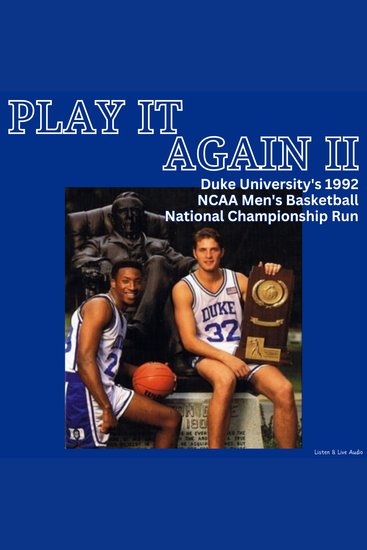
    Play It Again II!, with voice of the Blue Devils Bob Harris and color commentator Mike Waters, features radio highlights from Duke University's 1992 NCAA Men's Basketball National Championship run that saw the team defeat Campbell, Iowa, Seton Hall, and edge Kentucky in what is widely considered one of the greatest college basketball games ever played, before beating Indiana and the University of Michigan's Fab Five in the title game. Duke became the first team since UCLA, nineteen years earlier, to repeat as National Champions.
    Show book
  • Data Driven - Truckers Technology and the New Workplace Surveillance - cover

    Data Driven - Truckers...

    Karen Levy

    • 0
    • 0
    • 0
    A behind-the-scenes look at how digital surveillance is affecting the trucking way of life. 


    Long-haul truckers are the backbone of the American economy, transporting goods under grueling conditions and immense economic pressure. Truckers have long valued the independence of their work, sharing a strong occupational identity rooted in a tradition of autonomy. Yet these workers increasingly find themselves under many watchful eyes. Data Driven examines how digital surveillance is upending life and work on the open road, and raises crucial questions about the role of data collection in broader systems of social control. 


    Karen Levy takes listeners inside a world few ever see, painting a bracing portrait of one of the last great American frontiers. Federal regulations now require truckers to buy and install digital monitors that capture data about their locations and behaviors. Intended to address the pervasive problem of trucker fatigue by regulating the number of hours driven each day, these devices support additional surveillance by trucking firms and other companies. Traveling from industry trade shows to law offices and truck-stop bars, Levy reveals how these invasive technologies are reconfiguring industry relationships and providing new tools for managerial and legal control—and how truckers are challenging and resisting them.
    Show book
  • 20 Myths about Religion and Politics in America - cover

    20 Myths about Religion and...

    Ryan P. Burge

    • 0
    • 0
    • 0
    The way most people think about religion and politics is only loosely linked to empirical reality, argues Ryan P. Burge in 20 Myths about Religion and Politics in America. Instead, our thinking is based on anecdotes, a quick scan of news headlines, or worse, flat-out lies told by voices trying to push a religious or political agenda on a distracted public. 


    Burge sees this fundamentally flawed understanding of the world around us and our misperceptions about where we fit into the larger fabric of society as caustic for the future of American politics and religion. Without an accurate picture of our society, when we subscribe to only caricatures of what our country looks like, we never really address the problems facing us. 


    Striving to be an impartial referee, Burge describes with accessible and engaging prose what the data says. Step by step, he debunks twenty myths, using rigorous data analysis and straightforward explanations. He gives listeners the resources to adopt an empirical view of the world that can help all of us, religious and nonreligious alike, get past at least some of the unsupported beliefs that divide us.
    Show book
  • French Revolution The: The History and Legacy of the World’s Most Famous Social Revolution - cover

    French Revolution The: The...

    Editors Charles River

    • 0
    • 0
    • 0
    As one of the seminal social revolutions in human history, the French Revolution holds a unique legacy, especially in the West. The early years of the Revolution were fueled by Enlightenment ideals, seeking the social overthrow of the caste system that gave the royalty and aristocracy decisive advantages over the lower classes. But history remembers the French Revolution in a starkly different way, as the same leaders who sought a more democratic system while out of power devolved into establishing an incredibly repressive tyranny of their own once they acquired it. 
    The early years of the French Revolution were fueled by Enlightenment ideals, seeking the social overthrow of the caste system that gave the royalty and aristocracy decisive advantages over the lower classes. But history remembers the French Revolution in a starkly different way, as the same leaders who sought a more democratic system while out of power devolved into establishing an incredibly repressive tyranny of their own once they acquired it. 
    The height of Republican France’s tyranny came during a 10 month period forever known as the Reign of Terror, the most notorious and arguably most memorable part of the French Revolution. One of the first victims of the Reign of Terror was its most famous: former French Queen Marie Antoinette. But Antoinette was followed by thousands more, including everyone from aristocrats to clergy to prostitutes and even instrumental revolutionaries like Danton, Desmoulins, and, most notably, Robespierre. It was Robespierre whose position on the Committee of Public Safety made him the Reign of Terror’s instrumental figure until he himself became a victim of it in July 1794. Robespierre’s date with the guillotine is often considered the official end of the Reign of Terror, but by then it is estimated that at least 16,000 people were guillotined in that time and possibly 25,000 more were summarily executed across the country.
    Show book
  • Thales - Thoughts and Ideas from the First Philosopher - cover

    Thales - Thoughts and Ideas from...

    Hector Davidson

    • 0
    • 0
    • 0
    Thales of Miletus, often hailed as the first philosopher in Western history, was born in the ancient Greek city of Miletus, around 624 BCE. As a figure whose contributions have shaped the course of philosophy, science, and mathematics, Thales stands as a foundational figure in intellectual history. Although much of his life remains shrouded in mystery due to the passage of time, the few details that have survived reveal a thinker whose ideas and insights went beyond the conventional beliefs of his era. 
    Thales is traditionally considered the first to break away from mythological explanations of the world. Prior to Thales, the Greek understanding of nature was largely dominated by myth and religious explanations, where gods and divine forces were invoked to explain the natural phenomena. Thales, however, proposed a radical shift by seeking rational, natural explanations. He is best known for his theory that water is the fundamental substance from which everything originates. This insight marks a profound moment in intellectual history because it moved away from mythological thinking and introduced the idea of a unifying principle underlying all things. 
    In addition to his contributions to philosophy, Thales was also a mathematician and astronomer, and his influence in these fields is considerable. He is credited with being the first to predict a solar eclipse, using his understanding of the stars and celestial movements. His work in geometry is equally important—he is famously known for Thales’ Theorem, which laid the groundwork for the development of geometry. This theorem states that if two points are on a circle, and a line is drawn through them, then the center of that line will always lie on a straight line through the center of the circle. This geometric insight shows his ability to understand and systematize mathematical concepts that were previously unexamined.
    Show book