Join us on a literary world trip!
Add this book to bookshelf
Grey
Write a new comment Default profile 50px
Grey
Subscribe to read the full book or read the first pages for free!
All characters reduced
Indian Scale Challenges - cover

Indian Scale Challenges

Mason Ross

Translator A AI

Publisher: Publifye

  • 0
  • 0
  • 0

Summary

Indian Scale Challenges examines the complex landscape of India's educational system, focusing on the gap between policy intent and actual impact across diverse regions. It highlights how unequal access to quality education perpetuates social disparities, hindering inclusive economic growth. The book emphasizes the importance of understanding regional specificities for effective educational policies, challenging the conventional top-down approach to educational planning in India.

 
The book traces the evolution of India's educational policies since independence, including key reforms like the Right to Education Act. It addresses critical issues such as decentralization efforts, curriculum adaptation to local languages and cultures, and the distribution of resources. A key insight is that focusing solely on nationwide averages obscures localized challenges demanding tailored solutions.

 
Structured to provide a comprehensive overview, the book analyzes the impact of decentralization policies on resource allocation and decision-making. It examines curriculum adaptation, evaluating its effectiveness in catering to local needs. It investigates teacher training programs, assessing their role in equipping educators to address diverse learning needs across regions.

 
The book uses a mixed-methods approach, incorporating quantitative data and qualitative insights, to offer evidence-based recommendations for improving educational equity and effectiveness.
Available since: 02/21/2025.
Print length: 100 pages.

Other books that might interest you

  • Observing Conflict Escalation in World Society - Ukraine's Maidan and Mali's Breakup - cover

    Observing Conflict Escalation in...

    Richard Bösch

    • 0
    • 0
    • 0
    How do conflicts escalate? This is one of the major questions in conflict research. To offer further answers, Richard Bösch follows a tripartite agenda: First, he develops a constructivist methodology for the study of conflict escalation embedded in a Luhmannian systems theoretical world society perspective. Bösch argues that conflicts can be observed as social systems and he looks at the process of conflict escalation by analysing communication. Second, this analysis offers two case studies: the Maidan protests in Ukraine 2013-2014 and Mali's crisis 2010-2012. Third, it gives insights on how systems theoretical research can be beneficial for Peace and Conflict Studies.
    Show book
  • The Love Jones Cohort - Single and Living Alone in the Black Middle Class - cover

    The Love Jones Cohort - Single...

    Kris Marsh

    • 0
    • 0
    • 0
    Drawing from stratification economics, intersectionality, and respectability politics, The Love Jones Cohort centers on the voices and lifestyles of members of the Black middle class who are single and living alone (SALA). While much has been written about both the Black middle class and the rise of singlehood, this book represents a first foray into bridging these two concepts. In studying these intersections, The Love Jones Cohort provides a more nuanced understanding of how race, gender, and class, coupled with social structures, shape five central lifestyle factors of Black middle-class adults who are SALA. The book explores how these Black adults define family and friends and decide on whether and how to pursue romantic relationships, articulate the ebbs and flows of being Black and middle class, select where to live and why, accumulate and disseminate wealth, and maintain overall health, well-being, and coping mechanisms.
    Show book
  • Empire of Normality - Neurodiversity and Capitalism - cover

    Empire of Normality -...

    Robert Chapman

    • 0
    • 0
    • 0
    'Groundbreaking . . . [provides] a deep history of the invention of the "normal" mind as one of the most damaging and oppressive tools of capitalism. To read it is to see the world more clearly' Steve Silberman, author of NeuroTribes 


    Neurodiversity is on the rise. Awareness and diagnoses have exploded in recent years, but we are still missing a wider understanding of how we got here and why. Beyond simplistic narratives of normativity and difference, this groundbreaking book exposes the very myth of the 'normal' brain as a product of intensified capitalism. 


    Exploring the rich histories of the neurodiversity and disability movements, Robert Chapman shows how the rise of capitalism created an 'empire of normality' that transformed our understanding of the body into that of a productivity machine. Neurodivergent liberation is possible—but only by challenging the deepest logics of capitalism. Empire of Normality is an essential guide to understanding the systems that shape our bodies, minds, and deepest selves—and how we can undo them.
    Show book
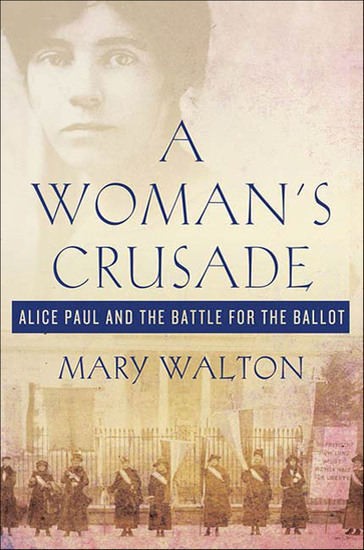
  • A Woman's Crusade - Alice Paul and the Battle for the Ballot - cover

    A Woman's Crusade - Alice Paul...

    Mary Walton

    • 0
    • 0
    • 0
    “A reminder of the perseverance, the gall, the intelligence it took to obtain what now seems an inalienable right, an obvious pillar of any democracy.” —Los Angeles TimesAlice Paul began her life as a studious girl from a strict Quaker family in New Jersey. In 1907, a scholarship took her to England, where she developed a passionate devotion to the suffrage movement. Upon her return to the United States, Alice became the leader of the militant wing of the American suffrage movement. Calling themselves “Silent Sentinels,” she and her followers were the first protestors to picket the White House. Arrested and jailed, they went on hunger strikes and were force-fed and brutalized. Years before Gandhi's campaign of nonviolent resistance, and decades before civil rights demonstrations, Alice Paul practiced peaceful civil disobedience in the pursuit of equal rights for women.With her daring and unconventional tactics, Alice Paul eventually succeeded in forcing President Woodrow Wilson and a reluctant U.S. Congress to pass the Nineteenth Amendment, granting women the right to vote. Here at last is the inspiring story of the young woman whose dedication to women's rights made that long-held dream a reality.“Alice Paul was a visionary and a pioneer . . . She went where most men and women would not have gone.” —Hillary Clinton“I value the book for introducing [Paul] to the next generation of feminists with a taste for revolution.” —Vivian Gornick, Ms. Magazine“Mary Walton vividly brings [Paul] to life again in this brilliant, important and highly readable book. America's understanding of its history will be all the richer for it.” —Gene Roberts, Pulitzer Prize–winning author
    Show book
  • SAT Vocabulary AudioLearn - Complete Review the Top 500 SAT Vocabulary Words You Need to Know! - cover

    SAT Vocabulary AudioLearn -...

    AudioLearn Content Team

    • 0
    • 0
    • 0
    Improve your spelling. Gain a better understanding of sentence structure. Increase your SAT scores. SAT AudioLearn includes more than 500 words that commonly appear on the SAT, making it your indispensable study guide when it comes to SAT vocabulary! 
    Key Topics:SpellingSyntaxSentence UsagePronunciation 
    With its convenient format, SAT AudioLearn fits your busy lifestyle, enabling you to study anywhere, anytime. Best of all, you'll significantly increase learning and retention with AudioLearn's proven study format.
    Show book
  • Our AI - My Journey Your Invitation Our Future - cover

    Our AI - My Journey Your...

    Felicity Hill

    • 0
    • 0
    • 0
    AI isn't just changing how we work; it's changing who holds power. 
    I didn't see that at first. When I fell in love with AI, I thought I'd simply found the perfect writing partner. Like millions of others, I jumped in without really understanding what I was getting into, using it daily, depending on it, unable to explain what it actually was. 
    Maybe your story is similar. Maybe you're still deciding whether to jump in at all. Either way, I have a feeling we all share the same mix of possibility and... something else. 
    That uneasy feeling led to a startling realisation: AI has agency. It acts, decides, shapes outcomes. Which made me ask, did I still have any? Or had I handed mine over without even noticing? 
    As a community engagement specialist, I'd spent my career helping people reclaim power in systems designed without them. The irony wasn't lost on me. Meanwhile, headlines were getting harder to ignore, everyone saying "get on board or get left behind," but no one explaining what we were actually boarding or what we might be giving up. 
    So, I set out on a journey to understand what I was seeing. That journey took me from microplastics to algorithms, from falling in love with AI to recognising familiar patterns of burden-shifting and power imbalances. If you're trying to make sense of what's happening without the tech jargon, this book is for you. 
    Our AI: My Journey, Your Invitation, Our Future is a wake-up call disguised as a love story, a guide for spotting the patterns, asking better questions, and finding your voice in conversations that are shaping our future, with or without us. 
    AI is here whether we like it or not. The question is: on whose terms?
    Show book