Begleiten Sie uns auf eine literarische Weltreise!
Buch zum Bücherregal hinzufügen
Grey
Einen neuen Kommentar schreiben Default profile 50px
Grey
Jetzt das ganze Buch im Abo oder die ersten Seiten gratis lesen!
All characters reduced
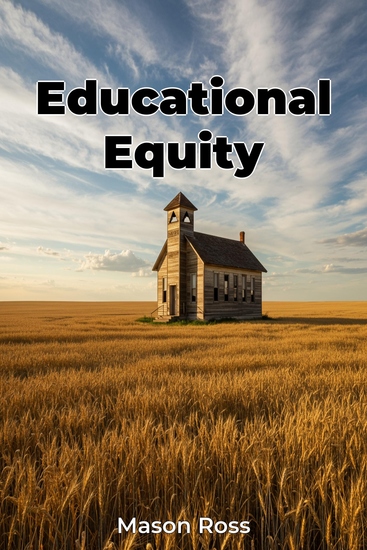
Educational Equity - cover

Educational Equity

Mason Ross

Übersetzer A AI

Verlag: Publifye

  • 0
  • 0
  • 0

Beschreibung

"Educational Equity" explores the pervasive issue of unequal educational opportunities, examining how factors like zip code can predict a child's academic success more reliably than their actual potential. The book delves into the historical roots and socio-economic influences that perpetuate achievement gaps, highlighting the urgent need for social justice within the education system. It emphasizes that achieving true equity isn't merely about equal resources; it requires tailored support to help students from diverse backgrounds reach their full potential, addressing systemic injustices that create educational disparities. 

 
This academic work uniquely connects disciplines like education, sociology, and public policy to provide a holistic understanding of educational inequality. By analyzing student achievement data, classroom practices, and policy evaluations, the book presents evidence-based strategies for transformative change. Beginning with definitions and historical context, it progresses through specific disparities like school funding and teacher quality before examining their impact on marginalized student populations. 

 
Ultimately, "Educational Equity" adopts a solutions-oriented approach, offering practical steps for educators, policymakers, and community leaders to advance educational equity. It serves as a guide for those seeking to understand and dismantle the systemic barriers hindering equal access to education, promoting policy reform for a more just and equitable system.
Verfügbar seit: 11.03.2025.
Drucklänge: 79 Seiten.

Weitere Bücher, die Sie mögen werden

  • Forbidden - A 3000-Year History of Jews and the Pig - cover

    Forbidden - A 3000-Year History...

    Jordan D. Rosenblum

    • 0
    • 0
    • 0
    Jews do not eat pig. This (not always true) observation has been made by both Jews and non-Jews for more than three thousand years and is rooted in biblical law. Though the Torah prohibits eating pig meat, it is not singled out more than other food prohibitions. Horses, rabbits, squirrels, and even vultures, while also not kosher, do not inspire the same level of revulsion for Jews as the pig. The pig has become a symbol for people to signal their Jewishness, non-Jewishness, or rebellion from Judaism. 


    Starting with the Hebrew Bible, Jordan D. Rosenblum historicizes the emergence of the pig as a key symbol of Jewish identity, from the Roman persecution of ancient rabbis, to the Spanish Inquisition, to Shakespeare's writings, to modern memoirs of those leaving Orthodox Judaism. The pig appears in debates about Jewish emancipation in eighteenth-century England and in vaccine conspiracies; in World War II rallying cries, when many American Jewish soldiers were "eating ham for Uncle Sam;" and in recent deliberations about the kosher status of Impossible Pork. 


    All told, there is a rich and varied story about the associations of Jews and pigs over time, both emerging from within Judaism and imposed on Jews by others. Expansive yet accessible, Forbidden offers a captivating look into Jewish history and identity through the lens of the pig.
    Zum Buch
  • Mauryan Empire - cover

    Mauryan Empire

    Saurabh Kumar

    • 0
    • 0
    • 0
    The Mauryan Empire was established in 322 B.C. by the great king Chandragupta Maurya. The era of the Mauryas is a milestone throughout the entire existence of Ancient India. The Mauryan Empire was broad and the most powerful in the realm of old Indian history in the ruling from 322 BC to 185 BC.
    Zum Buch
  • Standing Tall - Leadership Lessons in the Life of a Soldier - cover

    Standing Tall - Leadership...

    Robert F. Foley

    • 0
    • 0
    • 0
    The Medal of Honor recipient chronicles his life and military career in this memoir while also sharing his thoughts on leadership. Robert Foley had only been in Vietnam for six months when he was promoted to captain and given command of a rifle company. In November 1966, Foley led his men on a mission to rescue another company that had been pinned down by Viet Cong forces. His leadership that day inspired his men and led to a successful operation—and the Medal of Honor. His actions in Vietnam were only a small portion of a long and varied career of service in the U.S. Army, but Foley did not always seem marked for success. Coming from a blue-collar suburb of Boston, his years in West Point were marked by poor grades, injuries, and sickness. With a determination to lead by example and inspire trust among others, Foley served across the globe and rose through the ranks. He even returned to West Point as Commandant of Cadets, later retiring as a 3-star general and commander of Fifth Army.Praise for Standing Tall Finalist, 2022 Army Historical Foundation Distinguished Writing Awards “What an amazing opportunity! Standing Tall allows us to learn about leadership from a true American hero.” ―Mike Krzyzewski, former Head Coach, Duke University and USA Olympic Gold Medal basketball teams
    Zum Buch
  • History of Poland: A Captivating Guide to Polish History - cover

    History of Poland: A Captivating...

    Captivating History

    • 0
    • 0
    • 0
    If you want to discover the captivating history of Poland, then keep listening… 
    Poland, a modern state in the very center of Europe, used to be a battlefield of many nations. Throughout its history, Poland had to fight for its independence—for its very existence. This Captivating Guide to Polish History will get you acquainted with the country that is probably most overlooked in historical studies. Sure, everyone knows the Second World War started with the Nazi occupation of Poland, but the country is old and very rich in events, great kings, ruling nobles, and defining culture. 
    In the History of Poland, you will find answers to questions such as: 
    -         When did the Slavs first settle in central Europe? 
    -         Who united the Slavic tribes and founded the medieval Polish kingdom? 
    -         How did Poland develop during the Piast period? 
    -         How was the kingdom divided among brothers? 
    -         How did distinguished individuals try to reunite Poland, and how did they fail? 
    -         Who was Władysław I Łokietek, and why did he succeed in reuniting the kingdom? 
    -         What was the rule of Casimir III the Great like? 
    -         Why was a Lithuanian grand duke chosen to rule Poland? 
    There are so many interesting facts and pieces of information in this Captivating Guide to Polish History. 
    So pick up this audio book now by clicking the “add to cart” button and learn more about what lies in the very heart of Europe.
    Zum Buch
  • The Monsters We Make - Murder Obsession and the Rise of Criminal Profiling - cover

    The Monsters We Make - Murder...

    Rachel Corbett

    • 0
    • 0
    • 0
    A riveting work of true crime that tells the strange story of criminal profiling from Victorian times to our own. 
      
    Criminal profiling—the delicate art of collecting and deciphering the psychological “fingerprints” of the monsters among us—holds an almost mythological status in pop culture. But what exactly is it, does it work, and why is the American public so entranced by it? What do we gain, and endanger, from studying why people commit murder? In The Monsters We Make, author Rachel Corbett explores how criminal profiling became one of society’s most seductive and quixotic undertakings through five significant moments in its history. 
      
    Corbett follows Arthur Conan Doyle through the London alleyways where Jack the Ripper butchered his victims, depicts the tailgate outside of Ted Bundy’s execution, and visits the remote Montana cabin where Ted Kaczynski assembled his antiestablishment bombs. Along the way emerge the people who studied and unraveled these cases. We meet self-taught psychologist Henry Murray, who profiled Adolf Hitler at the request of the U.S. government and later profiled his own students—including the future Unabomber—by subjecting them to cruel humiliation experiments. We also meet the prominent Yale psychiatrist Dorothy Lewis, who ended up testifying that Bundy was too sick to stand trial. Finally, Corbett takes the story into our own time, explaining the rise of modern “predictive policing” policies through a study of one Florida family that the analytics targeted—to devastating effects. 
      
    With narrative intrigue and deft research, Corbett delves deep into the mythology and reality of criminal profilers, revealing how thin the line can be separating those who do harm and those who claim to stop it. 
      
    “Corbett [is] a gifted storyteller … A highly readable, endlessly revealing primer on the homicidal mind.”—Kirkus Reviews (starred review)
    Zum Buch
  • American Eagles - The 101st Airborne's Assault on Fortress Europe 1944 45 - cover

    American Eagles - The 101st...

    Charles Whiting

    • 0
    • 0
    • 0
    Of the 6,600 paratroopers of the 101st 'Screaming Eagles' Airborne Division who parachuted into France in the early hours of 6 June 1944—D-Day—some 3,500 were listed as missing by midnight that same night. Yet it was only the beginning of their 'rendezvous with destiny.' 


    American Eagles is the remarkable true story of the United States 101st Airborne Division. From their rigorous training in 'Old Jolly' (England) to their first operational jump in Normandy, Charles Whiting tells the story of this 'Band of Brothers', who fought, suffered, and died in the eleven-month campaign that followed. From Normandy and Holland through to the siege of Bastogne and their final triumphant capture of Hitler's Eagle's Nest in the Bavarian Alps, we gain a picture of a brave elite division which kept on getting the tough assignments. 


    Drawing on eyewitness accounts, painstaking research, and his own youthful experiences when his regiment was under the command of 101st Airborne in Holland, Whiting delivers a powerful account of each of the 101st's major operations during the European campaign of 1944/45. He brings to life the full horrors of war while shining a spotlight on the courage and determination of the 'Screaming Eagles' and their role in the destruction of the Nazi regime in World War Two.
    Zum Buch