Join us on a literary world trip!
Add this book to bookshelf
Grey
Write a new comment Default profile 50px
Grey
Subscribe to read the full book or read the first pages for free!
All characters reduced
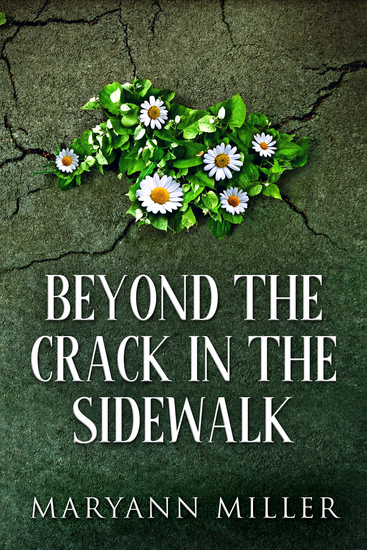
Beyond The Crack In The Sidewalk - cover

Beyond The Crack In The Sidewalk

Maryann Miller

Publisher: Next Chapter

  • 0
  • 0
  • 0

Summary

The short stories in 'Beyond The Crack In The Sidewalk' explore aspects of living, loving and dying: the main elements that define our human existence. Included is also a lighter story: a mystery written in the vein of "The Twilight Zone".
 
The characters in these stories range in age from seventy-year-old Gloria, who is about to find love again, to five-year-old Bobby, who has no concept of why his daddy is no longer there. Then there's sixteen-year-old Hannah, a runaway who finds love only to lose it.
 
On a philosophical level, these stories reflect the world in which we live, bringing to light social issues such as homelessness, the human cost of war, sexual abuse, and when do we go too far in medical treatment.
Available since: 12/19/2021.

Other books that might interest you

  • I Am Alien to Life - Selected Stories - cover

    I Am Alien to Life - Selected...

    Djuna Barnes, Merve Emre

    • 0
    • 0
    • 0
    Djuna Barnes is rightly remembered for Nightwood, her breakthrough and final novel: a hallmark of modernist literature, championed by T. S. Eliot, and one of the first, strangest, and most brilliant novels of love between women to be published in the twentieth century. Barnes's career began long before Nightwood, however, with journalism, essays, drama, and satire of extraordinary wit and courage. Long into her later life, after World War II, when she published nothing more, it was her short fiction above all that she prized and would continue to revise. 


    Here are all the stories Barnes sought to preserve, in the versions she preferred, as well as a smattering of rarities as selected by critic and New Yorker contributor Merve Emre. These are tales of women "'tragique' and 'triste' and 'tremendous' all at once," of sons and daughters being initiated into the ugly comedy of life, monuments all to a worldview singular and scathing. As Emre writes in her foreword "[Barnes's] themes are love and death, especially in Paris and New York; the corruption of nature by culture; the tainted innocence of children; and the mute misery of beasts . . . her characters may be alien to life, but they are alive—spectacularly, grotesquely alive."
    Show book
  • Honeymoons in Temporary Locations - cover

    Honeymoons in Temporary Locations

    Ashley Shelby

    • 0
    • 0
    • 0
    Climate disaster–induced fugue states, mutinous polar bears, support groups for recently displaced millionaires, men who hear trees, and women who lose their wives on environmental refugee resettlement trips. In these dispatches from a weirding world, the absurd and fantastic are increasingly indistinguishable from reality. Exploring this liminal moment, Ashley Shelby's collection of climate fictions imagines a near future that is both unnervingly familiar and subversively strange. 


    Set in the same post-climate-impact era, these stories range from playfully satirical to poignantly humane, bending traditional narrative forms and coming together into a brilliant and unusual contemplation of our changing world. Featuring the Hugo-nominated novelette "Muri," Honeymoons in Temporary Locations processes the unthinkable through riotous inventions like guided tours of submerged cities, Craigslist ads placed by climate refugees, and cynical pharmaceutical efforts to market a drug to treat solastalgia, the existential distress caused by environmental change. 


    Shelby reengineers the dystopic bleakness that characterizes so much climate fiction by embracing an eclectic experimentalism leavened with humor, irony, and the inevitable bathos that characterizes the human experience. Unexpected and clever, this innovative collection confirms her status as a visionary writer whose work expands the forms, attitudes, and possibilities of climate fiction.
    Show book
  • Ben Pitcher's Elly - Mann delves into the human psyche with great touch in this story of murder and parenting - cover

    Ben Pitcher's Elly - Mann delves...

    Mary E Mann

    • 0
    • 0
    • 0
    Mary Rackham was born in Norwich on 14th August 1848 to a merchant family.  Little is known of her early life and her biography only re-appears in September 1871 with marriage to Fairman Joseph Mann, a farmer with 800 acres.   
     
    Mary moved to Shropham, Norfolk and became involved with the workhouse, visiting the sick and other unfortunates of the parish, her observations and experiences a valuable source for her later stories.  
     
    She took up writing, partly to offset the dreary village life of her surroundings, in the 1880s and published her first novel, ‘The Parish of Hilby’ (1883) at her own expense. It was well received by the critics.  
     
    Thus began a career that spanning three decades provided thirty-three novels, hundreds of short stories, and fourteen plays.  Her work was largely focused on rural life in Norfolk and centered on the fictional town of Dulditch, with grim but authentic accounts of poverty and deprivation.  
     
    Her marriage produced one boy and three girls. With her husband's death in 1913, she moved to Sheringham.  
     
    She is regarded as a major contributor to East Anglian literature with particular praise given to her short stories. 
     
    Mary E Mann died on 19th May 1929.  She was 80.  Her grave-marker is a carved open book with the epitaph ‘We bring our years to an end, as if it were a tale that is told’. 
     
    Life in ‘Ben Pitcher's Elly’ is degrading, awful and unvarnished.  The chances of this young girl having a happy life are remote but her story must be heard.
    Show book
  • Aloysha the Pot - From their pens to your ears genius in every story - cover

    Aloysha the Pot - From their...

    Leo Tolstoy

    • 0
    • 0
    • 0
    Leo Tolstoy was born in 1828 in the Russian province of Tula to a wealthy noble family. As a child, he had private tutors but he showed little interest in any formal education. When he went to the University of Kazan in 1843 to study oriental languages and law, he left without completing his courses.  Life now was relaxed and idle but with some writing also taking place.  Gambling debts forced an abrupt change of path and he joined the army to fight in the Crimean War.  He was commended for his bravery and promoted but was appalled at the brutality and loss of life.  He recorded these and other earlier experiences in his diaries which formed the basis of several of his works. 
    In 1852 ‘Childhood’ was published to immediate success and was followed by ‘Boyhood’ and ‘Youth’. 
    His experience in the army and the horrors he witnessed resulted in ‘The Cossacks’ in 1862 and the trilogy ‘Sevastopol Tales’. After the war he travelled around Europe, visiting London and Paris and meeting such luminaries as Victor Hugo and Charles Darwin.  
    It was now that Tolstoy began his masterpiece, ‘War and Peace’. Published in 1869 it was an epic work that changed literature. He quickly followed this with ‘Anna Karenina’.  
    These successes made Tolstoy rich and helped him accomplish many of his dreams but also brought problems as he grappled with his faith and the lot of the oppressed poor. These revolutionary views became so popular that the authorities now kept him under surveillance.  
    He led a life of asceticism and vegetarianism and put his socialist ideals into practice by establishing numerous schools for the poor and food programmes. He also believed in giving away his wealth, which caused much discord with his wife.  
    His writing continued to bring forth classics such as ‘The Death of Ivan Ilyich’ and many brilliant and incisive short stories such as ‘How Much Land Does A Man Need’.  
    In 1901 Tolstoy was excommunicated from the Church and controversially deselected for the Nobel Prize for Literature. 
    Whilst undertaking a pilgrimage by train in October 1910 with his daughter Aleksandra he caught pneumonia in the nearby town of Astapovo.  Leo Tolstoy died on November 9th, 1910, he was 82.
    Show book
  • I Hear You - cover

    I Hear You

    Paul McVeigh

    • 1
    • 1
    • 1
    Irish Times: Books to Look Out for in 2025
    This collection of stories, written especially for BBC Radio 4, includes a ten-part sequence: 'The Circus', set around Cliftonville Circus, where five roads meet in North Belfast.
    It's five minutes from the nationalist Troubles flashpoint of Ardoyne, where Paul grew up. It's close to Holy Cross Girls' School, where protests targeting primary school children drew international attention. The Circus is situated in the poorest part of Belfast – it is also the most divided.
    Each road leads to a different area – a different class – a different religion. The Circus explores where old Belfast clashes with the new around acceptance, change, class and diversity. But this is 2024 and a fresh energy exists.
    Other stories include 'Tickles', a story about a man visiting his mother in a dementia ward where he finds he is the one who had forgotten important things; 'Cuckoo', about a man's collapse and surgery – where he feels something more sinister has happened to him; and 'Daddy Christmas', where a gay man writes a letter to the son he never had.
    Show book
  • Human Error - 30 stories beyond common sense - cover

    Human Error - 30 stories beyond...

    Dr Dimitrios Papadimitriadis

    • 0
    • 0
    • 0
    A collection of thirty short stories that move along the edges of the existential and the social, the tender and the ironic. Set against the backdrop of Greece, and drawing deeply from its unique spirit and contradictions, each story reveals a subtle fracture in the surface of daily life, where a person confronts themselves, the systems that enclose them, and the illusions they invent just to endure. 
    These are finely tuned explorations of the human psyche—part microscope, part mirror—unveiling the quiet absurdities we all share. In this space, reason withdraws, cynicism smirks, and mistakes are no longer silent; they speak, take on form, and, inevitably, a face.
    Show book