Join us on a literary world trip!
Add this book to bookshelf
Grey
Write a new comment Default profile 50px
Grey
Subscribe to read the full book or read the first pages for free!
All characters reduced
A Vindication of the Rights of Woman (a feminist literature classic) - Challenging Gender Roles: A Feminist Manifesto from the 18th Century - cover

A Vindication of the Rights of Woman (a feminist literature classic) - Challenging Gender Roles: A Feminist Manifesto from the 18th Century

Mary Wollstonecraft

Publisher: Good Press

  • 0
  • 0
  • 0

Summary

In her groundbreaking work, 'A Vindication of the Rights of Woman,' Mary Wollstonecraft challenges the prevailing notions of the late 18th century that relegated women to subservient roles within society. Employing a rational and passionate literary style, Wollstonecraft articulates her plea for women'Äôs education and autonomy, arguing that the perceived inferiority of women is not inherent but rather a consequence of their lack of access to education. This pioneering text intertwines Enlightenment ideals of reason and individualism with a fierce critique of patriarchy, establishing a foundational argument for feminism that resonates through history and remains relevant today. Mary Wollstonecraft, often regarded as one of the first feminist philosophers, drew on her experiences as a governess and a writer to illuminate the barriers faced by women in her society. Her own struggles with gender-based limitations prompted her to advocate for women's rights fervently, showcasing her belief in the power of education as a transformative force. Wollstonecraft's personal history, marked by challenges and intellectual fervor, provided the impetus for her radical ideas that astonished and provoked her contemporaries. This pivotal text is highly recommended for readers seeking a profound understanding of feminist theory's origins and the historical context of women's rights. Wollstonecraft'Äôs powerful arguments will inspire and challenge modern audiences, making 'A Vindication of the Rights of Woman' an essential read for anyone interested in the evolution of gender equality and the struggle for human rights.
Available since: 12/20/2023.
Print length: 526 pages.


Other books that might interest you

  • Rare Recording of Yuri Bezmenov A - Volume 3 - cover

    Rare Recording of Yuri Bezmenov...

    Yuri Bezmenov

    • 0
    • 0
    • 0
    Yuri Bezmenov (1939 - January 5, 1993), was a Soviet journalist for RIA Novosti and a former KGB informant who defected to Canada. After being assigned to a station in India, Bezmenov eventually grew to love the people and the culture of India. At the same time, he began to resent the KGB-sanctioned repression of intellectuals who dissented from Moscow's policies and he decided to defect to the West. Bezmenov is best remembered for his anti-communist lectures and books published in the 1980s under the alias of Tomas David Schuman.
    Show book
  • The Tensaw River - Alabama's Hidden Heritage Corridor - cover

    The Tensaw River - Alabama's...

    Mike Bunn

    • 0
    • 0
    • 0
    The Tensaw River introduces one of the American South's richest and most fertile natural features. Author Mike Bunn is director of Historic Blakeley State Park, which is nestled in a prominent bend of the majestic Tensaw River. 


    Forming the eastern boundary of the expansive Mobile-Tensaw Delta, the Tensaw has had little industrial development. Left largely undisturbed, the river flows free and bountiful into the grand estuary of Mobile Bay in ways that would be recognizable to Native Americans centuries ago and to pioneers who arrived before Alabama became a state. 


    Bunn's unforgettable stories in The Tensaw River trace the construction and occupation of the Bottle Creek site, an important mound complex built by Southeastern Native Americans a millennia ago. Nearby Blakeley is an antebellum ghost town whose lost memories tease the imagination. During the Civil War, the boom of artillery fire in the battle that sealed the fate of the city of Mobile echoed along the bends in the Tensaw. 


    Located near popular travel destinations, the Tensaw's "Forgotten Cultural Heritage Corridor" is a gateway to the enchanting beauty of—and humankind's relationship to—the landscape of the American South.
    Show book
  • Dreyfus Affair and the Leo Frank Trial The: The History of the Most Notorious Antisemitic Cases in France and America - cover

    Dreyfus Affair and the Leo Frank...

    Editors Charles River

    • 0
    • 0
    • 0
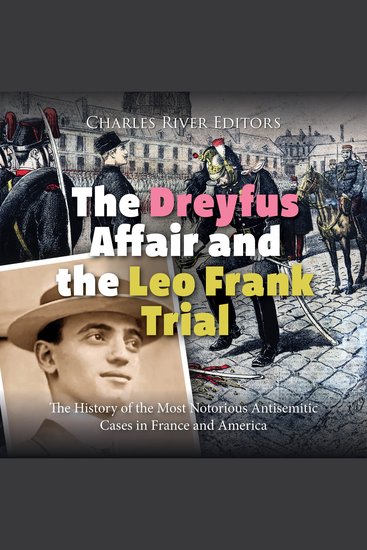
    In September 1890, among a pile of torn-up documents delivered by Mme. Bastian was found a note handwritten in French which, when pieced together, proved to be a list of French military secrets handed over to the Germans by an unknown French officer of the General Staff. This discovery, which proved the existence of a traitor in the department, triggered a ferment in the corridors of the Conseil Supérieur de la Guerre, and the hunt was on for the culprit. By a process of elimination, officers of the military intelligence were able to narrow down a list of probable traitors, among whom was a young Jewish staff officer, Captain Alfred Dreyfus, who was immediately earmarked as the chief suspect.  
    	These are the essential facts of the “Dreyfus Affair,” as it came to be known, an episode that in many respects defined French anti-Semitism in the late 19th century. A case was built with the central objective of protecting the integrity of French military establishment, and in the process, the relatively muted anti-Semitism in France (at least compared to other European nations) was transformed into an era of virulent and violent Jew-hatred that characterized and sullied the final decade of the 19th century in France. Even today, as many of the affair’s nuances and facets have faded from memory, its political importance and anti-Semitic elements continue to be well-known and quite relevant today.  
    In 1913, Mary Phagan, a young Georgia factory girl and the daughter of tenant farmers, was raped and killed, and suspicion fell upon Leo Frank, the Jewish-American factory manager, who was subsequently arrested, tried, and convicted of her murder based on the thinnest of circumstantial evidence. The entire case against Frank rested on the testimony of the factory janitor, Jim Conley, despite the fact Conley had been arrested almost immediately after Frank when he was spotted washing what appeared to be blood off his clothes. 
    Show book
  • Leading Like the Swamp Fox - The Leadership Lessons of Francis Marion - cover

    Leading Like the Swamp Fox - The...

    Kevin Dougherty, Steven D. Smith

    • 0
    • 0
    • 0
    A study of how Francis Marion delivered the leadership and strategy to defeat the British in the South Carolina Lowcountry campaigns. “Dougherty and Smith have produced an excellent study of Marion as a commander for history enthusiasts, their work deserves to garner equal attention from those in the business community, business schools, public sector management, and the military.”—Journal of the American RevolutionFrancis Marion is certainly the stuff of which legends are made. His nickname “The Swamp Fox,” bestowed upon him by one of his fiercest enemies, captures his wily approach to battle. The embellishment of his exploits in Parson Weems’s early biography makes separation of fact from fiction difficult, but certainly represents the awe, loyalty, and attraction he produced in those around him. His legacy is enshrined in the fact that more places in the United States have been named after him than any other soldier of the American Revolution, with the sole exception of George Washington. Even today’s U.S. Army Rangers include Marion as one of their formative heroes. Surely much about leadership can be learned from such an intriguing personality.Leading like the Swamp Fox: The Leadership Lessons of Francis Marion unlocks those lessons. Divided into three parts, the book first presents the historical background and context necessary to appreciate Marion’s situation. The main body of the book then examines Marion’s leadership across eight categories, with several vignettes demonstrating Marion’s competency. The summary then captures some conclusions about how leadership impacted the American Revolution in the South Carolina Lowcountry. An appendix provides some information about how the reader might explore those physical reminders of Marion and his exploits that exist today. Readers interested in history or leadership, or both, will all find something for them in Leading like the Swamp Fox.“Useful to students of leadership, or as an introduction to the Southern Campaign and to Marion…. [A] good treatise on leadership, and its overview of the Southern Campaign is an ideal introduction to the topic.”—Journal of Military History
    Show book
  • Find Your People: Audio Bible Studies - Building Deep Community in a Lonely World - cover

    Find Your People: Audio Bible...

    Jennie Allen

    • 0
    • 0
    • 0
    Never in the history of civilization have we been more connected and felt more alone. We are all so lonely. What if fundamentally the ways we have set up our lives is broken? We've withdrawn rather than moved through it. We want supper clubs and friends, instead of war partners. We have a wrong view of community. 
    This seven-session audio Bible study begins with a look at the original community in Genesis, the Trinity, and the creation of people to see what God had planned for us all along. We will also discover throughout the study the five life patterns required to build deep, connected relationships:ProximityShared MissionTransparencyAccountabilityConsistency 
    Sessions include:Introduction (16:30)The Disruption of Community (16:30)Proximity (18:30)Transparency (16:00)Accountability (17:30)Shared Mission (17:00)Consistency (21:00) 
    Coordinating study guide available separately.  
    The Audio Bible Studies series provides a unique audio learning experience. Unlike a traditional audiobook's direct narration of a book's text, Find Your People includes high-quality, live audio sessions from the author that cover important Bible-based topics. These sessions will reflect the ambiance of the unique recording locations, immersing the listener into the teaching. While not required for the audio experience, these studies are designed to partner with the coordinating study guide, sold separately.
    Show book
  • Why It's Normal for Men to Cheat - cover

    Why It's Normal for Men to Cheat

    A.A. Castor

    • 0
    • 0
    • 0
    In a culture that often condemns male infidelity as a simple moral failing, Why It's Normal for Men to Cheat offers a more nuanced perspective. Author A.A. Castor delves into the deep-seated forces—evolutionary instincts, historical precedents, and psychological drivers—that shape male desire and can lead to unfaithful behavior. Far from excusing betrayal, Castor's aim is to illuminate the complex interplay between biology and culture, ultimately inviting a more compassionate and informed dialogue about what it means to be faithful in a modern world. 
    Drawing on fields such as psychology, anthropology, and relationship studies, Castor examines how factors like testosterone, societal power dynamics, and personal insecurities converge to influence men's actions. Through real-life stories and data-driven insights, readers gain a clearer understanding of how male infidelity can emerge from natural impulses, yet still inflict profound emotional harm on partners and families. 
    At its core, Why It's Normal for Men to Cheat is a call to self-awareness and accountability. Castor underscores that while natural drives are powerful, they do not override the moral responsibility we hold in committed relationships. By unpacking the taboo surrounding male infidelity, the book paves the way for honest conversations about trust, desire, and the boundaries that sustain healthy connections. Whether you have experienced betrayal firsthand or simply wish to understand the complexities of human sexuality, this book offers a balanced exploration that encourages empathy, introspection, and the possibility of genuine healing.
    Show book