Begleiten Sie uns auf eine literarische Weltreise!
Buch zum Bücherregal hinzufügen
Grey
Einen neuen Kommentar schreiben Default profile 50px
Grey
Jetzt das ganze Buch im Abo oder die ersten Seiten gratis lesen!
All characters reduced
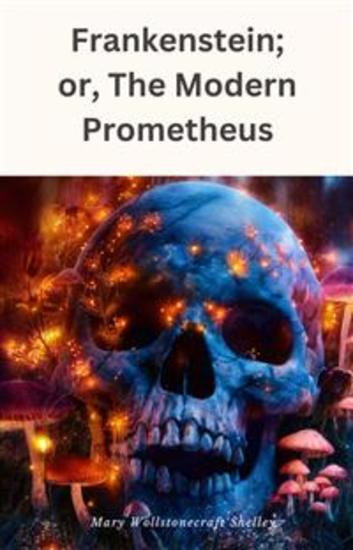
Frankenstein; or The Modern Prometheus - cover

Frankenstein; or The Modern Prometheus

Mary Wollstonecraft Shelley

Verlag: POST Service & Consulting Limited 2RS28195X2143763S@post.sc Independence Ave. 1523 00000 Victoria, Mahé, Seychelles

  • 0
  • 0
  • 0

Beschreibung

Frankenstein; or, The Modern Prometheus is a novel written by Mary Shelley and first published in 1818. It tells the story of Victor Frankenstein, a young scientist who creates a grotesque creature in an unorthodox scientific experiment. The novel explores themes of ambition, hubris, isolation, and the consequences of playing god.

Considered one of the earliest works of science fiction, Frankenstein has had a significant influence on popular culture and has spawned numerous adaptations in various forms, including films, plays, and other literary works. Despite its initial mixed critical reception, the novel is now widely regarded as a classic of English literature and a seminal work in the Gothic genre.
Verfügbar seit: 11.04.2024.
Drucklänge: 420 Seiten.

Weitere Bücher, die Sie mögen werden

  • Robert Browning's Dramatic Monologues - A Selection - cover

    Robert Browning's Dramatic...

    Robert Browning, Adriel Brandt

    • 0
    • 0
    • 0
    A selection of Robert Browning's dramatic monologues. 
    In "My Last Duchess," an entitled nobleman shows off a portrait of his late wife. 
    In "Soliloquy of the Spanish Cloister," a frustrated monk dwells on a petty rivalry. 
    In "The Bishop Orders His Tomb at Saint Praxed's," a dying man instructs his family in how to elevate his final resting place above that of his rival's. 
    In "Porphyria's Lover," a sinister narrator considers how to preserve the pure beauty of his trusting partner. 
    "Bishop Blougram's Apology" is a lengthy reflection on faith, doubt, and the pursuit of contentment.
    Zum Buch
  • NMLCT - Poems - cover

    NMLCT - Poems

    Paul Vermeersch

    • 0
    • 0
    • 0
    Imagine The Matrix retold by the reanimated cyborg bodies of the Brothers Grimm.
    		 
    Fables and fairytales collide with virtual reality, artificial intelligence, and monstrous myths in a world where no one knows what to believe. In his eighth book of poems, Paul Vermeersch responds to the increasing difficulty of knowing what is real and what isn’t, what is our genuine experience and what is constructed for us by The Algorithm. In a “post-truth” society rife with simulations, misinformation, and computer-generated hallucinations, these poems explore the relationship between the synthetic and the authentic as they raise hope for the possibility of escape from MCHNCT (Machine City) to NMLCT (Animal City), where the promise of “real life” still exists.
    		 
    These poems — all precisely 16 lines long, identically formed as though mass-produced — are themselves artificial creations, products of the imagination, sometimes disorienting but always vivid. They hold up a mirror not only to nature, but also to its unnatural distortions and facsimiles. In NMLCT, Vermeersch gives us his answer to an existence in thrall to the artificial. But it also foretells a different future, one where the air and the grass and the trees, and all the life they engender, might always be genuine and sensed and safe.
    Zum Buch
  • The Prophet - cover

    The Prophet

    Kahlil Gibran

    • 0
    • 0
    • 0
    I go with the wind, people of Orphalese, but not down into emptiness; And if this day is not a fulfilment of your needs and my love, then let it be a promise till another day.” 
      
    The beloved prophet Almustafa (meaning “The Chosen One”) has lived within the city walls of Orphalese for twelve years. He has walked among the people and formed a deep connection to the place, but he knows this is not where he ultimately belongs. On the seventh day of Ielool (“the month of reaping”), Almustafa climbs a hill beyond the boundaries of the city wall and gazes out across the misty sea. He is filled with joy as he catches sight of the ship that has come to free him from exile. As he bids farewell to the people of Orphalese, Almustafa speaks with them on the topics closest to their hearts. His series of sermons form the 28 prose poems of this book. 
      
    The Prophet is a work of fiction, written by Lebanese-American artist, poet, and philosopher Kahlil Gibran. Gibran was a key figure in Arabic literary modernist movement, which spanned the first half of the twentieth century. As a product of his culturally-rich upbringing, Gibran’s work beautifully blends religious traditions and philosophies from around the world.
    Zum Buch
  • Picasso - Poetesque - cover

    Picasso - Poetesque

    Mike Blake

    • 0
    • 0
    • 0
    PICASSO : Poetesque  
    A poem about the cubist painter of the last Century (20th). 
    He was a surrealist artist, and in his earlier works painted in the neoclassical. 
    Born in Spain, he escaped Franco's regime by being in exile in France. 
    Some of his cubist art may have been influenced by his knowledge of the atrocities committed during 
    the Spanish Civil war, especially in his Masterpiece Guernica. 
    Released on Amazon :   https://www.amazon.com/dp/B0FPPF6YW5 
    ***** Please leave your Review/feedback, many thanks. ***** 
    *NO A.I. has been used in the creation of this Poem.* As for all the Authors poems & Short Stories.* 
    Instagram: wild_poetrys // wild.poetry.webs 
    TikTok: @wild_poetrys - CCO charliechaplinsoffice
    Zum Buch
  • Treasure - cover

    Treasure

    Jemima Foxtrot

    • 0
    • 0
    • 0
    "religion's been cruel to people like usthe darkwood sluts      the good time girlsbut god as my witnesssome of us           we're just trying to wrangle our powerback from the species that took it"
    Jemima Foxtrot's Treasure is a shining work of alchemy and liberation which explores power dynamics, sex work, desire, and female friendship with a fresh and playful perspective. Foxtrot investigates shimmering sexualities, the economies of desire, the theft of childhood and pathways towards reclaiming it. Her language is lush: intimate, intricate, full of fertile earth's possibility. The poems of Treasure live up to its name: showing us where the gold is—the joy—how to feed it into the soil of our lives.
    "Treasure is an aptly chosen title for this collection, both as a noun (that quantity of precious ore dug from the stuff of experience) and as a verb (the imperative to seek out, sing, and cherish joy through the sharing of it). Foxtrot is a savvy, sometimes savage, sensualist; her poetic speakers alert to injustice, but alive to pleasure in every way that counts. These are superbly tactile poems, poems of being-in-the-body, and being-in-the-world; they are full of wit, vigour and feminist jouissance. These are also formally exciting poems, poems that showcase a beautifully bold and oddly tender lyric defiance." Fran Lock, Hyena, T.S. Eliot Prize Shortlist
    Zum Buch
  • Eumenides - cover

    Eumenides

    Aeschylus

    • 0
    • 0
    • 0
    The final play of the Oresteia, called The Eumenides (Εὐμενίδες, Eumenídes), illustrates how the sequence of events in the trilogy ends up in the development of social order or a proper judicial system in Athenian society. 
    In this play, Orestes is hunted down and tormented by the Furies, a trio of goddesses known to be the instruments of justice, who are also referred to as the "Gracious Ones" (Eumenides). They relentlessly pursue Orestes for the killing of his mother. However, through the intervention of Apollo, Orestes is able to escape them for a brief moment while they are asleep and head to Athens under the protection of Hermes. Seeing the Furies asleep, Clytemnestra's ghost comes to wake them up to obtain justice on her son Orestes for killing her.
    Zum Buch